
There are quite a few smart home gadgets that promise to change daily life, but few actually manage to become a product that is hard to imagine the home without. Smart locks have been one of the biggest trends in the smart home world in recent years, but for many, they also raised quite a few question marks surrounding security, privacy, and reliability. Nuki, the Austrian manufacturer that focused from the outset on the European cylinders common across the continent and the Middle East, managed to build an exceptional reputation for itself thanks to a more conservative approach to security and a product that continues to consistently improve over the years. In fact, we have already had the chance to review the Nuki 4 Pro, which left a particularly positive impression thanks to a combination of simple installation, a rich application, and almost uncompromising operation.
Now comes the turn of the Nuki Ultra, the company's newest and most ambitious model to date. After a few years in which the smart lock category advanced at a relatively moderate pace, Nuki is making a significant leap forward with a new mechanism, a more compact body, and a promise of a usage experience that is faster and quieter than ever. After several weeks of daily use, we returned with conclusions.
Let's start with the big question: Security
One of the most common claims against smart locks is that they are less secure than a regular mechanical lock. On the face of it, the concern sounds logical: The moment you connect a lock to the network, an app, or a smart home, it seems as though a new door opens for attackers. In practice, reality is much more complex. Leading manufacturers like Nuki invest heavy resources in security, encryption, and external audits, and in many cases, it is much easier for an occasional burglar to deal with a physical cylinder than to try to breach a secured digital system. Anyone who is determined enough to enter a home will usually find simpler and faster solutions than trying to hack a smart lock remotely.
Beyond that, a smart lock adds layers of security that a regular lock simply cannot offer. In the Nuki Ultra, you can set an automatic lock a few minutes after opening the door, so that even those who tend to forget to lock upon leaving the house will not be left with an open door for long. The app is capable of alerting when the door is left unlocked, setting an automatic lock during night hours, and displaying a detailed activity log documenting every opening, closing, or change of state. Whether the door was opened manually, via the phone, or through smart home automation – everything is documented and available for viewing. This is a level of control and transparency that a regular mechanical lock simply cannot provide, and it is one of the main reasons why anyone who gets used to a smart lock finds it very difficult to go back.
Design
One of the most prominent changes in the Nuki Ultra is the design. The new lock is significantly smaller, rounder, and more elegant than the company's previous generations. According to Nuki, it is a product that is about two-thirds smaller compared to the previous model, and the difference is felt immediately at first glance.
If in previous generations we were used to Nuki's large body with the prominent metal ring on the front, this time it seems the company gave up on everything that was not essential. The result is a short and wide cylindrical body in a brushed stainless steel finish, which blends better into the door and looks less like a gadget and more like an integral part of it. The reduction in dimensions can be credited to the new built-in battery, which replaces the large battery compartment that was responsible for most of the lock's volume in previous generations. Beyond the cleaner look, it is also a more convenient solution for ongoing use.
Full compatibility with doors in Israel
Unlike the European version of the Ultra, which requires replacing the cylinder with a dedicated Nuki model, the Israeli version was developed especially for the local market and is installed on top of the existing cylinder. The lock supports the common manufacturers in Israel, including Mul-T-Lock, Rav-Bariach, Magnum, and Yale, so that in most homes, the installation does not require replacing the mechanism or making changes to the door itself. This is a relatively simple process that does not involve drilling or special adjustments, which significantly eases the transition to a smart lock.
<br>Faster, quieter
Alongside the change in design, Nuki also upgraded the internal mechanism. The new motor is faster than the previous generation and is capable of opening and locking the door in a noticeably shorter time.
The difference might sound marginal on paper, but in daily use, it is well felt. If in previous generations one had to wait a few seconds until the locking action was completed, here the response is faster and more fluid. In addition, the new motor operates relatively quietly, so that even automatic locking during evening hours is not as prominent as it was in the past.
And of course, if there is an area where Nuki was already strong in the previous generation, it is the software. In the Ultra as well, the company continues to offer one of the most advanced and comprehensive apps in the category (available for iOS and Android devices). You can set automatic locking, receive notifications for every opening and closing, manage temporary access permissions, enable or disable remote connections, set automated scenarios, and view a detailed activity log. The level of control is particularly high, and the feeling is that the user decides exactly how the lock will behave – and not the other way around.
By the way, there is also full support here for smart home systems, including Apple Home and also Google Home alongside Alexa and SmartThings.
The door sensor, the keypad, and automation
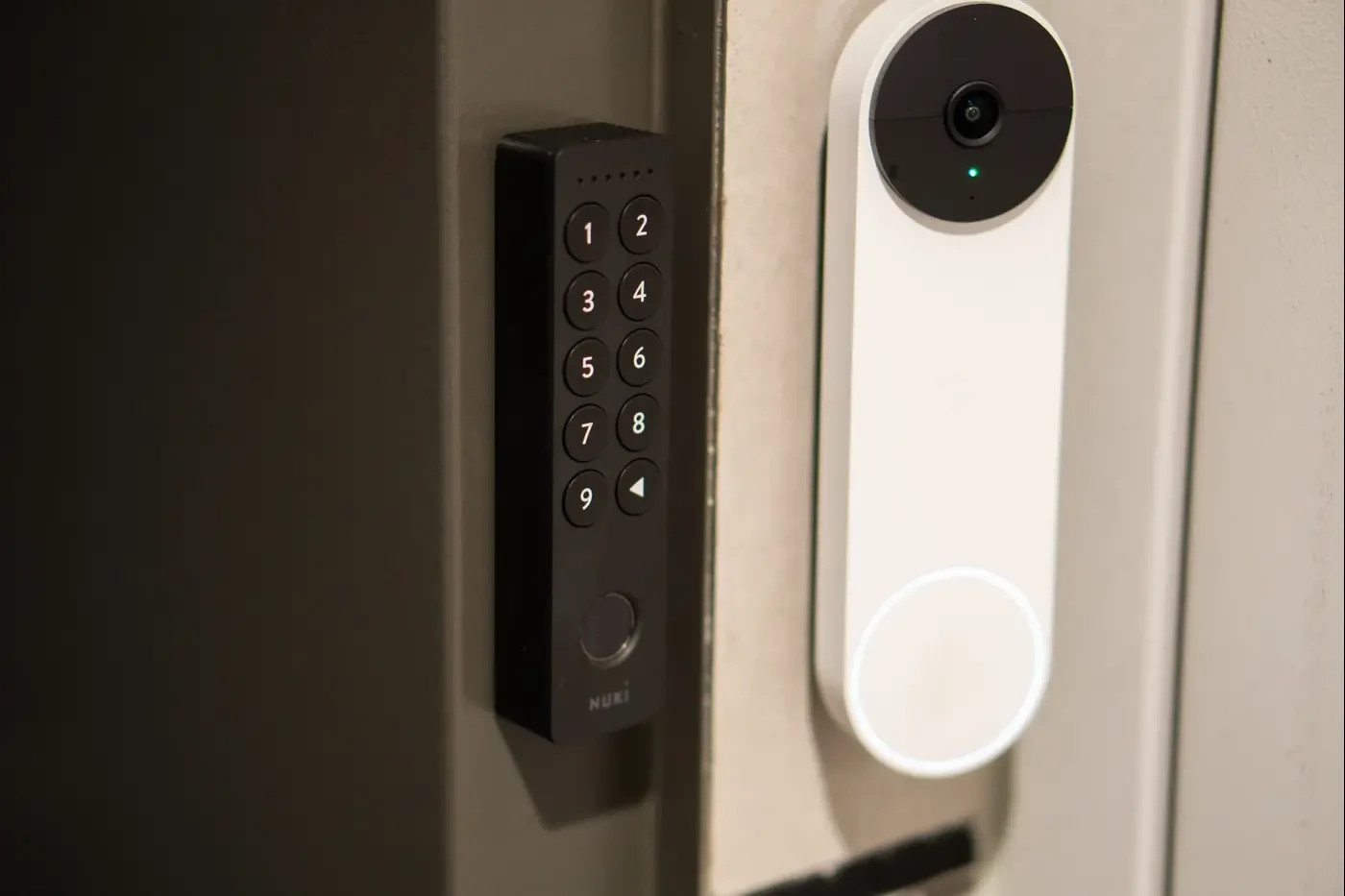
Alongside the lock itself, Nuki also offers an external door sensor and a smart keypad that significantly expand the system's capabilities. The small door sensor connects to the frame and allows the lock to know not only if it is locked, but also if the door itself is open or closed. Thanks to it, you can configure the door to lock automatically immediately after it closes, receive alerts if it remains open for too long, and check its status remotely at any moment. In my case, I set an alert if the door is open for more than two minutes – a simple solution that provides quite a bit of peace of mind, especially when there are pets in the house.
To the sensor, you can also add an external keypad with a six-digit access code and a fingerprint reader. This combination allows entering the house without keys and without pulling the phone out of the pocket, and simultaneously granting temporary access to family members, guests, or service people via a temporary code or a dedicated link. One of the most useful features is the ability to send a remote access permission to someone who needs to enter the house while you are away, without handing over a physical key or opening an account in the system. All of these integrate well with the Nuki app, which allows managing all permissions, alerts, and automations from one place, making the lock much more than just a replacement for a key.
Who is it suitable for and is it worth upgrading?
If you are already using the Nuki 4 Pro and are satisfied with it, there is no revolutionary feature here that would justify an immediate replacement. The core capabilities, control options, and excellent app remain very similar. On the other hand, anyone looking for a lock that is smaller, quieter, faster, and more designed, will find in the Ultra the most polished and mature version of Nuki to date.
For those who do not yet have a smart lock at all, this is already a much simpler recommendation. The Ultra offers all the advantages of Nuki in a more compact package and with full compatibility with Israeli doors – making it one of the most impressive smart locks that can be purchased today in Israel.