
Studies show that 30 percent of the adult population in the Western world suffers from problems. We, the Israelis, do not need to look far with the three nightmare years we have endured since October 7, and the sleep problems they caused us as a result of dealing with the stress of living in a war zone. Now, technology comes to the rescue.
Yadid Ayzenberg knows very well the moment when sleep technology turns from a nice product into something people actually need. This happened to him at Bose, when he worked on the Sleepbuds, those small earbuds designed for one thing only: To sit in our ear during sleep and play masking noises, whether rain loops, waves, white noise, or any other sound designed to save people from snoring partners, noise from neighbors, the street, or anything else that wakes us up at three in the morning. And for the rather limited product of sleep earbuds, a market of millions of consumers was created, and of course, other companies like Ozlo and Anker jumped on the bandwagon as well.
"People said it saved their lives", Ayzenberg shares in an interview with "Walla" from his home on the outskirts of Boston. "It allowed them to sleep with a partner in the same room, or stay living in a noisy apartment. But they asked for more. They wanted the ability to stream, they wanted meditations, they wanted to know how they slept. The technology back then simply did not allow it in such a small device body."
So now, a few years later, Ayzenberg is trying to close this loop with SOND, the company he founded together with Amir Lazarovich, another Israeli who studied with him at MIT and worked for many years at Google. Their first product, Dreambuds, was launched a few days ago on Kickstarter, and it looks like an answer to a question that the Bose product at the time failed to answer: What happens when sleep earbuds stop being smart earplugs, and become a smart sleep system inside the ear?

The answer, at least on paper, is quite ambitious: SOND's Dreambuds are supposed to detect heart rate, respiration, breathing depth, sleep position, heart rate variability (HRV), sleep apnea also known as snoring, movement, and a host of other physiological signals. According to the company, they measure 12 different signals. But the difference is that SOND's system does not settle for a morning report along the lines of "You slept terribly, your sleep score is 48% and a fail, have a nice day" as happens with many wearable computing products – but is supposed to react in real time: It switches content when the user falls asleep, activates noise masking, plays sounds that enhance sleep stages, will offer different content if they woke up in the middle of the night and try to lull them back to sleep, and wake them up during a lighter sleep stage.

"I don't think it's just the blue light", he says. "It's that the brain stays turned on. We used to go to sleep with a book. Today we are connected to work, emails, social networks, to everything happening in the world. The phone creates engagement. The brain fails to shut itself off."
What to do with all the data from wearable sensors?
Ayzenberg arrived in this field long before "sleep AI" was a phrase someone would put in an investor presentation: He started his journey in Israel in the chip world, among others at the startup Passave. In 2010, he moved to the United States for a PhD at the Massachusetts Institute of Technology, where he engaged in analyzing data from wearable sensors. "Even then, we identified that even a small group of people with sensors operating all the time creates massive amounts of data", he says. "There were no suitable computational tools back then to analyze all of this", notes Ayzenberg.
From this research, The Sync Project was later born, a startup that tried to use audio as a health interface: Not just to play music, but truly to adapt it to the physiological state of the user. The company was acquired by the Boston audio giant Bose, and Ayzenberg found himself in the company's health division, initially in software and later managing the sleep products domain.
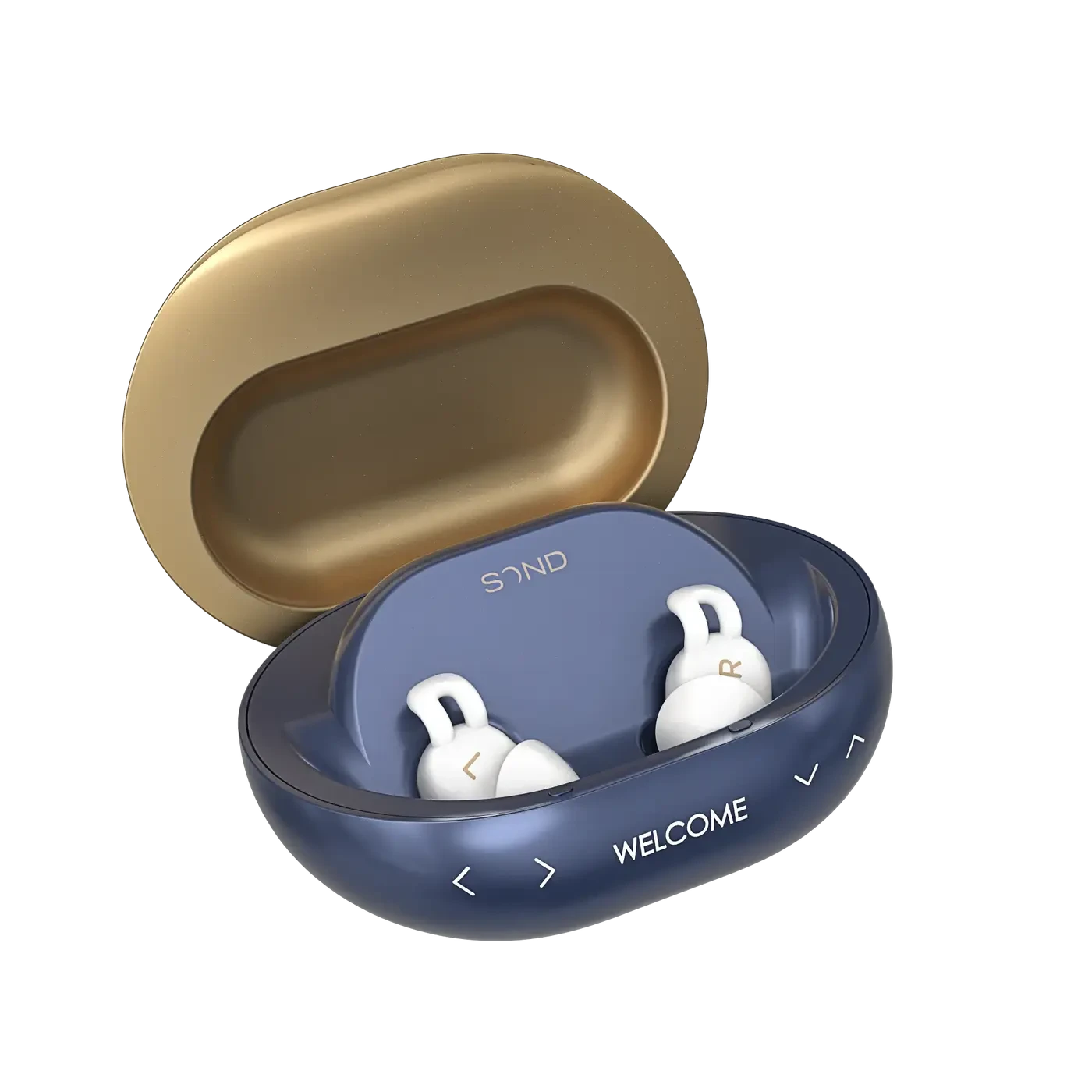
There, according to him, the understanding was formed that the market wants something more advanced. The Sleepbuds were a successful product and beloved by users, but limited. They did not play free content, did not provide sleep metrics, and could not do much beyond noise masking. The reason was simple: Battery, antennas, processors – all the boring things that separate user desires could not fit into the small body of sleep earbuds that would also be comfortable without giving you the feeling that you slept with a pebble in your ear all night. "Towards the end of my time at Bose, I realized that the technology was starting to become available", he says. "Still at the sharp edge, but available. It is probably possible to build the product that all those customers asked for."
Sleep earbuds without a phone by the bed
Here comes one of the more interesting ideas in Dreambuds: They do not require a connection to a phone or keeping it by the bed. In fact, they were built so you can get by without it, even take it out of the room. The earbuds talk to the case, which is a type of "smart sleep station" by the bed and connected to the power outlet. The case itself connects to the internet via the wireless network, eliminating the need for a smartphone in the middle as a mediator.
It has a display, touch controls, cloud connection, and the option to talk to the sleep coach. The smartphone is still in the picture, of course. There is an app, you can see data in it, edit sleep playlists (which Sond calls Sleepland), add podcasts you want to hear, and configure preferences. But the idea is that you don't need to open it every night. And by the way, yes, these earbuds are also good for daily use – and you can connect them directly to the phone via Bluetooth when they are not in sleep mode and "talking" to the case.
"The experience I want is simple", says Ayzenberg. "You open the case, take out the earbuds, put them in your ear, and go to sleep. Without a phone. It can be in another room, turned off, it doesn't matter. If you need something, you double-tap and talk to the sleep coach (in natural language)."
This is an important point, because many sleep products fall short right there: They require the user to do the last thing they should do before sleep – fiddle with a screen, and re-awaken the brain (Oops, there is just this email from the boss I must reply to...). The equivalent of treating sleep problems while fiddling with the phone before bed – is likened to a sugar addiction recovery course inside a pastry shop.

SOND the dreamer
The case of SOND is therefore not just a charger, it is a kind of small sleep station. In sleep mode, the earbuds communicate with it via an energy-efficient protocol. During the day, they can connect to the phone as regular Bluetooth earbuds – and this is an important matter if you are going to invest 450 dollars in a pair (yes, the technology here is not cheap). A product that costs hundreds of dollars and knows how to work only when you are unconscious is a product that is a bit hard to justify, even in an era where people pay for a watch to tell them they are stressed...
The second part of the product is the content. SOND offers users a catalog of more than 500 tracks: Meditations, guided breathing, sleep stories, sleep music, and soundscapes. The AI-based coach can also generate new content upon request, using generative artificial intelligence. But here is also where the "magic" and the treatment of sleep quality that SOND wants to give users comes in:
Ayzenberg explains that audio is not a single solution but a family of interventions. Guided breathing can affect the nervous system and calm it down. Music and stories can affect pleasure and relaxation mechanisms in the brain. Certain frequencies or acoustic stimuli may affect specific sleep stages. The ear, from his perspective, is a natural place for this intervention: It both plays sound, blocks noise, and allows the measurement of physiological signals.
Once the system detects that the user has fallen asleep, it will transition from active content, for example a meditation or a story, to a noise-masking mode or simply silence for those who prefer it. If the user wakes up in the middle of the night, a double tap on the earbud will bring the system back to action, which will try through guidance to lull them back to sleep. In the morning, you can ask the coach how you slept, and receive a vocal explanation about the duration of falling asleep, sleep cycles, REM sleep percentage, and the rest of the metrics. It will also be able to wake you up from a light sleep stage, for a better awakening. The coach will also notice which contents and which combinations worked well on you, and create recommendations for you accordingly. If you will, it is also the Spotify of dreams.
And here, another cute and surprising feature also enters that perhaps also gave the product its name – a dream diary and analysis. Dreambuds will also allow you to document the dreams you just dreamed, simply by describing them to the sleep coach, who can also offer you a Jungian or other interpretation of what you dreamed. Truly Joseph the dreamer, just in a digital version.
Crowded in the ear
One of the metrics that Dreambuds measure is heart rate variability (HRV), meaning the changing intervals from beat to beat. This is a metric that has become a star in recent years in smartwatches and smart rings, because it can teach about stress, recovery, and general cardiac health. SOND tries to go further, with continuous measurement throughout the night and with a seismocardiographic sensor, which is supposed to detect minute mechanical movements of the heart muscle, and could, in theory, alert to cardiovascular problems as well.
Ayzenberg has a vision in this matter, but as someone who knows the field well, he is also cautious: "This is still not a product that has undergone clinical validation as a medical device", he says. "In order to tell people something medical about their health, one needs to undergo validation against recognized equipment, and go through the entire process." – by which he means the grueling process of FDA approval and its equivalents for recognition as a device with medical accuracy, such as the ECG in Apple's watch received, for example. Right now, SOND's product can only tell you – maybe there is a problem here, talk to your doctor.
The future vision, according to him, is not only sleep improvement but long-term tracking of cardiac and respiratory health. For example, possible detection of sleep apnea, or alerting a user who snores when lying on their back that they should perhaps turn to the side.
Meanwhile, the immediate test of Dreambuds will be much less theoretical: Whether it is comfortable to sleep with them. Ayzenberg returns again and again to this point. "If it is not comfortable, it interferes with sleep, and then people don't use it", he says. "Especially for those who sleep on their side."
This is perhaps the least glamorous sentence in the conversation, but it is important: The sleep earbuds market has already seen interesting products, including Ozlo, Soundcore, and others. Some know how to mask noise, some play content, some measure sleep. However, the human ear is a crowded and merciless place when hardware is stuffed into it. Every unnecessary millimeter is felt when the head is pressed against the pillow. Any bump or movement becomes a reason to wake up, and every promise of "comfortable also for side sleepers" must pass the comfort test of the fourth hour of the night, without you feeling discomfort, and this is a challenge they are definitely trying to answer.
And another challenge of sleep earbuds, is of course battery life. SOND promises up to about 12 hours in sensing only, about 9 hours with noise masking, and naturally, less than that when there is continuous audio streaming. The main case is designed to stand by the bed and connects to the power outlet, but also includes a battery that is supposed to suffice for a few nights, if you go on a trip or to a place where there is no power outlet. In the Kickstarter campaign, the company also offers a smaller case, designed mainly for charging and daily carrying, without all the network capabilities of the home station, which is supposed to be like a regular earbuds case.
And another question I just had to ask is regarding the health claim that the auditory canal needs to be open at night and without things stuffed inside it. Ayzenberg is not particularly moved by it. According to him, he knows of no study showing that sleeping with such earbuds causes an increase in ear infections, and reminds that people slept with earplugs long before anyone thought of connecting Bluetooth to them, which is a claim that is hard to argue with. "The ear cleans itself excellently even if it is closed during the night", he says.
Dreambuds are an intriguing product precisely because it sits on the seam line between three markets: Earbuds, health measurement, and behavioral sleep treatment, and it will be interesting to see whether they will bring tidings to the sleepy market, pardon the pun, of sleep earbuds. For those interested, their Kickstarter campaign is located here.