
The effects that AI will have on the world economy, says Dr. Michael Gofman, senior lecturer in finance and head of the PhD Program at the Hebrew University Business School, cannot be overstated. “The entire economy is going to undergo an enormous transformation,” he says. “It can be relatively smooth and controlled, or it can be quite disruptive.”
Gofman, who made aliyah from Bishkek, Kyrgyzstan, at age 16, is known for his extensive research on AI as a driver of long-term economic growth and on the key factors in the success of AI start-ups.
He explains that the potential AI has to change society is both exciting and daunting. “AI is a huge productivity boost across all areas. Today, when you tell young people that not long ago, people manually wrote software code for the Linux kernel, they can’t understand how tasks that AI can now do automatically were once done by hand.”
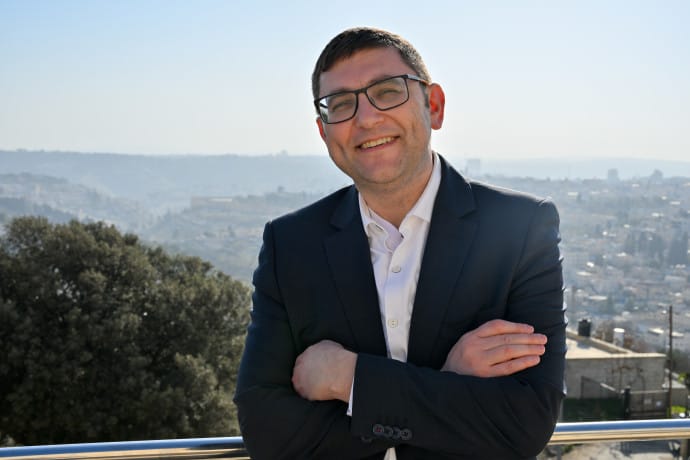
Additionally, says Gofman, AI is used for drug discovery, automating R&D in companies, and advancing academic research. It can also customize products, from a one-size-fits-all model to mass customization, where individual user preferences are taken into account.
An additional benefit of AI is accessibility. For example, he notes that if someone can’t physically meet with a doctor, they could use an AI consultant for their medical needs. “Potentially, it can save lives,” he notes.
What are the risks of AI? While Gofman says that apocalyptic fears that AI will take over the world may be a bit overstated, there are some short-term risks, such as the possibility that mid- and lower-level jobs could be eliminated by companies using AI agents to do the work.
Additionally, AI can pose cybersecurity threats. While in the past, hackers needed to be well trained to break into systems, today, less proficient hackers can use AI tools to do so. “The bottom line is that the opportunities are amazing and the risks are also very, very great.”
While some may try to draw comparisons between the AI revolution and historical transformations such as the Industrial Revolution, comparing events from vastly different eras is often difficult and imperfect. “The risk with AI is that you don’t even know what the risk is,” says Gofman. “And, whenever you have this type of technology, you are saying, ‘How can I manage this risk if I don’t know what I need to manage?’”
It’s hard to imagine a more promising time in history for people who have vision, a strong desire to succeed, and the willingness to work hard
Gofman researched systemic risk after the 2008 financial crisis, which caused a major recession in the US, and says that the most relevant lesson that one can learn from that period is that most people – even financial experts – assume that the next crisis will be the same as the previous one, but that is usually not the case. That lesson can be applied to the potential problems of AI.
“At that time,” he says, “I was studying for my PhD at the University of Chicago, which is considered the top school in the world for finance. I was surprised to see how the best professors in the world, like Nobel Prize winners, were caught unprepared for what had happened. The goal now is for researchers and policymakers to think ahead. AI risk is a good example. We have no idea how it will play out, but it is better to be prepared.”
One of Gofman’s most significant AI responsibilities at Hebrew University is his position as co-founder of the new Jerusalem Research Center for AI in Organizations, part of the Business School. Located at the school’s Mount Scopus campus, the research center, which received seed funding from Google, focuses on implementing AI in organizations, including nonprofits, commercial entities, universities, and governments, to enable safe, efficient adoption. Gofman says the center is seeking additional corporate sponsors to partner in its AI work.
“We felt that there is a gap, not just in Israel but globally. Our goal was to establish a center in Jerusalem as a gravitational force to tackle these issues. We said we want to structure this as a corporate affiliates program, where corporations can access this research and support it, so that we are not just doing top-tier research in terms of publications but also have a practical impact on organizations in Israel and globally.”
Gofman explains that one of the center’s goals is to ensure that companies in the age of AI know how to manage risks and seize opportunities to become more productive.
“It’s a challenge that requires a great deal of cooperation between universities and the public sector to make it interdisciplinary. Our vision is to create opportunities, conferences, and grants, so that researchers can first research based on data, to understand how we can deal with this situation where AI meets the economy, and how to make this meeting less dangerous, less disruptive, and more constructive so that it’s safe, while preserving opportunities.”
How can AI shape the future of Israeli innovation in the next decade? First, says Gofman, universities need to be proactive and provide students with the platforms they need to foster entrepreneurship. Second, they need to provide opportunities for students to take their prototypes and actively develop them with the mentorship of their instructors. Next, an incubator program can help them further develop their ideas.
“If you build the right pipeline,” he says, “then during the three, four, or five years that students spend at the university, you can give them a real pathway to test, develop, and even fail with AI-driven ideas and start-ups. I believe that in that kind of environment, the Hebrew University of Jerusalem would not only remain among the top universities outside the United States in producing unicorn founders, but could potentially become one of the leading institutions in the world.
“That’s why I see the investment required from academic institutions for entrepreneurship-driven tracks as relatively small compared to the enormous potential impact. The start-ups these students can build – across virtually every industry imaginable – could be transformative. If universities across Israel embrace this approach and provide students with the right entrepreneurial tools, then Israel, already known as the ‘Start-Up Nation’ and one of the world’s leaders in innovation, could reach an entirely new level.”
Practically speaking, explains Gofman, businesses and institutions need to prepare for the transition to AI in several ways. “If you don’t invest or take any action, you will be in trouble. You need to research, you need to see what your competitors are doing, you need to investigate Open AI, Anthropic, and Google, and then you need to recognize the risks.”
The next thing they need to do, he says, is develop a vision for using AI. “You need to see how your company and your industry look in a world in which we have cheap, efficient, and disruptive AI.”
Once companies have invested in and developed a vision, says Gofman, they need to carefully estimate how much to invest in AI. If they underinvest, they risk falling behind. If they invest too much too soon, investors may become skittish.
Training the workforce to leverage AI capabilities is essential, as is hiring consultants to stay on top of new technologies. In short, he says, “You really need to be on top of things. And in some ways, you need to reinvent the wheel.”
One of the key advantages of AI, Gofman explains, is that it lowers the barriers to entry. For example, AI tools can produce high-quality code, making prototyping much easier and reducing costs. “Before, you would need to have a significant seed investment to generate revenues. But now with AI agents, you can get to much higher valuations the first time you raise the money. So it means that you give less of your company. You can check many ideas simultaneously to prototype them.”
Gofman then points out the crucial question that students ask: “If AI can do everything, then what is my added value?” In response, he says, humans bring two vital components to any project that AI cannot supply. The first is vision. “You need the ability to think abstractly and envision how you see the world and the type of products you want to make. AI does not have that ability to have this imagination or vision.”
The second quality that is needed is will, or as he puts it, “the desire to do things. And, if you have the imagination and the will, AI can give you the rest.” He adds that would-be inventors and students should not think that they will not need to work hard because AI is there for them. “As an entrepreneur, you will be working much harder nowadays than before because opportunities are everywhere. You have more things to verify, things to do, and that is going to be a hard job.”
Despite the risks and potential pitfalls of AI, Gofman remains optimistic. “It’s hard to imagine a more promising time in history for people who have vision, a strong desire to succeed, and the willingness to work hard.”
This article was written in cooperation with Canadian Friends of Hebrew University.