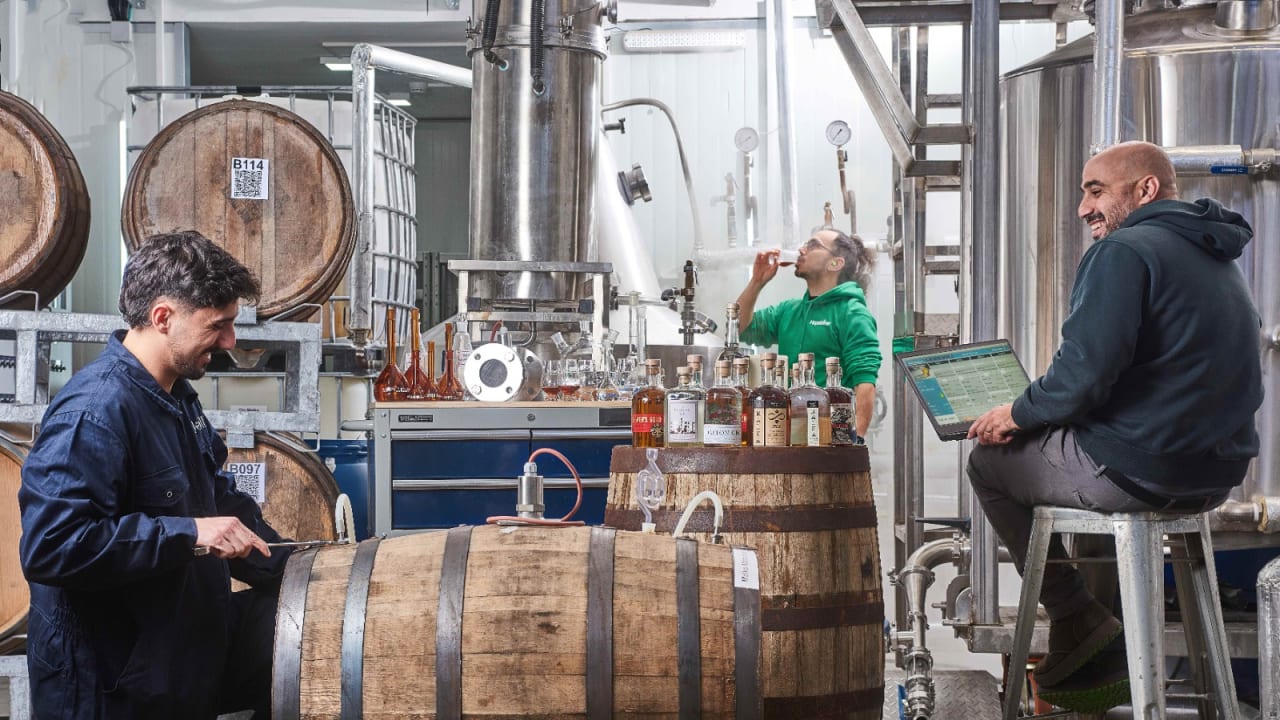
Israeli start-up Verstill, specializing in controlled maturation technology for the spirits industry, is working on modernizing one of the sector’s most time-intensive traditional processes.
The company, founded in 2015 and located in northern Israel near the Lebanese border, has developed systems that replicate the chemical changes associated with long-term barrel aging, allowing producers to create spirits in a matter of weeks rather than years.
Its approach combines controlled thermal environments and molecular analysis with automated maturation tools designed to give distillers precise control over flavor development.
“We look at the traditional way but innovate,” Yinon Tamir, head of product at Verstill, told The Jerusalem Post during a visit to the facilities in Lehavot Habashan.
According to Tamir, while the spirit industry, one of the most traditional industries, doesn’t tend to rush towards innovation, “every customer who tries our spirits is convinced.”
“We are in a market where taste talks,” Tamir said, adding that “it starts with a dream, a vision of the client, and our customers are our partners. The liquid is custom-designed, hand-in-hand from its smell to its look to cocktail recipes, branding, and distribution. We are the brand behind the brand.”

Verstill works with distilleries, breweries, wineries, and hospitality groups seeking to expand into spirits production without investing in traditional aging infrastructure. It has over 70 clients around the world, including Western Galilee’s Malka Brewery and The Norman Tel Aviv hotel.
The company was founded by Matan Edvy, a distiller and winemaker, and Yechiel Ben-Zvi, a chemist at the Weizmann Institute of Science, who moved to Israel from the United States. It maintains additional offices in Tel Aviv and in upstate New York and is looking to expand into other countries such as Japan and India - where it also plans to transfer the manufacturing of its technology.
“New York shows the opportunity clearly. It is one of the world’s great hospitality and beverage markets, with restaurants, bars, hotels, liquor stores, breweries, and cultural brands that know their customers and have strong ideas for products, but the spirits infrastructure was not built for them,” Edvy said.
The global spirits market in 2025 is valued at $641.53 billion, with India at $10.81b. and the US is benchmarked at $76.16b. in 2024, while Israel’s spirits market is valued at $1.9b.in 2025.
Verstill has filed over 20 patent documents in multiple jurisdictions covering its maturation systems and related processes; and in 2023 it secured $3.5 million in later-stage venture funding to support continued development.
“Creating a premium spirit still requires distillery access, capital, regulatory capacity, inventory, technical expertise, and time. Verstill is building the infrastructure layer that makes that process more controlled, measurable, repeatable, and accessible,” Edvy said, adding that “we are not trying to replace tradition. We are trying to open it up so more creators can bring distinctive, high-quality spirits to market.”

Local pride
The company’s northern Israel location has introduced challenges unrelated to its technology. Lehavot Habashan, situated near the Lebanese border, has been affected by the ongoing conflict with Hezbollah, which has led to evacuations, disruptions to daily life, and interruptions for businesses across the region. Verstill has had to adjust its operations accordingly, managing staffing and logistical constraints while maintaining research and production activity.

Despite the instability in the area, the company continues to refine its systems and support partners through both on-site licensing and regional production services.
“The past two years have been tough, but we’ve tripled the amount of liquids going out,” said Tal Cymbalista, business development manager at Verstill.
The company also works closely with Tel-Hai Academic College in neighboring Kiryat Shmona.
“It’s important for us to be part of the local tech community of northern Israel,” Cymbalista told the Post.
As global demand for new spirits grows and producers search for ways to shorten development timelines, Verstill’s maturation systems position the company as a practical alternative to traditional aging. Its continued work in northern Israel, despite the challenges, alongside its global expansion plans and a growing client base, has seen Verstill steadily establish itself as a notable player in a traditional yet evolving spirits industry.