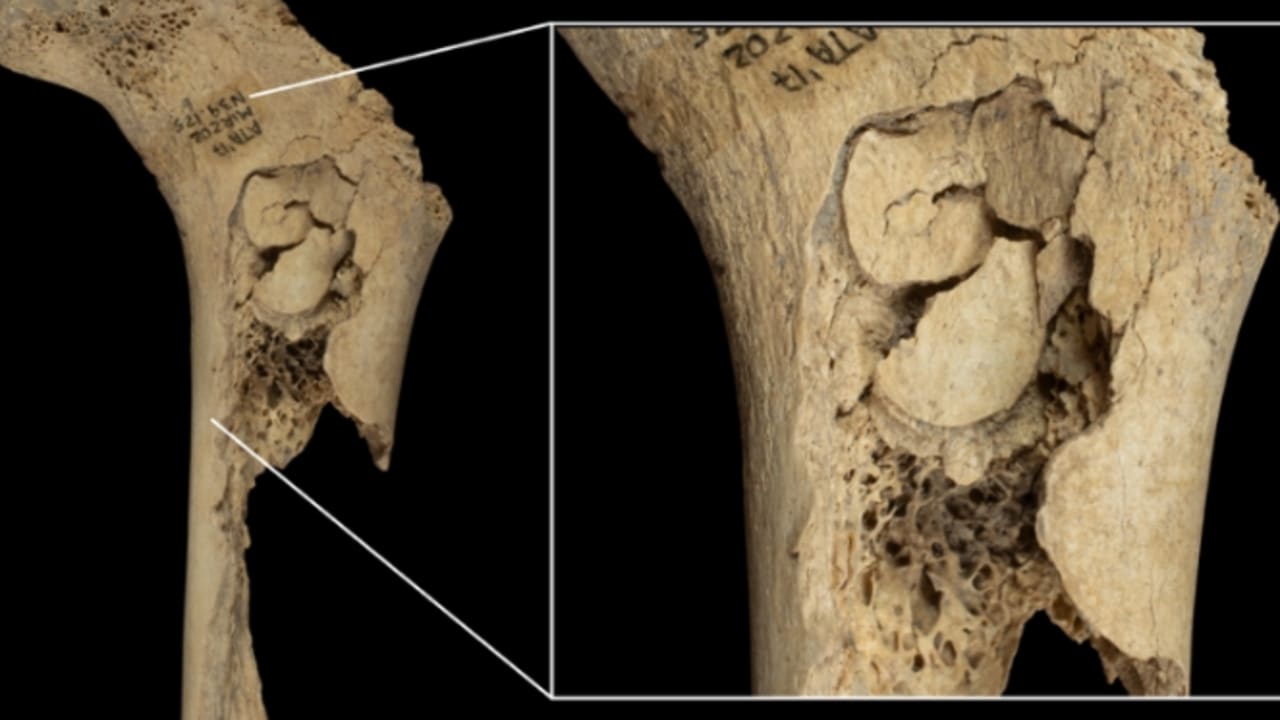
A study published in Scientific Reports described what its authors called cannibalistic warfare in El Mirador cave, part of Spain’s Sierra de Atapuerca. Led by Palmira Saladié of the Catalan Institute of Human Paleoecology and Social Evolution (IPHES-CERCA), the team examined 650 bone fragments belonging to at least eleven late-Neolithic individuals.
Radiocarbon tests dated the episode to 5,700–5,570 years ago, just before the cave became a collective burial site. Isotope data showed the dead were local. Cut marks, marrow-extraction fractures, burning, and bite impressions indicated that the bodies were skinned, disarticulated, roasted, and eaten in a single event that lasted only a few days. Sixty-nine bones bore stone-tool cuts, and 222 displayed heat-related color changes.
“There are no signs of famine or a funerary tradition. Everything points to an act of deliberate violence between conflicting peasant groups,” said co-author Francesc Marginedas of the Universitat Rovira i Virgili, cited by El País.

Cannibalism is “one of the most complex behaviors to interpret, due to the inherent difficulty in understanding the act of consuming other people… our own cultural prejudices push us to conceive it as an act of barbarism,” said Saladié, according to Público. She argued that the pattern at El Mirador matched ethnographic cases in which enemies were eaten as a form of ultimate elimination.
The Atapuerca karst system preserved other cannibalistic incidents. About 3,400 years ago, six Bronze Age individuals were consumed in the same cave, their skulls later reshaped into cups. Roughly 850,000 years ago, cut marks on a toddler’s vertebra at nearby Gran Dolina showed that Homo Antecessor also practiced cannibalism.
Comparable Neolithic massacres have been documented at Herxheim in Germany, Fontbrégoua Cave in France, and Els Trocs in Spain.
“Even in societies with little social hierarchy, episodes of violence can occur that culminate in the consumption of the enemy as a form of extermination,” said Antonio Rodríguez-Hidalgo of the Institute of Archaeology in Mérida. The authors concluded that organized conflict shaped the Iberian Peninsula during the Late Neolithic.
The preparation of this article relied on a news-analysis system.