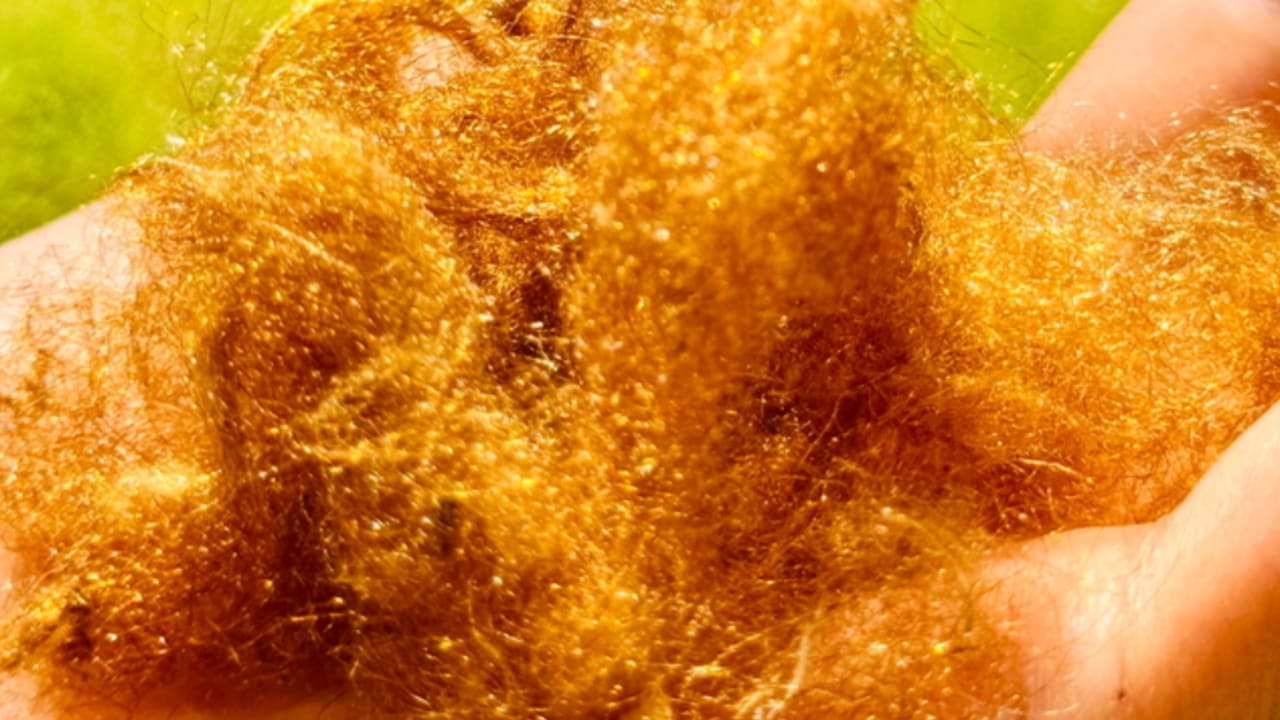
On Wednesday, Pohang University of Science and Technology (POSTECH) announced that its research team successfully recreated the ancient luxury fiber known as sea silk using pen shells cultivated in the coastal waters of Korea. The team achieved this by processing the byssus of Korean scallops, known locally as 'kijogae,' offering a sustainable alternative to the endangered Mediterranean clam Pinna nobilis, according to Business Korea.
Sea silk, often referred to as 'the golden fiber of the sea,' is a fabric that dates back to ancient Roman times. Historically, it was reserved for powerful figures such as emperors and popes, which indicates its rarity and value. The luxury item became a relic, with only a handful of artisans capable of producing it in extremely limited quantities.
The Mediterranean clam Pinna nobilis, traditionally the sole source of sea silk, is now facing extinction due to marine pollution and other environmental factors. Consequently, the European Union has banned the harvesting of this endangered species. In contrast, pen shells used by the POSTECH team are cultivated for food in Korea, making them a sustainable alternative.
Both Pinna nobilis and pen shells produce byssus—silky threads they use to anchor themselves to rocks. The research team discovered that the byssus of pen shells is physically and chemically similar to that of Pinna nobilis. By processing the byssus of 'kijogae' scallops, they recreated a fiber that mirrors the appearance and properties of traditional sea silk.
Professor Hwang Dong-soo, who led the joint research team from the Division of Environmental Science and Engineering, Interdisciplinary Bioscience and Bioengineering, and Graduate School of Convergence at POSTECH, stated, "Structural color-based fibers have the characteristic of not fading, allowing for long-lasting colors without the use of dyes or metals," according to Business Korea. He added, "We expect this research achievement to open new avenues in eco-friendly fashion industries and advanced material development."
The team not only replicated the ancient fiber but also unraveled the secret behind sea silk's enduring golden hue. They discovered that the non-fading color is due to a phenomenon called 'structural color.' The golden color arises from the stacking of round-shaped proteins called 'photonin' in multiple layers, which reflects light. The researchers found that the more orderly the arrangement of photonin proteins, the more vivid the structural color becomes. Because the color is produced by the structure of the material itself, it does not change over time.
By transforming the discarded pen shell byssus byproduct into a valuable fiber, the research team aims to contribute to solving marine waste problems. This approach not only provides a sustainable material but also offers potential as a cultural heritage product.
The research findings were published in Advanced Materials. The team included Professor Lee Ki-ra of the Department of Chemical Engineering at POSTECH and Professor Choi Ji-min of the Environmental Research Institute at POSTECH. Their work was supported by projects from the Ministry of Oceans and Fisheries, the Sejong Science Fellowship, and the Korea Research Foundation's Mid-Career Research Project, according to Munhwa.
Produced with the assistance of a news-analysis system.