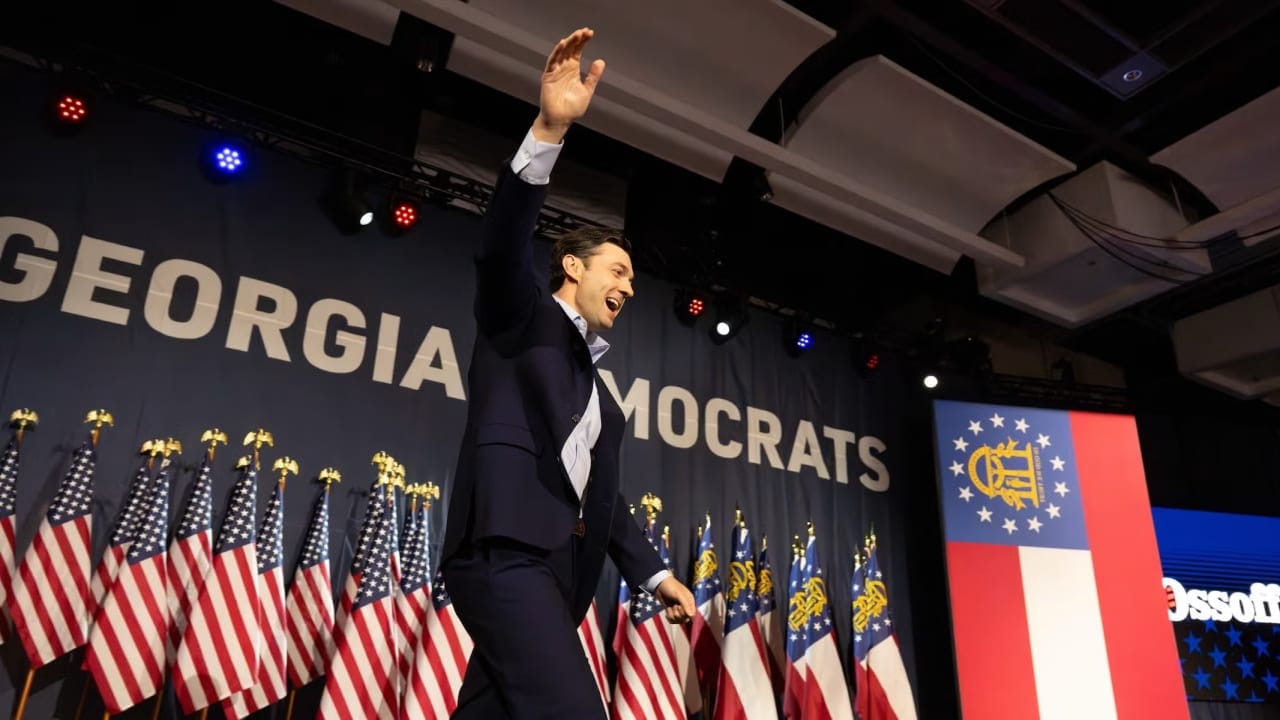
US Sen. Jon Ossoff’s soaring popularity and cruise to reelection last Tuesday have spurred speculation about his political future - and whether he might aim to become the first Jewish president of the United States.
Less than an hour after polls closed on Election Night, he was projected to handily defeat his Republican challenger Mike Collins. With a campaign focused on expanding affordability and fighting corruption, Ossoff built a broad coalition in one of the nation’s most diverse states, even earning Republican endorsements. Ultimately, he retained his seat by 59%-41%.
The leading polling analyst Nate Silver said Saturday that Ossoff was his “slam dunk number one pick” for a Democratic presidential candidate in 2028, despite Ossoff’s insistence that he has “zero interest in running for president.”
Ossoff’s Jewish supporters have expressed pride in his affirmation of Southern Jewish history while leading a state with a fervent Christian population. But other Jewish constituents have said they feel betrayed by his mounting criticism of Israel’s actions in Gaza, and it remains to be seen whether Georgia’s pro-Israel Jews would coalesce around Ossoff if he pursues the country’s highest office.
For Andrew Lewis, Ossoff is a worthy standard-bearer for the Jewish community. A board member of Atlanta’s oldest synagogue, the Temple - where Ossoff had his bar mitzvah - Lewis said the senator frequently cites the Temple’s role in the civil rights movement, a point of pride for Jewish Atlantans.
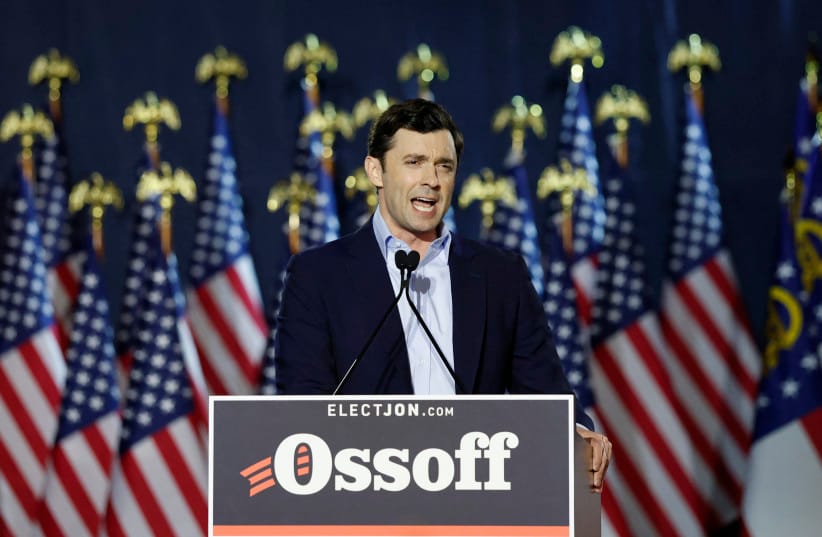
In 1958, white supremacists bombed the Temple because its rabbi, Jacob Rothschild, advocated desegregation and allied with Martin Luther King Jr. Ossoff was sworn into the Senate on Rothschild’s well-worn bible.
“Our Rabbi Rothschild worked with Dr. King and helped shepherd Atlanta’s Jewish community, and our city and nation, through a very different yet equally divisive time,” said Lewis, who also co-founded the interfaith organization First Five Freedoms. “I take a great deal of pride in that, and I see every time Jon Ossoff speaks about it, he takes equal pride.”
Ossoff has said his entry into politics began with an internship for Rep. John Lewis, the late civil rights giant, which helped spur his career as an investigative documentarian before he ran for office.
Ossoff’s fellow Georgian in the Senate, Raphael Warnock, serves as a pastor at King’s former pulpit, Atlanta’s Ebenezer Baptist Church. When Ossoff and Warnock ran at the same time in the 2021 runoff elections for the state’s two Senate seats, they called attention to their rekindling of the Southern Black-Jewish alliance.
Elise Eplan, a former president of the American Jewish Committee chapter in Atlanta, said she appreciated Ossoff’s references to his Jewish identity. Ossoff has said that his father descended from Ashkenazi immigrants and he grew up among relatives who were Holocaust survivors.
“When you grow up in the South, it used to be harder to talk about not being Christian, and being really open about it,” said Eplan. “I have admired the fact that he’s not shied away from that.”
Ossoff's 2021 appeal to Atlanta's Jewish community
During his 2021 run, Ossoff delivered a direct appeal to the state’s Jewish community in the Atlanta Jewish Times, saying his Jewish upbringing instilled “a conviction to fight for the marginalized, the persecuted and the dispossessed.” He noted to JTA in 2019 that his wife, physician Alisha Kramer, is also Jewish. The couple started dating in high school, according to the Atlanta Journal-Constitution.
Two years ago, Ossoff faced blowback from Jewish institutions for supporting Sen. Bernie Sanders’ resolutions to block certain weapons sales to Israel. The local Anti-Defamation League Southeast chapter, the Jewish Federation of Greater Atlanta, the American Israel Public Affairs Committee (AIPAC) and an array of synagogues said they were “deeply disappointed” by his votes for the resolutions, which did not pass.
In 2025 and 2026, he voted for further measures to restrict offensive military aid to Israel, while supporting defensive arms sales.
Ossoff stood by those votes during a debate with Collins last month. He also said he had “no doubt” that Israeli forces committed war crimes in Gaza, deferring the charge of genocide as “a question for the International Criminal Court (ICC).”
Michael Morris, the publisher of the Atlanta Jewish Times, accused Ossoff in an open letter of “lying to me and your constituents” about his support for Israel by repeatedly voting against arms sales.
But when Ossoff emerged triumphant on November 3, the ADL offered him congratulations - despite denouncing other victorious Israel critics.
ADL Southeast Director Todd Young rebuked Collins, Ossoff’s opponent, for links to white nationalists. “This race also underscored the importance of confronting antisemitism in Georgia politics,” he said in a statement. “Throughout the campaign, serious concerns emerged about individuals close to Mike Collins.”
Collins’ former staffers were accused of posting racist and antisemitic imagery and participating in a white nationalist group chat, while his son-in-law promoted antisemitic conspiracy theories online. Those controversies might have muffled Jewish groups’ objections to Ossoff’s voting record on Israel, according to Rebecca Stoil, a professor of US political history at Clemson University.
“Ossoff, and his candidacy with Jewish voters, benefited from the clear concerns that Jewish voters had with Collins,” said Stoil, a member of Atlanta’s Jewish community.
In his 2021 campaign, Ossoff accused his then-opponent, Sen. David Perdue, of antisemitic dog-whistling after a campaign ad depicting Ossoff with an elongated nose.
Ossoff says that he supports the security of Israelis as well as the safety and security of Palestinians. In a Senate speech in November 2023, he said, “Just as I pray for the freedom of hostages taken so cruelly from their families, as a pro-Israel Jewish American I urge mercy for the innocent civilians in Gaza.”
As a rising left flank of his party presses for the end of the US-Israel alliance, Ossoff continues to define himself as “pro-Israel.” He argued last month that before sending weapons to any ally, the United States should assess “whether that foreign government is acting consistent with our interests, our laws and our values.”
Ossoff’s argument that one can be pro-Israel even while conditioning US aid has been increasingly embraced by the center of the Democratic Party, according to political scientist Dov Waxman. He pointed to surveys that capture a drop in sympathy for Israel among Americans, including American Jews.
A new poll from J Street, a liberal Jewish Middle East policy group, reported that 39% of Jewish voters said defensive aid for Israel should continue with conditions, while 31% said all military aid should end and 30% said aid should continue without conditions. Among Jews under 35, 60% supported severing military aid and said that Israel has committed genocide in Gaza.
Waxman said those trends spelled both parties moving away from traditionally stalwart pro-Israel positions of delivering offensive and defensive aid to Israel with few conditions.
“I think Ossoff’s position is really the mainstream position now in the Democratic Party - the center of gravity,” said Waxman. “Which is to say, a position that broadly supports the continuation of the US-Israel alliance, but is not willing to write a blank check for Israel, and is not willing to support what the Israeli government does unconditionally.”
Eplan, the former AJC leader, said she was initially “concerned” about Ossoff’s votes to block offensive weapons sales in 2024. But three years into Israel’s prosecution of the war in Gaza under Prime Minister Benjamin Netanyahu, she said, “I understand it.”
“Unfortunately, under Netanyahu, it has become more and more difficult to be pro-Israel in the way we always have been historically,” said Eplan. “I do think that we need leaders who understand some of the nuance, and who are willing when necessary to take a tough stand, but at the end of the day understand the importance of Israel as our ally and as a Jewish homeland.”
If Ossoff decides to run for president, it would mark a new era in US-Israel relations. Democrats are not alone in increasingly scrutinizing the alliance. US Vice President JD Vance blamed his party’s crushing defeats in the midterm elections partly on “our relationship to Israel” and the Iran war, which the United States joined with Israel.
Trump announces halt to Israel aid by year's end
US President Donald Trump announced on Election Day that the United States would halt military aid to Israel by the end of 2026, saying that Republicans “suffer the slings” from Democrats over the issue.
“Now it is the policy both of the incumbent administration and of people like Jon Ossoff to limit aid to Israel,” said Stoil. “For voters who did care so much about Israel that it was going to be their basis for voting, the moment it becomes a bipartisan consensus to cut off aid, then you pick what most closely represents you on the other topics.”
Meanwhile, Israel is undergoing its own political change following elections on Oct. 27. The next president of the United States could face a new Israeli government after Netanyahu’s rival, Gadi Eisenkot, scored enough seats and endorsements from other parties to seek to form a new governing coalition.
Pro-Israel groups in the United States are already retooling for the next stage of relations. Kathy Manning, a former North Carolina congresswoman and chair of the advocacy group Democratic Majority for Israel, hopes a new Israeli government will pave the way for a renewed alliance that Democrats like Ossoff can support.
“If the current government, Netanyahu and his far-right extremists, continue to be the leaders of Israel, I think that it’s going to be very tough for many Democrats to continue to stand shoulder to shoulder,” said Manning. “If the government of Israel changes and we see a Gadi Eisenkot coalition moving forward, I think that’ll be an opportunity for us to rebuild the US-Israel relationship.”