
Mordechai Frizis was raised in Athens in a traditional, Zionist Jewish family. He was named for his grandfather Col. Mordechai Frizis, a Greek-Jewish veteran of both world wars and the Greco-Turkish War of 1919-1922.
In December 1940, fighting on the Albanian front, Col. Frizis became the first senior Greek Army officer to be killed in action in the Greco-Italian War. He is revered as a war hero in Greece, whose Jewish population was decimated in the Holocaust.
“Many Greeks remember my grandfather for good, and bearing his name opens some doors for me in the field of Israeli hasbara [public diplomacy]. I also come from Greece and from a family that sacrificed for Greece,” says Frizis. He notes that October 28 is a Greek national holiday in commemoration of the start of the Greco-Italian War against the fascist forces of Italy.
Since 2011, the 48-year-old Jerusalem resident has devoted himself to educating fellow Greeks about Jews and Israel via social media channels, newspaper articles, videos, and TV appearances. He is currently the World Likud representative to Greece.
“One of the biggest challenges is being confronted with misunderstandings and stereotypes, not only about the Arab-Israeli conflict but also pure antisemitism,” he says.
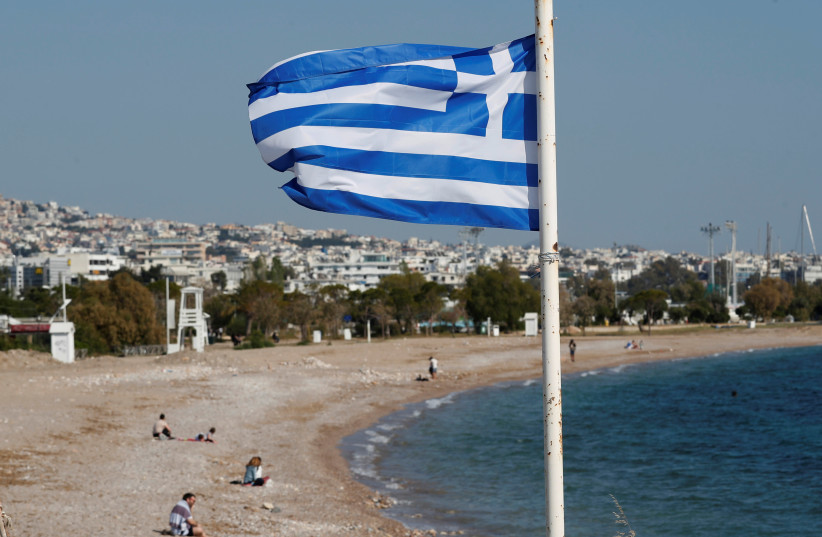
“Many people think Jews are the bad guys, the killers of Jesus, and now the killers of babies in Gaza. They believe we have all the world’s money and power in our hands. But I have to say that in the last few years, especially since Oct. 7, I see that the vast majority of Greeks are pro-Israel. The ones who make the noise are the minority.”
Unfortunately, Frizis was already well acquainted with anti-Jewish tropes. Because there was no Jewish secondary school in Athens, he attended public school from the age of 13 to 18. “I was the only Jew in the school, and I experienced antisemitism during those six years. I knew I had to come home.”
To Israel, that is.
He explains that his family “loved Greece and the Greek people, but we considered the land and the State of Israel as our homeland. When I was growing up in the 1990s, there were so many terror attacks in Israel, and I felt bad that my people were suffering and I was not with them. I always wanted to be a part of our nation, in the good times and the bad times.”
Nevertheless, when he left Athens for Israel in 1995 after high school, he came without his parents and sister. And he did not officially make aliyah at that time, having pledged to return as a shaliach (emissary) to Jewish communities in Greece.
IN THE eight years until he went back to Greece, Frizis studied history and Jewish history at the Hebrew University of Jerusalem, where he met his future wife, an immigrant from Buenos Aires. He then studied for rabbinic ordination at Yeshiva Midrash Sefaradi in Jerusalem’s Old City.
Following their wedding in 2000, the newlyweds lived for three years in Mitzpe Yericho. Then, true to the pledge Frizis had made, they went to Thessaloniki (Saloniki) on shlichut for four years.
Named for the sister of Alexander the Great, Thessaloniki long housed the largest Jewish community in Greece. At the beginning of World War II, the Jewish population of Thessaloniki numbered more than 55,000, comprising the majority of the city. Only 1,950 of them survived the war, and many chose to resettle elsewhere.
“Most of the 1,000 Jews in Thessaloniki now are assimilated, and they don’t all live in the same area,” says Frizis.
He served as the rabbi of this scattered community, doing everything from leading prayers to slaughtering kosher animals. “But most of my time was invested in the Jewish youth. I wanted these youths to learn about Israel and Judaism in general.”
Living in Israel
The couple returned to Israel in 2007 with a daughter and later welcomed a son and another daughter. The Frizis family now lives in Pisgat Ze’ev.
“Two young Jews came with us from Thessaloniki, and only one is still here. It’s very complicated; not all the people who come on aliyah have the support of their families,” says Frizis. “My sister made aliyah some years after us, stayed 15 years, and then went back to Greece.”
Aside from his work in hasbara, Frizis gives Greek language lessons. “Many Israelis like Greek music and culture, so they want to learn the language; others have Greek heritage and want to come back to their origins,” he says.
Frizis is involved in the “small but active” Greek Israeli community and in the Association of Survivors of Concentration Camps of Greek Origin Living in Israel. “Our goal is that Israelis will learn the story of the Holocaust in Greece. But we also strive to be a point of contact between Greece and Israel.”
In addition, Frizis teaches Torah studies to families who lost relatives in wars and terror attacks, through the organization Yad LaBanim.
If you search for “Rabbi Mordechai Frizis” on YouTube, you’ll see not only his hasbara videos but also – perhaps surprisingly – his many videos in Greek, Hebrew, and English paying homage to heavy metal music.
“I’m a very big collector of heavy metal music,” he says. Among his favorite bands are Slayer, Manowar, and Iron Maiden. “I’m known as the Metal Rabbi,” he adds.
He points out that although every Israeli Jew, like himself, is unique, “in the eyes of the antisemites and enemies of Israel we are one thing: Jews. It doesn’t matter if you’re religious or not, if you’re Right or Left. And I understand where that comes from.”
Ironically enough, he thinks it would be beneficial if we thought of ourselves from a similar perspective. “We have differences, but we have to understand we are one people – not in a bad way but in a good way.”
This transplanted Greek rabbi intends to continue his hasbara efforts on behalf of Israel, citing Isaiah 62:1 – “For the sake of Zion I will not be still; and for the sake of Jerusalem I will not be silent.” ■
RABBI MORDECHAI FRIZIS, 48 FROM GREECE TO JERUSALEM, 2007