
Tacit learning in medical education refers to the unwritten, experiential “know-how” –clinical intuition, surgical skills, and bedside manner – that cannot be explained easily in textbooks.
It’s acquired primarily through direct observation, mentorship, and “learning by doing” – the physical intuition needed to know how much pressure to apply, where to place one’s hands, when tissue feels wrong, or when to stop.
It’s the knowledge that allows someone to perform a procedure well, even when that knowledge is difficult to put fully into words. It refers to things such as how deep to cut, what “softer than usual” means, or when to stop inserting a needle by sensing the density of tissue.
Such teaching allows practitioners to quickly synthesize subtle visual, auditory, or nonverbal cues to make rapid, adaptive decisions in high-risk environments and builds the muscle memory, spatial awareness, and physical judgments necessary for surgical and listening to internal body sounds (like the heart, lungs, and abdomen) using a stethoscope or similar device.
It also teaches the cultural norms, ethical behaviors, and relational dynamics of the medical workplace. Medical schools increasingly turn to virtual reality (VR), 3D models, and digital simulations.
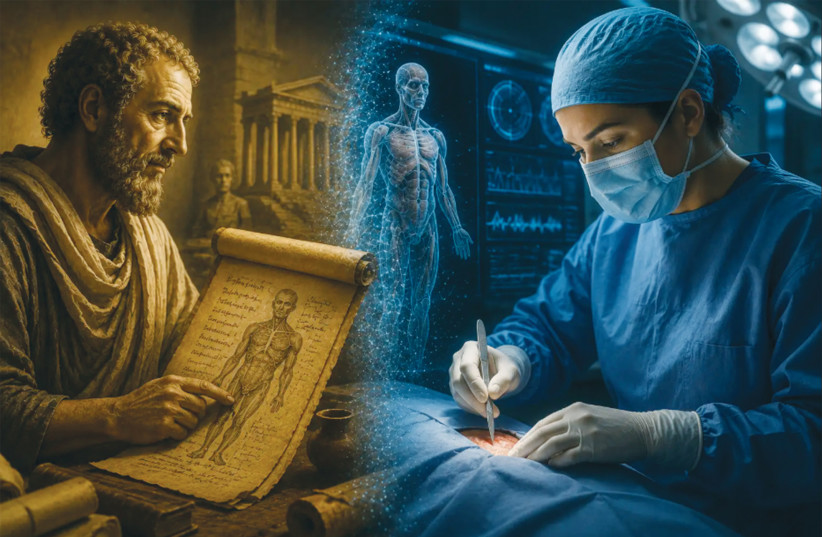
In a new study under the title “What Galen’s dissections reveal about tacit learning in modern medical education” in Nature Medicine, Hebrew University of Jerusalem (HUJI) researchers argue that one essential part of clinical training remains difficult to digitize: the hands-on judgment physicians develop through real-life, mentored practice.
It was led by Prof. Orly Lewis of HUJI’s Faculty of Humanities’ classical studies department, who has long been intrigued by how people explored and interpreted nature, in particular the living body, its structure, and its workings. She finds collaboration with modern medical experts and practitioners particularly stimulating and fruitful.
A growing challenge in today’s medical education is digital tools that can teach anatomy, procedures, and decision-making with increasing sophistication, but they often struggle to transmit tacit learning,
To expose this gap, Lewis (who earned the highest honors for her three degrees at Humboldt University in Berlin and at Tel Aviv University) and her multidisciplinary team turned to an unexpected source – Galen, the influential Roman physician who lived 19 centuries ago.
Her study showed that written instructions and digital tools alike can’t replace the physical intuition and judgment gained through real-life, mentored practice. They suggested identifying and integrating these unspoken, tacit elements into the design of future digital pedagogical tools to better align with the actual needs of clinical skill acquisition.
The researchers tried to recreate a dissection of the abdominal wall and peritoneum of a female pig by following instructions from the second book of Galen’s Anatomical Procedures. Galen’s text is highly detailed and teaches readers, for example, to cut superficially around the umbilicus until the underlying tissue appears “whiter” than surrounding structures.
But when the researchers tried to follow the ancient directions in practice, they encountered a familiar modern problem – the instructions were explicit, but the skill was not. What does “superficially” mean under a scalpel? How much pressure is enough to expose tissue without damaging or distorting it? How should the hand move when resistance changes?
These are the kinds of judgments that cannot be fully captured in a manual, a checklist, or even a sophisticated simulation.
“Even Galen’s highly detailed written instructions weren’t enough to guide us, and today’s augmented reality simulations face the same challenge,” Lewis told The Jerusalem Post. “We can program the visible steps of a procedure, but simulations still struggle to transmit the physical intuition of an experienced physician.”
Asked why they chose Galen specifically as the historical model, she said that his book “is the only surviving ancient text that gives instructions so specifically.”
The experiment aimed to learn about Galen’s empirical methods of research that informed his influential medical theories and to answer scholarly historical questions being asked about Galen – “not only his theories, but also the practical and environmental contexts of his dissections (including how tissues were cut, stretched, and exposed, what instruments were used, and what kind of practical guidance Galen’s text presupposed) and the relation between his experimental work and how he describes it in writing.
“As is always the case in the study of the history of medicine, this work made us reflect also on current practices and concerns,” she said.
The researchers argued that this problem has become especially urgent as medical training increasingly relies on digital resources while opportunities for physical dissection, bedside teaching, and supervised clinical practice decline in some settings.

Unspoken elements of expertise traditionally passed from teacher to student
In today's competency-based training, complex procedures are often broken down into discrete steps that can be taught, measured, and assessed. But the researchers warned that this approach may overlook the unspoken elements of expertise traditionally passed from teacher to student through observation, imitation, correction, and repeated hands-on practice.
Whether a trainee is placing a catheter, making an incision, palpating tissue, or navigating anatomical variation, clinical competence depends not only on knowing what to do, but on developing the sensory judgment to do it safely and effectively, Lewis stressed.
The authors don’t oppose digital innovation in medical education, but they call for a more rigorous approach to designing these tools.
“If virtual reality, augmented reality, and digital simulations are to replace or supplement hands-on training, they must identify and incorporate the tacit dimensions of medical skill acquisition, including touch, pressure, resistance, timing, and embodied judgment,” she said.
The lesson from Galen “is both ancient and urgently modern – medical knowledge has never been transmitted by words or images alone. Even the most detailed instructions leave something out – and that missing knowledge may be exactly what future doctors need most.
The experiment completely changed her view of how ancient physicians taught anatomy, she said, “but it also added more clarity and nuance – how it really worked. One thing we learned is that, as detailed as the texts are, there is much more to teaching, such as transmitting anatomical and other medical knowledge, than what he described in the text.”
Both expert veterinary surgeons and medical physicians were involved in the research from planning through performance and analysis. The planning was done by researcher and practitioner Dr. Andrés Pelavski, who is both a classicist and a practicing physician with many years of experience in both analysing ancient texts and treating patients.
The procedure was performed by Prof. Joshua Milgram, who has many years of experience in surgery and teaching veterinary anatomy.
“This means that we were confident about our skills in performing such challenging surgical tasks,” Lewis said.
Lewis said she was most surprised by “the level of detail; things that Galen had observed but that physicians today don’t pay attention to are not taught in anatomy class, such as the shade of particular muscles (one being darker than the other). And conversely, certain omissions of details are obvious to us, and we do not know if he did not observe them or decided not to report them in this context of writing.”
Asked if she thought Galen himself assumed students would already possess hands-on mentorship before reading his texts, she replied that “this is one of the big ongoing scholarly questions that we managed to address through our experiments. The answer is a nuanced yes. The texts were not self-sufficient, but they were nonetheless intended as training aids.”
Surgeons often train with VR robotic training systems.
“These simulate very closely the reality they will encounter, but after some practice with real-life experience, there is considerable progress and a learning curve,” Lewis concluded. “I envision that ‘next-generation’ simulations that combine AI, robotics, and tactile feedback will be a big leap forward for incorporating tacit learning into such systems.”