
Israel risks making the same mistake twice.
Earlier this year, some Israeli assessments suggested that military setbacks might embolden popular unrest and fracture the Islamic Republic from within.
Now attention has shifted to a blockade, with reports suggesting that strangling Iran’s economy could accomplish what protests did not.
Both ideas rest on the same assumption: that enough pressure will finally cause the regime to collapse. History suggests otherwise.
Israel should welcome a blockade. Every barrel of oil Iran cannot export is revenue the regime cannot spend on ballistic missiles, drones, terrorist proxies, or its nuclear program. A blockade would impose real costs on Tehran and make Israel safer.
But weakening Iran is not the same as toppling the regime. That distinction is more than academic. It is the difference between buying time and solving the problem.
The current debate risks confusing economic weakness with political vulnerability. But the Islamic Republic has endured sanctions, currency collapses, inflation, isolation, and repeated waves of domestic unrest.
Millions of educated Iranians have left the country. Living standards have steadily deteriorated. Yet the regime remains firmly in control.
Authoritarian regimes rarely collapse simply because their economies do. Saddam Hussein survived years of crushing sanctions. Bashar al-Assad endured sanctions, isolation, and economic collapse for more than a decade before his regime finally fell.
Cuba survived decades of embargo. Zimbabwe and Venezuela endured economic catastrophes that impoverished millions while their rulers remained firmly in power.
In each case, ordinary citizens became poorer. The ruling elite stayed in office and even tightened its grip over society.
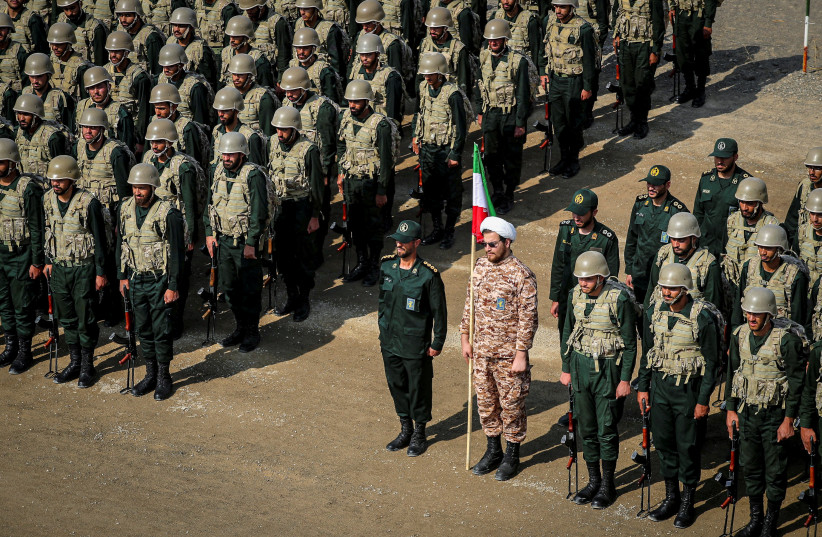
Iran fits this pattern. The country is no longer best understood as a revolutionary theocracy led by clerics. It is increasingly a security state dominated by the Islamic Revolutionary Guard Corps.
The IRGC controls the instruments of coercion, vast segments of the economy, intelligence services, and many of the country’s most important political institutions. It has repeatedly demonstrated that it is prepared to use overwhelming force against its own population to preserve its rule.
The regime has spent years adapting to sanctions. Rather than seeking prosperity, it has learned to survive without it.
As the Wall Street Journal recently described, Iran has become a “survival economy” – one structured to absorb prolonged external pressure through sanctions evasion, smuggling networks, informal trade, and tighter state control.
The objective is not growth. It is endurance.
A blockade makes that endurance more difficult, but does not end it. And at some point, the blockade will have a political expiration date.
Maintaining one requires an enormous and sustained American military commitment. Carrier strike groups, destroyers, intelligence assets, logistics, and regional force protection cannot remain concentrated around the Persian Gulf indefinitely.
The United States has global responsibilities and domestic political constraints. Over time, pressure will mount in Washington to reduce its military presence.
America’s allies will add to that pressure. The Strait of Hormuz is not simply Iran’s problem; it is the economic lifeline of America’s Gulf partners and a critical artery for the global economy.
Saudi Arabia, the United Arab Emirates, Qatar, and other Gulf states cannot indefinitely tolerate a stalemate that leaves their exports, infrastructure, and security under constant threat, while America’s allies in Europe and Asia absorb higher energy prices and disrupted trade.
What comes next?
Over time, the political pressure to end an open-ended blockade will become difficult for Washington to resist.
If the regime survives the blockade, Iran is likely to emerge with a dangerous new source of leverage. The IRGC has repeatedly demonstrated its ability to threaten shipping through the Strait of Hormuz.
If American naval forces are no longer present in overwhelming numbers, Tehran could repeatedly use that capability to intimidate its neighbors, disrupt global trade, and extract political or economic concessions.
In effect, the regime would have demonstrated that it can outlast American resolve and use Hormuz as a recurring source of regional and global leverage.
Israel should therefore see the blockade not as the endgame but as an opportunity – valuable, but temporary – to build a strategy capable of ending the threat at its source.
Economic pressure can buy Israel time. But time is valuable only if it is used to build the strategy the blockade itself cannot provide.
What comes next must be a comprehensive strategy aimed not simply at weakening Iran’s economy but at eroding the political foundations of the Islamic Republic. Success depends on attacking the regime’s sources of strength simultaneously rather than sequentially.
Israel should pursue four mutually reinforcing lines of effort, ideally in partnership with the US: expanding support for democratic opposition inside and outside Iran; widening fractures within the regime and particularly the IRGC’s ruling coalition; waging a sustained information campaign that exposes corruption, repression, and incompetence while undermining the regime’s legitimacy; and applying economic pressure with far greater precision against the IRGC’s commercial empire and the networks that sustain it.
Wherever possible, these efforts should remain indirect and discreet, since initiatives perceived as Israeli-backed are far less likely to gain credibility inside Iran.
None will succeed in isolation. Together they form a single integrated campaign, each reinforcing the others.
Israel has shown remarkable creativity in degrading Iran’s nuclear program and regional proxy network. It now needs to apply that same strategic imagination to the harder challenge of weakening the regime itself.
The Islamic Republic has spent nearly half a century proving it can survive hardship. Israel’s challenge is no longer simply to weaken Iran’s economy or slow its nuclear program.
It is to fracture the system that has survived every previous challenge to its power. Only that strategy offers a path to lasting security.
The writer teaches political risk at Johns Hopkins University’s School of Advanced International Studies and writes about and works on fragile states and political transitions.