‘Had we not acted against the existential threat, had we not acted with determination and daring, the names of the death sites Natanz, Fordow, Isfahan might have joined the names of the death camps of the Holocaust: Auschwitz, Majdanek, Treblinka.”
Prime Minister Benjamin Netanyahu made this chilling statement at the Yad Labanim ceremony in Jerusalem on the afternoon before Remembrance Day. The words are still ringing in my ears.
I was in the audience at Yad Labanim House not, thank God, as a war widow or bereaved mother. For me, the sacred passage between Remembrance Day and Independence Day begins with the ceremony for the victims of the Hadassah convoy. On April 13, 1948, seventy-eight women and men, among them Holocaust survivors, were murdered on their way from downtown Jerusalem to Mount Scopus, where the hospital and the Hebrew University stood.
Every year, together with the children and grandchildren of the victims, representatives of Yad Labanim are there, too, the support organization for fallen IDF soldiers and victims of terrorism. They invite my Hadassah colleagues and me to their ceremony, which opens the national observances of Remembrance Day.
Getting in is difficult, even with a personal invitation. I understand. The prime minister is there. Security has to be strict, even stricter than at Ben-Gurion Airport. Despite my long years in Israel, every now and then when I am flying out of the country, a youthful security person at the airport hears my lingering American accent and asks me to name my grandchildren who live in Israel. After I get through half the blessedly long list, all with biblical or modern Hebrew names, he or she laughs and lets me go.

The frosty young woman who questioned me at the security tent in front of Yad Labanim’s building in Sacher Park asked me to name fallen soldiers or murdered civilians. She let me through after hearing a few names, but the experience was unsettling. An only-in-Israel moment, and not one to treasure.
Still, the questioning was worth it because the ceremony was poignant, meaningful, and inspiring. Netanyahu was speaking both as prime minister and as the bereaved brother of Yoni Netanyahu, killed in the Entebbe rescue, 50 years ago this year.
Auschwitz, Majdanek, Treblinka. The shadow of the Holocaust is always present. Even in private moments of self-pity or foolishness, I have found myself silently reciting the names of the camps, as if they could summon me back to proportion.
Hadassah professors honored on Independence Day
So when two Hadassah professors were honored on Independence Day, I could not help noticing that both are second generation, children of Holocaust survivors.
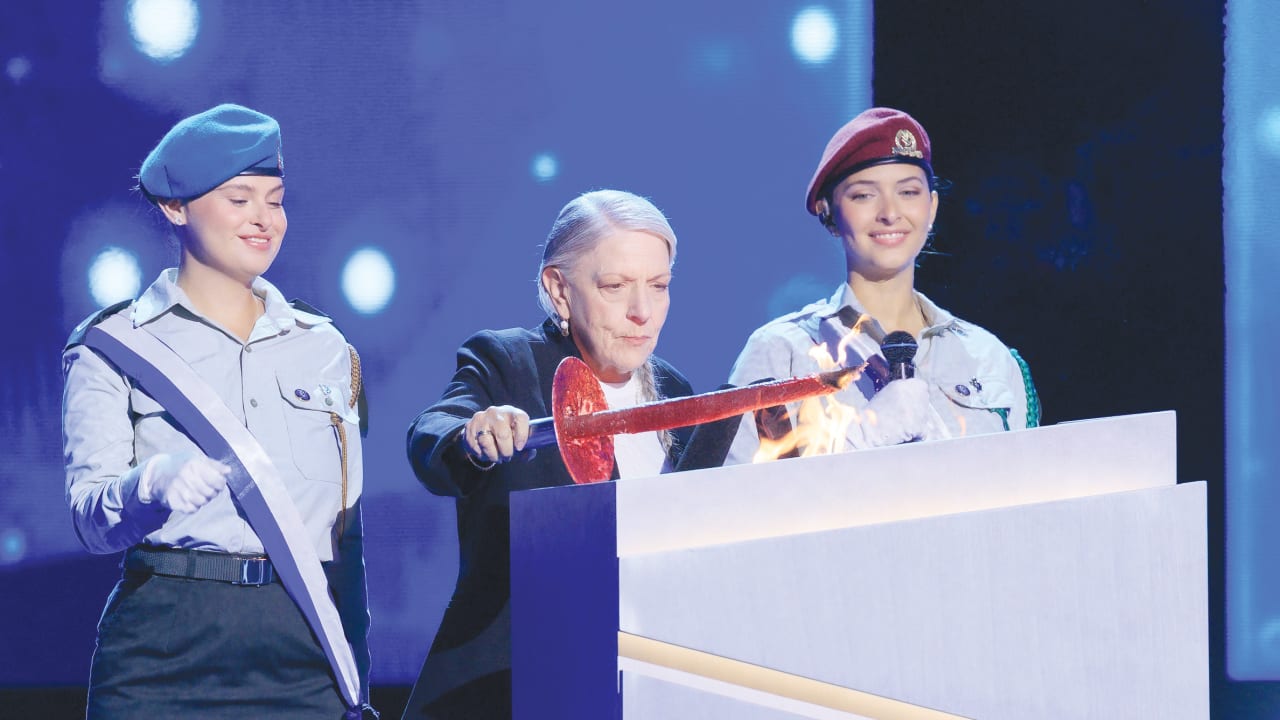
Prof. Dina Ben-Yehuda, who lit a torch on Independence Day, was a universally praised choice. She is a world-renowned hematologist and the brilliant, ethical head of the committee that decides which medicines go into the health basket for Israel’s 10 million citizens. She is known not only for her genius but also for her compassion.
As a medical educator, Ben-Yehuda teaches young doctors to stop searching for answers on their cellphones instead of touching and speaking to their patients. As a soldier, she initiated the military support system for bereaved families. Her mother was a Holocaust survivor. Her grandmother survived Auschwitz. “She only saw the good in people,” Ben-Yehuda said.
The last national event of Independence Day is the awarding of the Israel Prize to men and women whose achievements have shaped this country. This year, among them was Prof. Avi Rivkind, a giant in Israeli trauma medicine.
It seems almost impossible to believe that Israel once had no trauma units, until Rivkind actively sought support from the women of Hadassah to open the first. Today, trauma units are spread across the country. Imagine how many lives have been saved.
Rivkind also ran a safe driving initiative at Hadassah, inviting high school students to see real images of peers who had driven too fast and too carelessly. During the Second Intifada, he was recognizable on television in Israel and abroad, including on 60 Minutes. I remember a wounded soldier recognizing Rivkind when he was doing triage at the entrance to the emergency room. “I fell into good hands,” the soldier said with relief.
Rivkind is known for heroic efforts that go beyond the textbooks, and for urging others to do the same. I was present one Friday afternoon during the Second Intifada when a group of experts encircled the bed of a terror survivor about to go into surgery. “Can anyone think of anything else?” he asked.
Rivkind is the only child of Holocaust survivors. Both of his parents were saved by Righteous Gentiles.
Chosen to speak for all the recipients of the Israel Prize, Rivkind, sometimes the blunt Sabra, was eloquent. Here are a few excerpts (translated from the Hebrew):
“More than once I stood in front of human suffering. There, I learned that there is a single moment, a split second, when in front of me is a wounded person I must save. In that moment, there is no room for doubt, only to fight, always to fight.”
“My journey did not begin in the operating room but much earlier, with the harrowing story of my parents, of blessed memory, who lost their entire families in the Holocaust. From my parents’ home, the mission of my life was born, and I chose to practice medicine.”
“Indeed, I have seen the worst that can happen to the human body, but I have also seen the best that can happen to the human heart.”
He credits his belief that every human being will choose life, no matter how dire the trauma, to Rabbi Menahem Mendel of Kotzk, of whom he is a descendant.
“In a world where we are all experts in investments, options, and exits, I tell you there is no greater exit than bringing a person back to life.”
Rivkind’s most famous case, the rescue of border policeman Shimon Ohana in 2000 after he had been declared dead, deserves a column of its own. I plan to tell that story in my next column.
The writer is the Israel director of public relations at Hadassah, the Women’s Zionist Organization of America. Her latest book is A Daughter of Many Mothers, cowritten with Holocaust survivor and premier English-language witness Rena Quint.