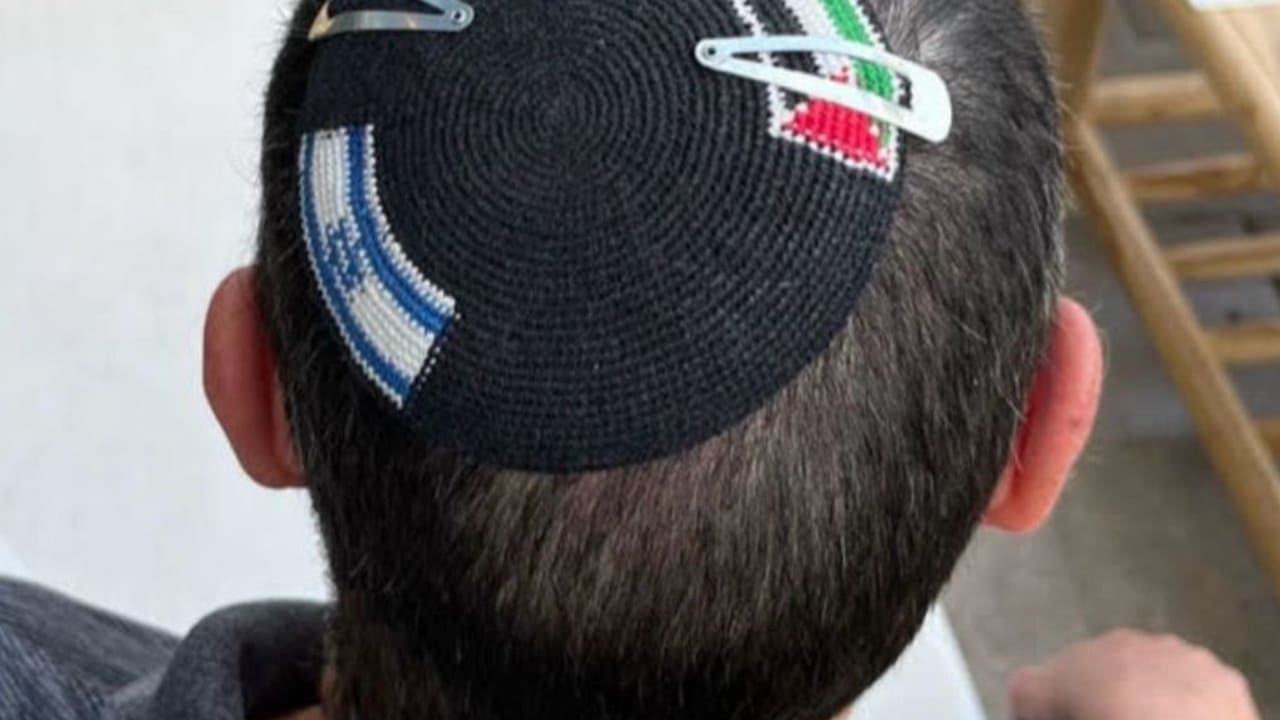
A religious man wearing a kippah is sitting in a café in Modi’in, sipping coffee and working on his laptop.
End of story? Not quite.
For nearly two decades, Dr. Alex Sinclair has worn a kippah embroidered with two flags side by side: an Israeli flag and a Palestinian flag. This week, a total stranger confronted him in the café, and within minutes, two police officers arrived at the scene, detained him, and marched him off to a cell.
Eventually, Sinclair was released, but only after returning his kippah with the Palestinian flag cut out of it. I came to know Alex some years ago through a joint program and found him to be thoughtful and moderate, an educator who posed no threat to anyone.
I write this as the CEO of an organization rooted in religious Zionism, characterized by a deep-seated conviction that the values of Torah are fully aligned and go hand in hand with those of moral leadership, social responsibility, and democracy.

For me, my kippah is a daily statement of these values.
Many will differ as to the specific kippah Sinclair chose to wear. No problem. Political debate in this country is necessary, and a range of views – from the Right and from the Left – deserves to be heard and debated.
But whatever one makes of Sinclair’s choice, we know that something has gone seriously wrong when the police feel empowered to take scissors to a Jew’s head covering because of the views it expresses. Sinclair’s detention should deeply trouble every Jew who loves this country.
A very troubling situation
It should trouble us on three levels.
First, as Jews. Israel was founded so that a Jew could walk down the street wearing whatever he chooses on his head, expressing whatever convictions live in his heart, without fear. The image of a police officer taking scissors to a Jew’s kippah should stop us cold.
For centuries, across many countries, Jews were dictated to as to what they could wear and what they could believe. The Jewish state was meant to be the place where that era ended, not where it returned in a new form.
The Jewish people are not monolithic. We hold a tradition of argument, of prophets and rabbis and dreamers who have always disagreed, sometimes fiercely, about the meaning of our Jewish belief and belonging. There are many Jews in Israel and around the world for whom the pursuit of peace is not a political preference but rather a religious calling.
When the police, under the authority of National Security Minister Itamar Ben-Gvir, treat such convictions as criminal, they do not merely violate civil liberties. They also narrow down what it means to be a Jew in the Jewish state.
A country that can only make room for the Judaism of the governing coalition is not realizing its mission as the state of the Jewish people; it is the state of only some among them.
Democracy at risk
Second, as citizens of a democracy. Throughout the attempts at a judicial overhaul, the current government sought to reassure the public that even as it worked to revamp the judicial system, individual rights and freedoms would remain protected.
Here is where that reassurance meets reality. A police force that detains a citizen and destroys his personal property because of a symbol on his kippah is precisely the kind of abuse that strong democratic safeguards exist to prevent.
Sadly, Sinclair’s detention is not an isolated anomaly. It is just one visible incident that is part of the daily pressures and threats to Israeli democracy – threats that many citizens feel but that too often go unaddressed.
Each and every Israeli who is committed to preserving this country as a democracy, regardless of his or her politics, must recognize how fragile those safeguards have become.
Third, as a state facing enormous challenges. After two-and-a-half years of war, one thing is painfully clear: Israel must have the wisdom, creativity, and fresh thinking to navigate the formidable security, diplomatic, and social challenges it faces.
No single political camp holds a monopoly on how to surmount these challenges. On the contrary, true creativity emerges from the crucible of genuine disagreement – from citizens who see things differently sitting together around the table and thrashing it out.
When police officers become the arbiters of which opinions may be expressed in public, they don’t just silence individuals – they stifle and smother the discourse that must underlie Israel’s future. A culture of fear is the enemy of the resourcefulness and creativity this country so desperately needs.
When I think of Alex sitting alone in a cell, his kippah taken and about to be mutilated, I have a sense of profound sadness.
At the same time, I also think of what happened in the hours and days afterward: the many Israelis, religious and secular, from across the political spectrum, who were outraged on his behalf. That outrage is itself a sign that the Israel we believe in is still very much alive.
Israel must be Jewish, democratic, and creative. In that café in Modi’in, the police trampled all those values. The next government must place the Israel Police in the hands of those who understand their role is to protect citizens, not to police their beliefs.
Until then, we who love this country have a job to do.
The writer is the CEO of Kolenu, a religious-Zionist organization working to support the values of Torah, moral leadership, and social responsibility.