Displaying a Palestinian flag is not explicitly illegal under Israeli law. Police are authorized to remove flags if they deem them a threat to public order, a symbol of support for terrorism, or a “breach of public peace.”
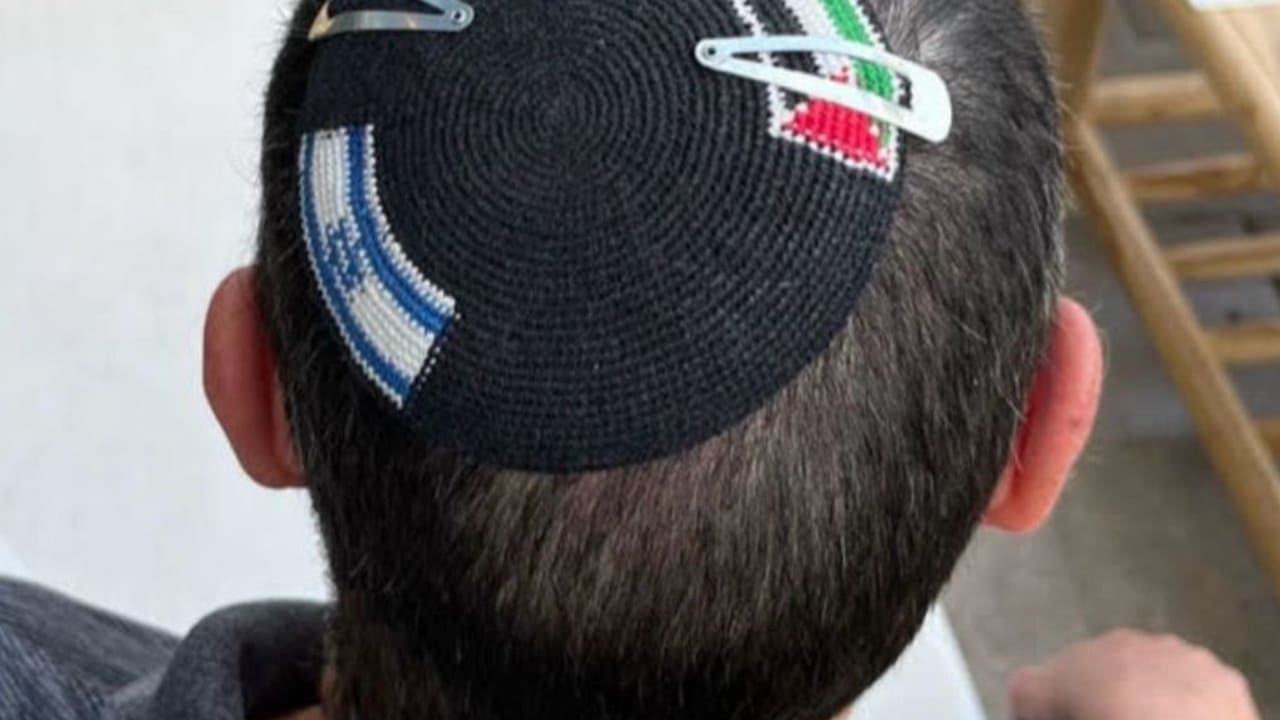
The Palestinian flag (alongside an Israeli flag) crocheted into the kippah of Alex Sinclair, the Modi’in resident at the center of a storm that has received international attention, did not pose any of those problems. It wasn’t a threat to public order; it wasn’t a symbol of support for terrorism or a breach of public space.
To recap the incident, Sinclair, originally from England and a self-described peace activist, was sitting in a Modi’in café when another patron complained about it, informing him that his kippah, bearing both the Israeli and Palestinian flags, was against the law.
With the issue unresolved, two police officers arrived and told Sinclair that his head covering was being confiscated. He was then taken to the Modi’in police station and held for 20 minutes. When the police released Sinclair, they informed him that his kippah had been confiscated and threatened to put him back in the cell if he didn’t leave without it.

Police returned the kippah, with the Palestinian flag cut out
When Sinclair continued to demand that his property be returned, the police relented and gave it back to him but only after cutting out the Palestinian flag.
Sinclair wrote about the incident in a Facebook post, saying that the police had “taken my possession, a religious ritual object, something that is very dear to my heart, and destroyed it.” The post went viral, and media ranging from CNN to the BBC have subsequently reported on the incident.
Any chance to portray Israel as an intolerant police state is seized by the international media, and unfortunately, this time, the police have given them ample material.
Democrats MK and Reform rabbi Gilad Kariv, who attended a protest rally Saturday night outside the Modi’in police station, responded to the incident, saying, “If police officers had cut off a Jew’s kippah in any other country in the world, there would have been an uproar here in Israel.”
Clearly, sporting a Palestinian flag, whether on a kippah or any piece of clothing, is outside of the mainstream in Israel. Perhaps, considering it was Palestinians who planned and implemented the October 7 massacre, the worst against Jews since the Holocaust, it’s even more insensitive and inappropriate.
But its confiscation and defacement by police officers last week reflect the overreaching arm of the law that allows the Israel Police to arrest people without warrants and confiscate individuals’ possessions.
There are those who blame National Security Minister Itamar Ben-Gvir for this type of behavior. Others see this as another reason to promote judicial reform, blaming the Israeli legal establishment for the situation of law enforcement in Israel.
That said, soon after being named national security minister in January 2023, Ben-Gvir told Israeli police officers to exercise wide latitude in removing Palestinian national flags from public places to preserve public order.
Most Israelis realize that a two-state solution that originated with the Oslo Accords in the 1990s is as far off as it’s ever been, especially after October 7, 2023. However, many still recognize that, in the end, there will be some sort of solution involving the Palestinians.
A shared homeland
“I’m a Zionist, and I believe in the Jewish people’s right to self-determination in this part of their historic homeland,” Sinclair told JTA. “And I also think that the Palestinians are also people who have a right to self-determination in part of this place, which is also their historic homeland.”
But beyond whether or not you agree with the ideology, both of which are valid and should be encouraged in a free, democratic society, the issue that Israel needs to grapple with is the increasingly draconian measures the police implement against those who veer from the path that the government has set.
This is exemplified in cases of excessive police violence at demonstrations where people protest against the government, as well as in arresting anyone the attorney general thinks will assist in taking down Prime Minister Benjamin Netanyahu.
The case of Sinclair and his kippah can’t be treated as an isolated incident; it is not. It should be treated as a symptom of an underlying sickness that must be remedied before it’s too late.