
Morid ha’tal. According to many customs, these words are inserted at the beginning of the second blessing of the thrice-daily Amidah prayer, starting with the Mussaf prayer on the first day of Passover.
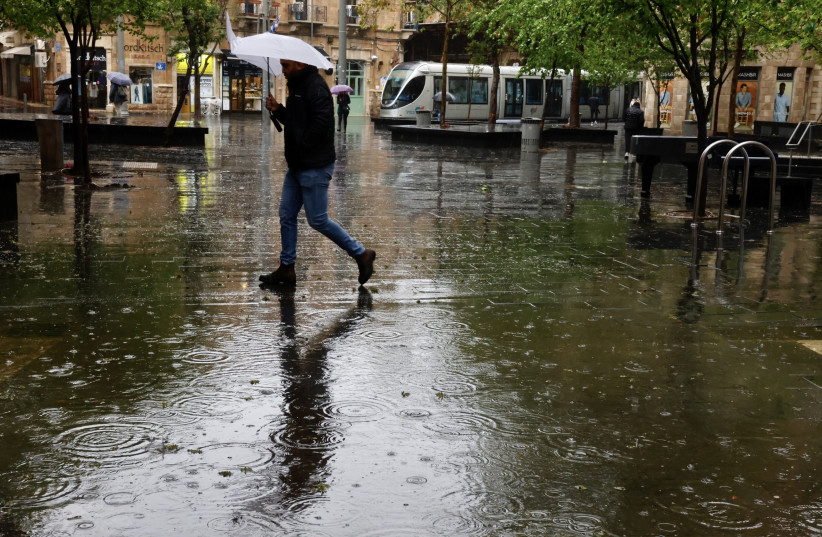
The basic meaning is clear. In the climate of the Land of Israel, we pray for rain in the winter so that there may be sufficient water to drink throughout the year. But starting in the spring, when the rains cease, our prayers shift to a request for dew.
But there is a deeper meaning as well – one that sheds light on the Jewish people’s recent history and bears lessons for the present.
Spiritual rains
The prayer for rain – mashiv ha’ruah u’morid ha’geshem – begins in the autumn after the holiday of Sukkot. Rather than physical rain, which is requested later in the Amidah, this refers to spiritual rain. We pray that the blessings and energy that flow from our repentance and joy during the month of Tishrei will accompany us through the long winter ahead.
Mashiv ha’ruaḥ opens the blessing highlighting God’s faithfulness. Among the many divine attributes listed in the blessing is matir asurim: God frees the bound.
The final day of Sukkot is known as Hoshana Raba – a “great salvation.” One could not imagine a more appropriately named day for the last remaining hostages in Gaza to have secured their freedom. God’s enveloping presence is felt during Sukkot more than any other time of the year, when we immerse our entire bodies in the sukkah. This presence was keenly felt by anyone who watched the videos of hostages reunited with their families after two years in captivity.
More recently, the US-Israeli attack on Iran began on Shabbat Zachor, when intelligence surfaced indicating that a window had emerged to assassinate Iran’s supreme leader Ali Khamenei. This special Shabbat, which immediately precedes the celebration of the Jewish people’s survival of Haman’s evil decree on Purim, is when we fulfil the annual requirement to remember Amalek’s attack on the Jewish people after they left Egypt.
Given that the descendants of Amalek are no longer identifiable, today we focus on combating our “inner Amalek.”
Nonetheless, it brought many comfort to witness firsthand that those who wish harm upon the Jewish people will incur the same fate as Haman did in Achaemenid Persia.
Spiritual dew
Passover falls one month after Purim. We replace mashiv ha’ruaḥ with morid ha’tal, the prayer for dew. We begin our annual journey anew, taking our first steps out of Egypt and celebrating our coming into being as a people.
During the Seder, we thank God for taking us “from sorrow to joy, from mourning to festivity, from deep darkness to great light, and from bondage to redemption.” This year, it felt as if these words referred to current events rather than to the Exodus.
This was the first Seder since the release of the last hostages. Those of us who lived through the horrors of October 7 yet who also witnessed the subsequent deaths of those who sought our destruction now have first-hand experience that “in every generation they rise against us to destroy us; but the Holy One, blessed be He, saves us from their hand.”
Passover is unique among the Jewish holidays in that it features a holy day both at the beginning and at the end of the festival. On the first day, we celebrate our physical liberation from Egypt. But on the last day, we celebrate our spiritual liberation.
On the last day of Passover, we recall the splitting of the sea not as a historical event, but rather as a symbol of the fact that – by drowning them in the sea – God rescued us from the fear that the Egyptians would continually pursue us. Ever since, it has become a day for us to conquer – as individuals and as a people – our own fears and anxieties.
The juxtaposition of this day with the morid ha’tal prayer teaches us that we must take the first step in conquering our fears, just as we are told that Nahshon ben Aminadav took the initiative to jump into the sea before it split. God’s blessings are not yet raining down as they do after Sukkot, thanks to six months of spiritual work. We must be courageous enough to move forward and confront an uncertain future head-on.
An uncertain future
It was therefore highly appropriate that the final day of Passover saw the announcement of a ceasefire, whose outcome remains uncertain.
Having successfully obstructed traffic through the Strait of Hormuz, Iran enters these talks with considerable leverage and confidence. Israel’s post-October 7 strategy of depriving its adversaries of any threatening capabilities, rather than attempting to divine their intentions, has encountered a roadblock. A correction is overdue – one that acknowledges that security can only be relative and not absolute.
I find it deeply moving that, for a people with such a rich past, Judaism is so deeply focused on the future. As we say on Seder night, “This year we are slaves, but next year we will be free.” Each of us has their own personal Egypt – their own imperfections and insecurities – that we strive to overcome.
For Israel, the task at hand is to confront the trauma of October 7 and help to shape a more durable and less zero-sum regional architecture. Jerusalem should explore to the fullest the possibility for peace with Lebanon and acknowledge that the emergence of a balance-of-power system in the Middle East comes with risks, yes, but also opportunities.
To cross the proverbial sea, Jews must embrace their role as shapers rather than victims of history. This is a perennial lesson, for as the Haggadah says, each generation must see itself as though it were the one to leave Egypt. The rest is up to God.
The writer is a Canadian international relations scholar and foreign policy professional. He lives in Geneva with his wife and three children.