The world debates Israel every day on television panels, in newspaper columns, and across social media feeds – voices raised, arguments sharpened, and moral judgments delivered with confidence.
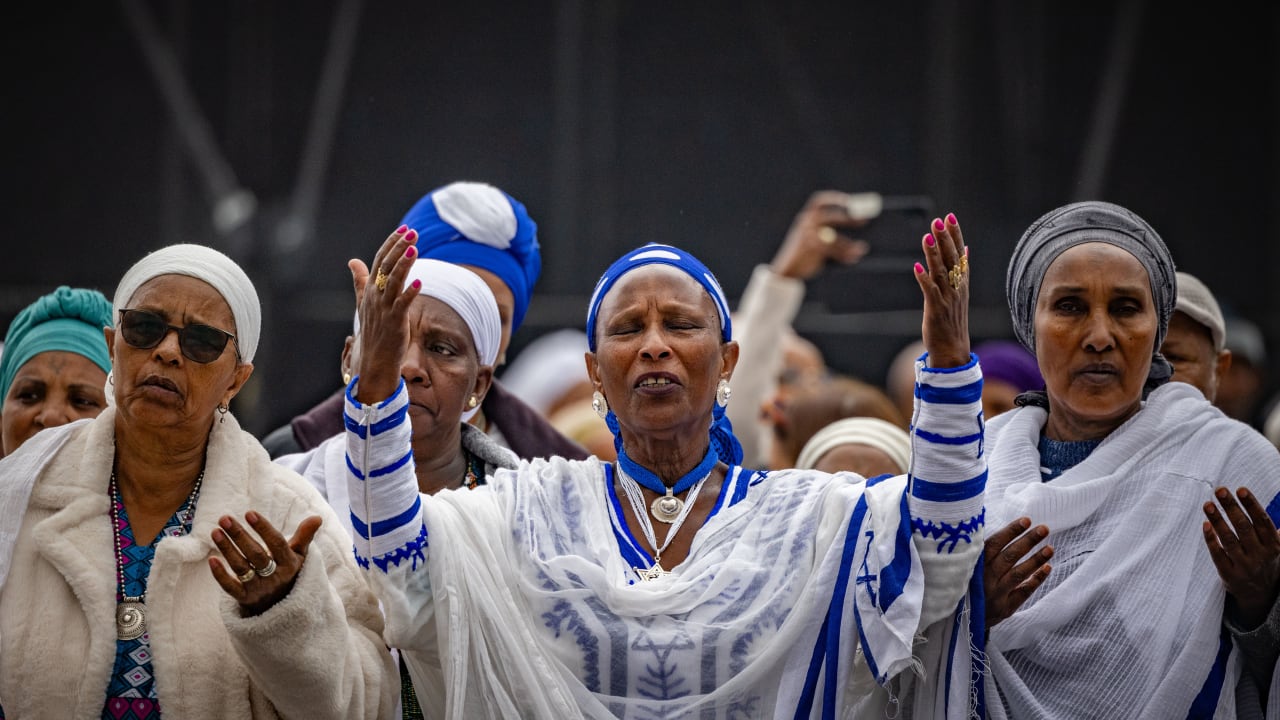
Yet in all this relentless conversation about identity, justice, and conflict, one absence remains both glaring and persistent: the voices of Black Jews, of African Jews, of Ethiopian Israelis who are not observers of this story but participants in it.
This absence is not accidental. It is patterned, repeated, and increasingly difficult to ignore.
Turn on CNN or Fox News, watch the BBC, scroll through The New York Times or the Los Angeles Times, or listen to the loud, confident debates that dominate platforms like Sky News or the commentary circuits of figures such as Piers Morgan, and you will hear endless analysis about Israel, about Jews, about race and power and morality.
But you will rarely – if ever – hear from Black Jews themselves.
Not from the Ethiopian Israelis whose ancestors prayed toward Jerusalem long before political Zionism had a name.

Not from African-born Jews who carry both the memory of exile and the reality of return. Not from Black Israeli citizens whose very existence challenges the simplified narratives the world continues to repeat.
We are not missing because we are invisible. We are missing because we are inconvenient. Global media depends on clean, simplified narratives that can be quickly understood and easily consumed.
Challenging simplified narratives
Israel is cast one way, Jews another, and conflict is reduced to familiar binaries that flatten complexity into something manageable. But Black Jews do not fit these frames. We complicate them.
We disrupt the assumptions about race, identity, and belonging that underpin so much of the global conversation.
We force a deeper, more uncomfortable question: what does it mean when the people the world describes in one color actually exist in many? And instead of expanding the narrative to include that truth, the narrative contracts, leaving us outside of it.
The cost of that exclusion is not symbolic. It is substantive. A conversation about Israel that excludes Ethiopian Jews is not simply incomplete; it is misleading. A discussion of Jewish identity that ignores African Jews is not just narrow; it is inaccurate.
A moral debate that claims universality while overlooking entire communities is not a debate at all; it is a performance.
And performance, repeated often enough, becomes perception, shaping how audiences understand conflict, how policymakers respond to it, and ultimately whose suffering is seen and whose allowed to remain invisible.
So the question must be asked, repeatedly, until it can no longer be avoided: when rockets fall, when sirens sound, and when families run to shelters in fear – why are some lives amplified while others are absent from the story?
Why are some voices considered authoritative while others are never even invited into the conversation? Why, in a global media landscape that prides itself on diversity and inclusion, does that inclusion seem to stop precisely where complexity begins?
Western media often presents itself as a champion of marginalized voices, as a corrective to historical exclusion, and as a platform where the unheard can finally be heard. But inclusion cannot be selective.
It cannot expand to accommodate certain narratives while contracting to avoid others. It cannot celebrate diversity in principle while resisting it in practice.
And yet, there are moments that suggest a different possibility. There are instances when publications like The Washington Post have shown a willingness to widen the frame, to include voices that do not fit neatly into established categories, and to engage perspectives that complicate rather than confirm.
This is not praise for its own sake; it is recognition of what is possible when editorial choices are guided by curiosity rather than convenience. It is proof that inclusion is not an abstract ideal but a practical decision.
What is needed now is not symbolic gestures, but structural change.
A recognition that lived experience is not secondary to analysis but a form of expertise in its own right. A commitment to seek out voices that have been historically overlooked, not as an act of charity, but as a matter of accuracy.
This is not a request to be invited into the conversation. It is a demand that the conversation reflect reality. We are not outsiders to this story. We are not footnotes or exceptions.
We are part of the fabric of Israel, part of the global Jewish experience, part of the human story that the media claims to tell. We are Ethiopian Jews who carried Jerusalem in our prayers for generations.
We are Black Israeli citizens raising families, contributing to society, and living the same complexities that are so often described without us.
We are here. We have always been here. And until our voices are included not occasionally, not symbolically, but consistently, the story the world tells about Israel will remain incomplete, not because something is missing, but because someone has been left out.
The credibility of global media will not ultimately be judged by how loudly it speaks but by how honestly it listens.
And listening, if it is to mean anything at all, must begin by acknowledging those whose voices have too long been ignored. Only then can the conversation move from performance to truth.
The author is a former NYC Supreme Court detective, and an investigator and educator in conflict resolution, restorative peace, and moral diplomacy expert. His upcoming book, Moral Diplomacy for a Broken World, is inspired by Rabbi Jonathan Sacks.