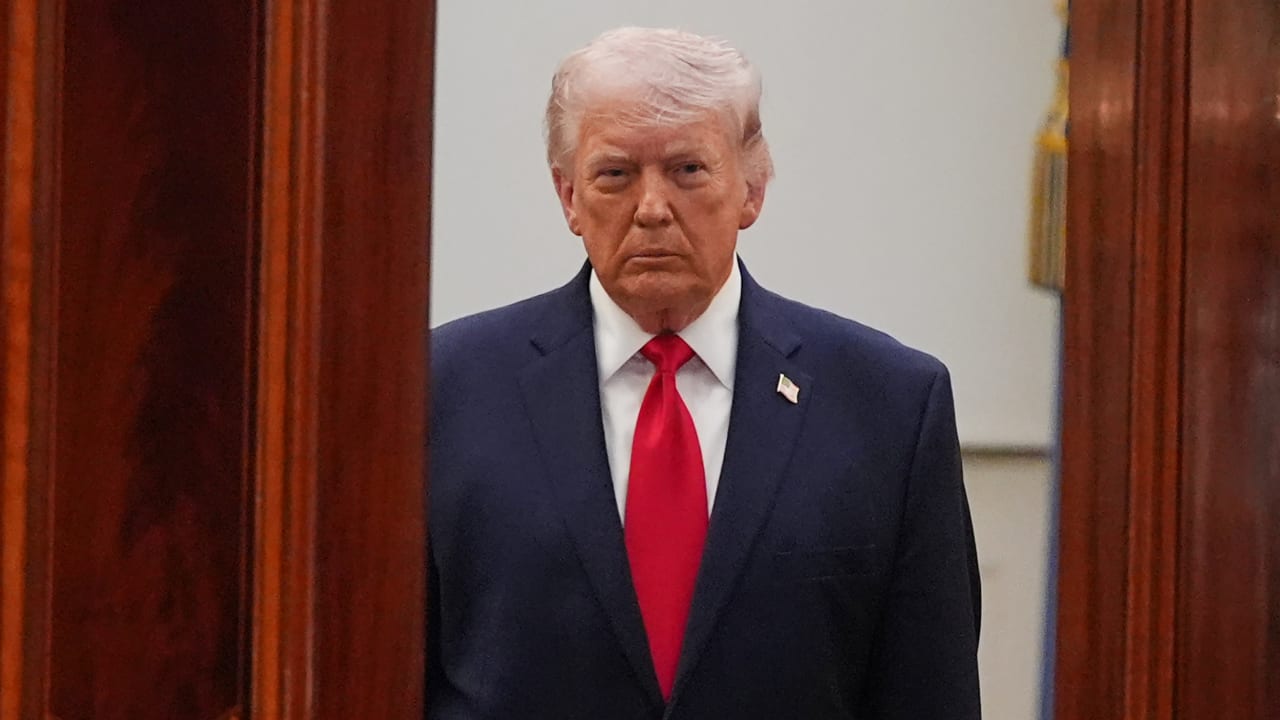
In his 19-minute address to Americans on Wednesday evening, US President Donald Trump did little to clarify the war’s aims or America’s next move in Iran. Instead, he went with the pattern of contradictory statements that left key allies, above all Israel, with more questions than answers.
The speech was meant to reassure an American public worried about rising oil prices and explain why the White House joined Israel in launching strikes against Iran. In actuality, it deepened uncertainty about what Washington is trying to achieve and whether its goals are shifting in real time.
Trump, who called for the fall of the Islamic Republic on the very day he and Prime Minister Benjamin Netanyahu launched strikes on Iran, now said that regime change was never a goal. Moments later, he suggested that such a change had effectively already taken place because so many of Iran’s senior leaders had been killed.
Earlier on Wednesday, Trump wrote on Truth Social that Iran’s “new leader” had asked the US for a ceasefire. Only hours later, the American president warned that the US would begin striking electric plants “very hard” if Tehran did not agree to a deal.
He also claimed that the new leadership in Tehran was “less radical and much more reasonable,” an assertion that so far has not been matched by action.

Trump’s comments on the Strait of Hormuz were similarly muddled. He tried to calm concerns by saying the US had “never been better prepared economically to confront this threat.”
Yet he also signaled earlier this week that Washington would agree to a ceasefire once the Strait of Hormuz is “open, free, and clear.” It remains unclear whether reopening the strait is a condition for talks, a strategic objective in itself, or simply one more talking point in a fast-moving crisis.
Trump distances US from responsibility for Strait of Hormuz
Simultaneously, Trump appeared to distance the US from direct responsibility for what happens there.
“The United States imports almost no oil through the Hormuz Strait and won’t be taking any in the future. We don’t need it,” Trump said.
He then shifted the burden to America’s allies, saying they should take the lead in protecting the oil route on which they depend.
The speech did succeed in one respect. It was among Trump’s clearest efforts yet to explain to the American public why he launched Operation Epic Fury alongside Israel.
Citing Iran’s role in the deaths of hundreds of American troops in the Middle East, its support regarding Hamas’s October 7 massacre, and the killing of “over 45,000” demonstrators during January’s protests, Trump argued that an Iranian nuclear weapon would pose “an intolerable threat.”
“The most violent and thuggish regime on earth would be free to carry out its campaigns of terror, coercion, conquest, and mass murder from behind a nuclear shield,” he said. “I will never let that happen.”
That is a serious and persuasive reason. But Trump also said that America’s “core strategic objectives are nearing completion,” without explaining what that means in practice.
This omission matters far more than the style of the contradictions. It goes to the heart of whether Israel is being asked to stop before the threat it faces has been fully and durably reduced.
Suppose the US and Israel have concluded that toppling the regime is no longer an attainable objective; that still does not justify ending the campaign based on slogans, confusion, or wishful thinking. Iran’s rulers have survived pressure before. They have been rebuilt before. They have lied before.
That is why Israel cannot afford to measure success by speeches from Washington or promises from Tehran. It must measure success by capabilities destroyed, command structures broken, and the regime’s ability to threaten Israel meaningfully reduced.
A ceasefire that leaves Iran with room to recover will invite the next war. A deal that lacks enforcement will be treated in Tehran as time gained rather than danger avoided. The lesson of the past two decades is clear enough: when the Iranian regime is given space, it takes advantage of it.
Washington has every right to define its own interests. Israel has every obligation to defend its own survival. At this stage, these two notions will remain aligned only if the United States understands a simple fact: unfinished work in Iran will not produce stability. It will produce a countdown.