Since the military escalation between Iran, Israel, and the United States, one question has been repeatedly raised: could Russia intervene alongside Tehran?
The idea is plausible. In recent years, Moscow and Tehran have significantly strengthened their cooperation, particularly in the military sphere. Iran has supplied drones used by Russia in the war in Ukraine, while the two countries often present themselves as partners in challenging the Western-dominated international order. In this context, some observers speak of the emergence of a genuine “Russo-Iranian axis.”
Yet this interpretation simplifies a more complex strategic reality. As several analyses by the Carnegie Endowment for International Peace and the Center for Strategic and International Studies point out, the relationship between Russia and Iran is closer to a pragmatic partnership than to a structured alliance.
Historically, the two countries have more often been rivals than allies. Since the 19th century, imperial and later Soviet Russia and Iran have competed for influence in the Caucasus and Central Asia. This mistrust has never completely disappeared.
Several Russian analysts themselves emphasize the limits of this rapprochement. Andrei Kortunov, former director of the Russian International Affairs Council (RIAC), regularly notes that Moscow and Tehran share tactical interests but not necessarily a common long-term strategic vision.
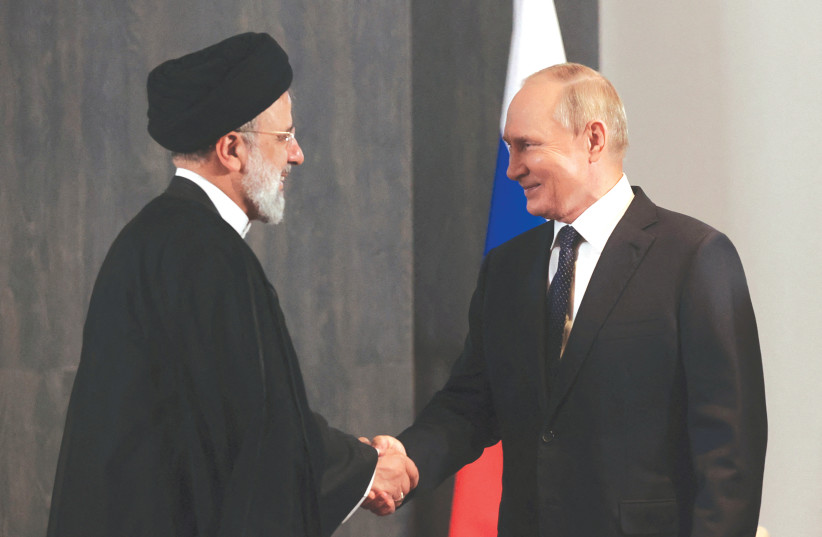
Likewise, Dmitri Trenin, long-time director of the Carnegie Moscow Center, argues that Russia views Iran as a useful partner in the regional balance of the Middle East, but not as an ally in the traditional sense of the term.
Long-term partnership between Russia, Iran
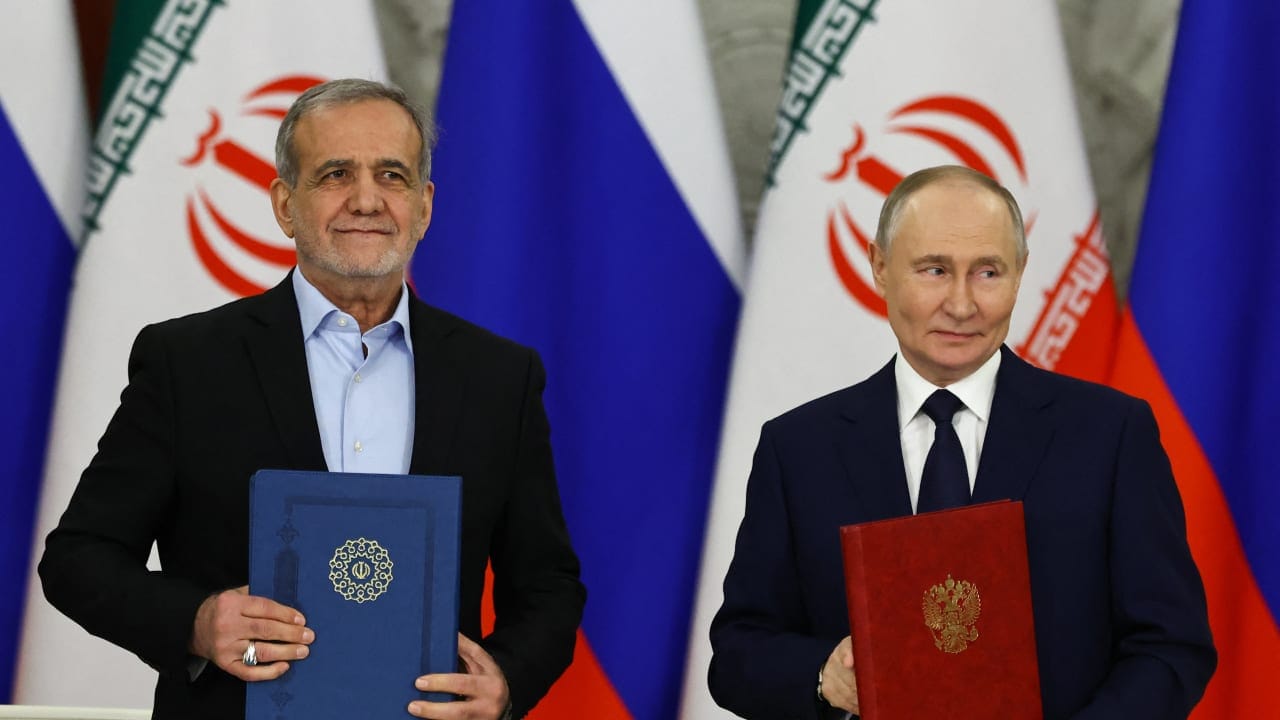
This caution appears clearly in the institutional arrangements between the two countries. In 2025, Moscow and Tehran signed a long-term strategic partnership. However, this document contains no clause of mutual defense. In other words, from a military standpoint, Russia is under no legal obligation toward Iran.
Another decisive factor, often overlooked, lies in the relatively close relations that Russia maintains with Israel. Since the early 2000s, Moscow and Tel Aviv have developed a regular strategic dialogue. This is partly explained by significant human and cultural ties: more than one million Israeli citizens originate from the former Soviet Union.
But Russian-Israeli cooperation took on a concrete military dimension beginning in 2015 with the Russian intervention in Syria. The simultaneous presence of Russian and Israeli forces in the same strategic space led the two countries to establish a military coordination mechanism designed to avoid any incident between their armed forces. Thanks to this arrangement, Israel has been able to carry out numerous strikes against Iranian positions in Syria while maintaining an operational dialogue with Moscow.
As Fyodor Lukyanov, editor-in-chief of the journal Russia in Global Affairs and a central figure of the Valdai Discussion Club, observes, Russia’s strategy in the Middle East consists precisely in maintaining functional relations with all regional actors – including those that are in conflict with one another.
This approach corresponds to what several Russian scholars describe as a “diplomacy of balance.” Moscow’s objective is not to build an ideological bloc, but to preserve maximum freedom of maneuver in a fragmented regional environment.
This logic is also defended by the Russian strategist Sergei Karaganov, associated with the Russian Council on Foreign and Defense Policy. According to him, Russia must avoid any direct military involvement in regional conflicts that could draw it into a frontal confrontation with the United States. Moscow’s strategic priority is to consolidate its status as a great power capable of maintaining dialogue with all parties.
In this context, direct Russian military engagement alongside Iran against Israel and the United States appears unlikely. Such a decision would not only compromise Russian-Israeli relations but could also provoke a major strategic escalation with Washington. Yet despite the confrontation between Russia and the West, Moscow continues to seek to stabilize its strategic relationship with the United States to avoid a direct confrontation between nuclear powers.
This does not mean, however, that Russia will remain entirely outside the conflict. Moscow could provide Iran with limited and discreet support, particularly in the fields of intelligence, technological cooperation, or certain specific military capabilities.
Such exchanges already exist in other contexts. But everything suggests that Russia will seek to avoid any direct involvement in a war capable of upsetting the global strategic balance. Russia is therefore likely to continue following the line that has characterized its diplomacy in the Middle East for a decade: supporting certain partners while maintaining relations with their adversaries.
In a regional environment marked by instability and rivalry among great powers, this strategy of balance allows Moscow to preserve its influence without being drawn into conflicts that do not directly serve its fundamental interests.
A former Russian ambassador to Colombia, the writer has held senior positions in the Soviet and Russian foreign ministries, as well as at the United Nations. Based in Paris, he is now a consultant in international affairs.