
The war on Iran’s Islamist leaders had hardly begun when its broad opposition emerged, an eclectic lot that splits into three groups: losers, cynics, and fools.
The losers are Russia and Turkey.
Russia is a major loser in this war, despite its absence from the battlefield of this conflict. Moscow and Tehran became close allies in recent years, especially after the outbreak of the Ukraine war. Iran supplied Russia with thousands of drones, which Russia unleashed extensively.
The ayatollahs’ help was crucial for Russia’s poorly supplied war effort. Iran thus had the right to expect Russia to come to its aid, now that the ayatollahs were attacked head-on. Moscow knew this and was quick to release a lengthy statement fully taking Iran’s side.
“Please accept my condolences,” wrote President Vladimir Putin to his Iranian counterpart, referring to the slain Ali Khamenei, “an outstanding statesman” whose killing was “committed in cynical violation of all norms of human morality and international law.”
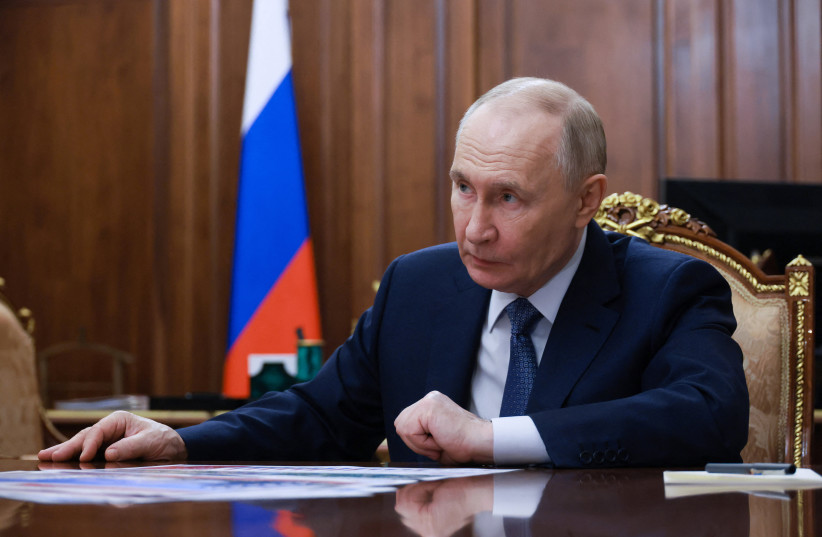
Russia's alliance does not deliver
Never mind the laughability of such crocodile tears shed by a man who has bombed Ukrainian cities, poisoned opposition leaders, and liquidated members of the press. The real cynicism lay in the fact that this statement was all Putin was prepared to offer his embattled ally.
Like the fallen leaders of Syria and Venezuela before them, the mullahs now see that Russia’s alliance, when it is needed most, delivers zilch. That is why the lamentation at the UN by Russia’s envoy, that “Tehran was stabbed in the back despite its willingness to engage in diplomacy,” impressed no one, least of all the mullahs themselves.
Even so, Putin’s opposition to the war on Islamic Iran could not be more sincere. He really resents America’s conviction, efficiency, and resolve.
That also goes for Turkey’s response to the war that broke out to its east.
The attacks in Tehran, protested President Recep Tayyip Erdogan, “violated Iran’s sovereignty and endangered its people.” This concern for sovereignty comes from the man who occupies one-third of Cyprus, as well as handsome chunks of Syria, just like his concern for war’s innocent victims comes from the man who bombed Kurdish villages on both sides of his border with Iraq.
Erdogan’s real concern is that an American-led defeat of Iran would deal a blow to the Islamist ideology that has been the engine of his career, even though he, unlike Shi’ite Iran, is a Sunni. That is why Erdogan’s opposition to the war, if even argued with hypocrisy, is nonetheless sincere. Like Putin, he abhors Western civilization’s values and resents its global sway.
These losers are part of the antiwar front’s non-Western flank. Yet the war also has a sizable Western opposition, on both sides of the Atlantic.
The war's Western discontents are Europeans like Spanish Prime Minister Pedro Sanchez, who banned American fighter jets’ usage of Spanish bases to bomb Iran, and Americans like former vice president Kamala Harris, who condemned the attack as a “regime-change war,” and Virginia Democratic Sen. Tim Kaine, who called the war “a colossal mistake.”
Such politicians could be expected to let political opportunism obstruct their moral conviction and strategic common sense. Their problem is not their intellect, but their integrity. The fantastic phenomenon is the liberal antiwar party’s conservative inversion – the likes of former Fox News host Tucker Carlson, who said “this is not the United States’ war,” or journalist Megyn Kelly, who said “this is clearly Israel’s war,” or former Republican congresswoman Marjorie Taylor Greene, who wrote “we are now a nation divided by those who want to fight wars for Israel and those who just want peace, and to be able to afford their bills and health insurance.”
These people are not cynics. They are ignoramuses who distort the American dream and parody yesteryear’s isolationists.
Born after World War I, isolationism was fed by that bloodbath’s senselessness, at a time when fascism’s threat to America had yet to become obvious, as it would only become after the Pearl Harbor attack. Until then, the prospect of tyrannies setting out to subdue the entire world seemed far-fetched.
Since then, the world has learned that wars can indeed pit justice against evil, and that evil, if not confronted, will readily kill millions. And as the 20th century made way for the 21st, America learned that fascism’s spirit had traveled from German Nazis, Italian fascists, and Japanese imperialists to Middle Eastern jihadists.
What began with the conquest of the American embassy in Tehran in 1979 was followed by the killing of 299 American and French troops in Beirut in 1983, the murders in 2001 of 2,977 people in Washington and New York, and countless subsequent Islamist attacks elsewhere, from Buenos Aires, London, Paris, and Madrid to Mumbai, Nairobi, Bali, and Riyadh.
The attack on Islamist Iran is thus not “a war of choice,” as former Swedish prime minister Carl Bildt has claimed. It’s a war on humankind, waged not by America, but by the jihadists whose Iranian inspiration now finally meets the counterattack it deserves.
Back in 1941, when Pearl Harbor had yet to be attacked, and isolationism’s futility had yet to be exposed, towering journalist Henry Luce made the case for America’s entry into the war against Nazi Germany.
“We are not in a war to defend American territory,” wrote Luce, “we are in a war to defend... democratic principles throughout the world,” which is why “all of us are called, each to his own measure of capacity, and each in the widest horizon of his vision, to create the first great American century.”
Americans did just that, and indeed produced that first American century. Now that American century is followed by a quest for an anti-American century, an effort that brings together Middle Eastern jihadists, Russian imperialists, European cynics, and American fools.
www.MiddleIsrael.net
The writer, a Hartman Institute fellow, is the author of Ha’Sfar Ha’Yehudi Ha’Aharon (The Last Jewish Frontier, Yediot Sefarrim 2025), a sequel to Theodor Herzl’s The Old New Land.