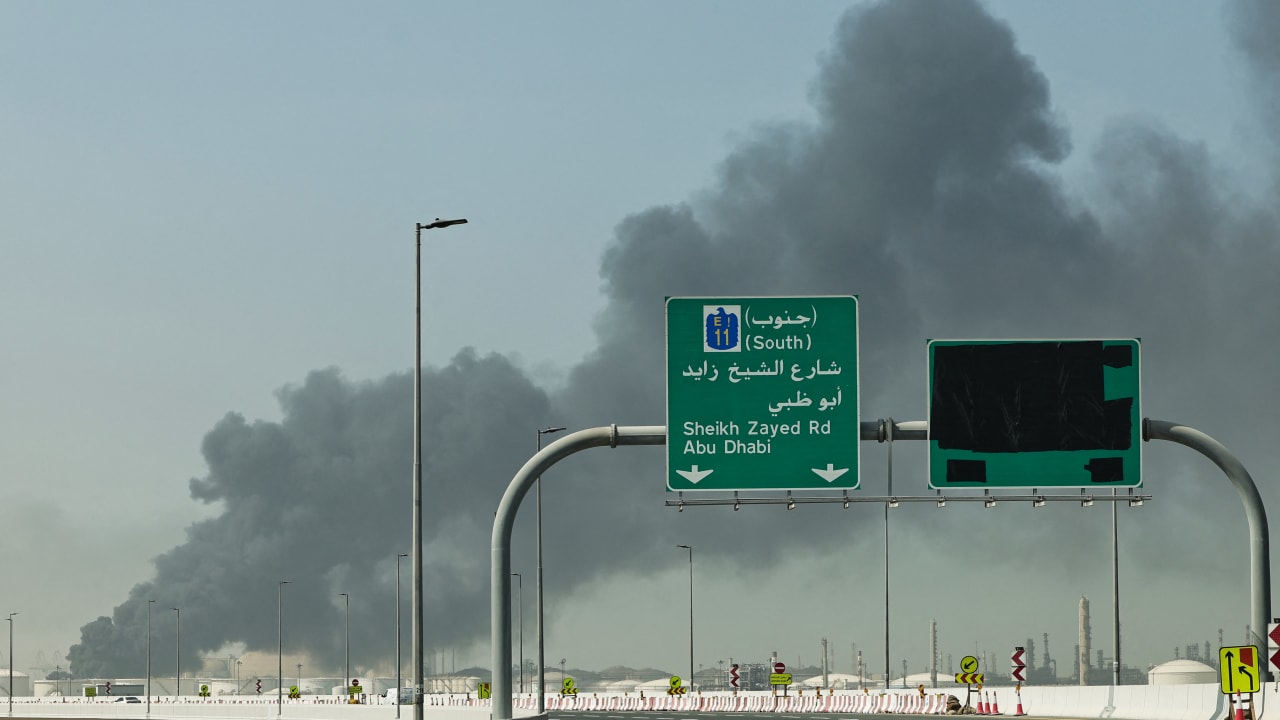
The missiles and drones didn't aim at the sand in the United Arab Emirates.
Had it not been for a 100% interception rate on ballistic missiles and 93% on drones, the story this week would have been written in rubble.
When Iran's dying regime dispatched 165 ballistic missiles, two cruise missiles, and 541 drones toward a single country in the days following the killing of Ali Khamenei, the distribution of fire told a story that pure military logic cannot explain. Nearly 65% of Iran's total munitions expenditure in this campaign was absorbed by one target: the UAE.
This isn't about Al Dhafra Air Base, proximity, or global economic blackmail. It isn't only about punishing a signatory to the Abraham Accords. Those are real factors, but they are downstream of something more fundamental. Iran attacked the UAE because the UAE is the argument Tehran cannot win.
This small Arab Gulf country represents the most operationally successful refutation of political Islam's central claim: that the path to dignity, power, and Arab identity runs through revolutionary resistance, divine mandate, and permanent conflict with the West.

Abu Dhabi didn't just reject that narrative. It built a civilization-scale counterexample. Through the Abraham Accords, the UAE chose normalization with Israel — positioning itself as an Arab state that moved toward integration, not perpetual grievance. The result is the most connected, prosperous, and diplomatically agile state in the Arab world. That is an existential ideological threat to any regime whose legitimacy rests on the promise that resistance, not engagement, is the only honorable path.
Notice what Tehran targeted in its symbolic geography: not military outposts in the desert, but landmarks. The Burj Al Arab, an icon of Emirati ambition exported to every phone screen on earth. Jebel Ali, the commercial artery of a state serving a hinterland of three billion people and ten trillion dollars of economic output within a 3,500-kilometer radius, is the beating commercial heart of the global south.
International airports are the infrastructure of a model built on connectivity rather than exclusion. This was not strategic targeting. This was an attempt at iconoclasm.
The ideological war had already begun before the first missile was launched. Just weeks prior, a strategic influence campaign was branding Abu Dhabi as an "Israeli Trojan horse," calling it a "betrayal of God, His Messenger, and the nation." Iran's drones and missiles and Gulf and Arab Islamist rhetoric were, however, unwittingly running the same operation: to delegitimize the UAE model, to prove that tolerance, moderation, and integration lead not to prosperity and protection, but to target acquisition.
It is telling that Muslim Brotherhood representatives across Sudan, Yemen, and even Oman rushed to declare solidarity with Iran against the American and Israeli strikes, while maintaining complete silence on Iranian missiles raining down on Arab capitals.
They did not fail to notice. They chose not to. The Brotherhood and Tehran were, as always, running the same operation, the same one that branded Abu Dhabi a traitor and Dubai a target. The missiles and the rhetoric share the same return address.
Tehran wanted to undermine the UAE model
Tehran wanted the UAE model, including the Abraham Accords, to become a liability. It wanted every future Arab leader contemplating engagement with Israel to see Emirati cities’ skyline burning and draw the obvious conclusion: don't.
The deeper question this moment forces is not whether the UAE will survive, because it will, but whether the New Middle East it embodies will expand or retrench.
The Abraham Accords are already moving toward Syria, Lebanon, and Saudi Arabia.
Syria and Israel have already established a joint intelligence-sharing and military de-escalation cell under US supervision, the first structured security framework between two former enemies since 1974, and a direct architectural beam of the New Middle East that Iran is trying to demolish. Meanwhile, Lebanon's President Joseph Aoun started discussions to join IMEC, the India-to-Europe trade corridor, a move that triggered immediate accusations of indirect normalization with Israel. Beirut, long paralyzed by Hezbollah's veto over its future, is now choosing connectivity over resistance.
Saudi Arabia's retreat from normalization is tactical, not terminal, as MBS is not rejecting the deal as much as he is pricing it. Riyadh doesn’t lack the strategic acumen to note that with Iran now degraded and the Axis of Resistance destroyed, the strategic cost of staying outside the New Middle East just rose dramatically. Many of the most serious and legitimate strategic burdens that made Riyadh's caution genuinely reasonable have been buried alongside Khamenei.
Iran understood, correctly, that the normalization architecture represented a structural reordering of the region's ideological market, one in which the "resistance" brand loses its monopoly on Arab and Muslim identity.
Every missile fired at Dubai is a confession. It is the admission that the regime that claimed to speak for the oppressed, the faithful, and the Arab and Islamic nations could not compete with what the UAE built, not in governance, not in economics, not in the imagination of the next generation across the Arab world.
So it reached for the one argument it had left: destruction.
A wounded animal still bites. But a wounded animal bites because it can no longer threaten. The Islamic Republic launched this campaign from a position of structural collapse. Its nuclear infrastructure degraded, its economy hollowed out, its supreme leader killed, its proxies scattered from Beirut to Damascus to Sanaa.
The ghosts of the old Middle East are departing, one funeral at a time.
The writer is a senior Emirati journalist and policy advisor.