
In many ways, the Jewish calendar is a direct manifestation of the very ebbs and flows of the land.
At their core, our holidays are agricultural milestones. We celebrate the harvest of Shavuot (Feast of Weeks) as the wheat turns to gold in the fields, and Sukkot (Feast of Tabernacles) when the stocks of grains are overflowing with the year’s bounty. These are moments of “revealed abundance” – moments where farming achievements are recognized and celebrated.
Yet, Tu Bishvat appears on our calendar in what seems to be a profound paradox.
It is called the “New Year for the Trees,” but take a look outside and you will see a reality that is anything but festive.
The ground is muddy, the skies are often still grey, and the trees stand stark and barren.
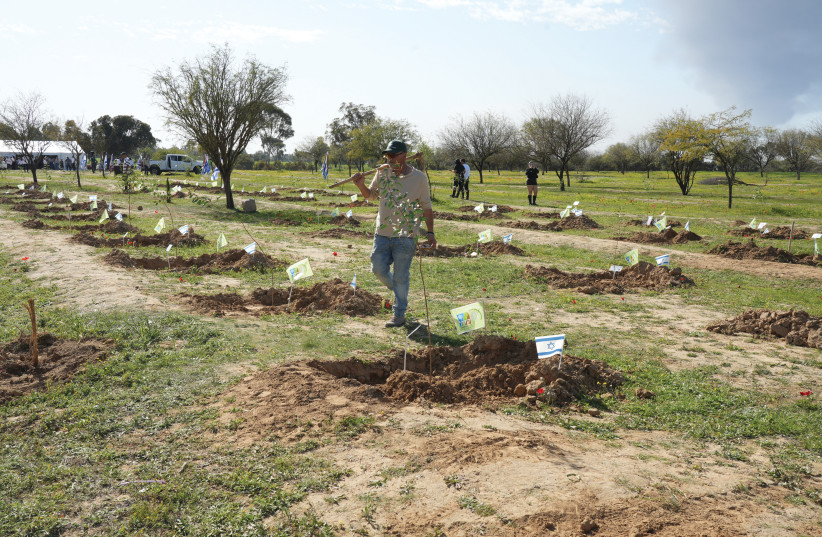
So why then did our Sages establish this festival at the very height of the winter freeze?
Why establish Tu Bishvat?
The answer lies in the observation that this is the moment when “the sap rises within the tree.” For if we were to take a microscope beneath the rough, cold bark to view the tiny capillaries that hide within the wood, life has begun to flow anew.
Tu Bishvat is a masterclass in the very human idea of potential: The day celebrates internal transformation precisely when the external world appears frozen in time.
The philosopher Emmanuel Levinas wrote that time is not merely a succession of moments, but an encounter with “the Other” and with that which is yet to come.
For Levinas, future is what gives meaning to the present – not because we can control what lies ahead, but because every moment is awaiting what might come next.
A day of discovery
In this spirit, Rabbi Manitou (Yehuda Leon Ashkenazi) saw Tu Bishvat as a moment of toledot – a day of discovering hidden generations and outcomes.
Although not apparent to the naked eye, a tree in the depths of winter is not static. Rather, it is in a perpetual state of “tense preparation.”
The vine, for instance, requires periods of biting cold – to ensure the quality of the fruit to come.
Through the lens of Levinas and Manitou, this is the process where the hidden prepares the ground for the revealed. What looks to the casual observer like a plant retreating into darkness is, in truth, the very moments where it is accumulating the strength for the growth and vitality that will come alive several weeks later.
This is a teaching that has critical importance when it comes to our faith as a people and as believers. As difficult as it might sometimes be, we have a deep responsibility toward that which is not yet born – the ability to nurture the seed buried in the earth, knowing that while yet unseen, birth, redemption, and growth are already stirring beneath the surface.
Faith in the process of rebirth
Rabbi Abraham Isaac Kook highlighted this vision by teaching us about the koakh hatzomeakh – the “vegetative power” of the soul. In his view, growth does not begin when the branch bursts from the trunk, but when the inner impulse awakens. On Tu Bishvat, we celebrate the roots, not the branches. The root operates at its maximum strength precisely in the darkness, within the damp earth, far from the seeing eye.
For Rav Kook, the faith of Tu Bishvat is faith in the process of rebirth. Even when our personal or national reality seems as dry as a withered tree, the divine “power of growth” never ceases.
I have long believed that true faith is the ability to hear the music of the future, and hope is the courage to dance to it in the present.
Tu Bishvat is the day we begin to dance to the melody of spring, even though the cold still surrounds us. It is an invitation to develop a “moral imagination” – to look at a barren tree and offer a blessing over its future fruit. It is the capacity to identify the “beginning of redemption” (atchalta degeulah) within the distress, understanding that at the lowest point, life has already begun its journey back upward.
At a time in Jewish history that might feel like an era of darkness or pain, it is well worth remembering that true redemption doesn’t actually begin when the beautiful and sweet produce is picked and eaten. Rather it begins when the sap begins rising deep within the roots and the trunk. That is the moment where we can begin to believe in the joy, promise, and blessing that is destined to come.
As we recognize this and commit to watering and investing in our roots, we are reminded that even when all might look bare, cold and dark, the light of life is only beginning to break its path through the earth.
So, this year, wherever in the world you find yourself as you gaze outside on Tu Bishvat, look not only at the trees themselves, but rather at the hope and promise that lie within.
The writer is deputy chairman of the World Zionist Organization and head of its Education Department.