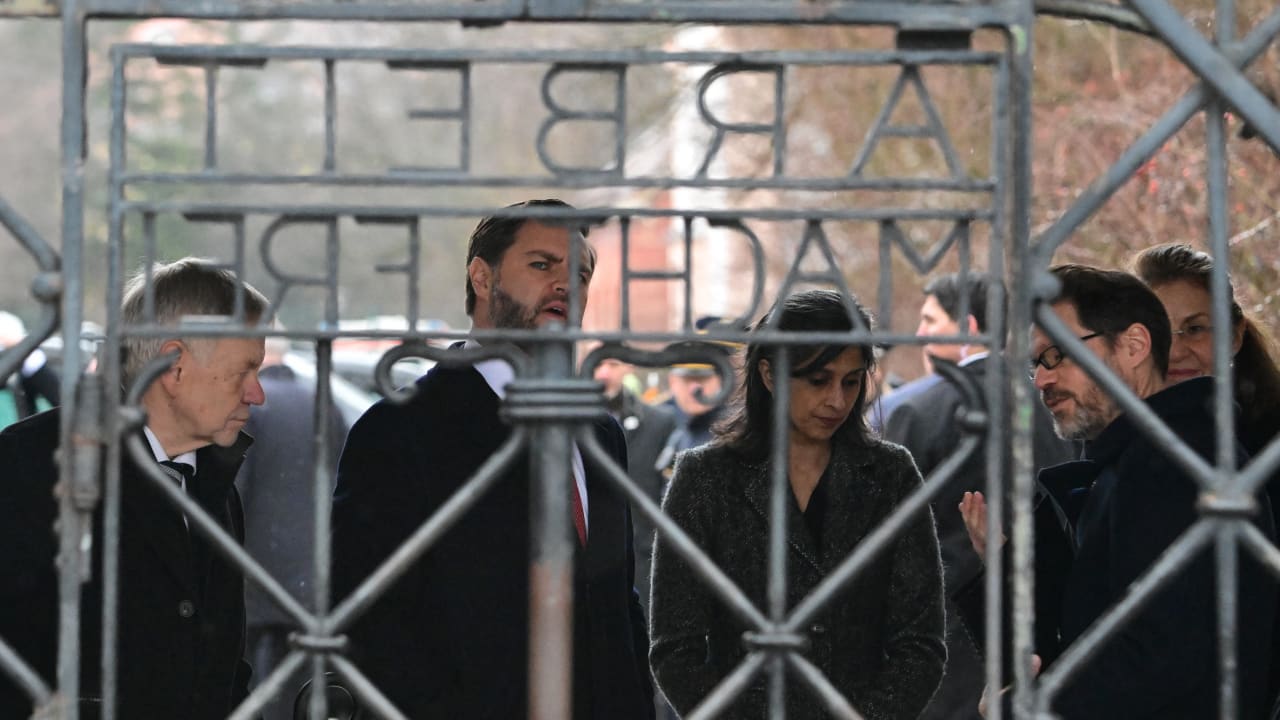
On Monday morning, Vice President JD Vance posted his Holocaust Remembrance Day statement on X/Twitter.
Millions of lives lost. Individual bravery and heroism. The dark chapter in human history. Our capacity for both compassion and unspeakable brutality. He promised America would never go down that path again. He didn’t mention Jews. Didn’t mention Nazis. Six million Jewish dead, the most systematic genocide in modern history, and the vice president couldn’t bring himself to name the victims or the perpetrators.
That same day, 5,600 miles away in Jerusalem, Yoram Hazony stood at a podium and delivered what may prove the most important speech about Jewish political survival in a decade.
Hazony runs the institutions that built the intellectual architecture of national conservatism. He chairs the Edmund Burke Foundation, leads the Herzl Institute, and according to the Associated Press, has been described as an intellectual influence on Vance. So the timing is almost perfect. The philosopher who helped shape the vice president’s worldview spent Holocaust Remembrance Day explaining to a room full of Jews why they’re catastrophically failing at politics.

Here’s what Hazony said, stripped of political correctness: For 18 months, influential right-wing podcasts in America have turned into factories of anti-Jewish propaganda.
Jews erased from Holocaust remembrance
Tucker Carlson’s show has become a place where you can hear that Jews are a demonic force in history, that we control the American government, that we shot Kennedy, that we bankrolled Churchill to start an unnecessary war with Hitler.
And what have American Jews done? They’ve tweeted. They’ve amplified conservative commentators like Mark Levin and Ted Cruz. They’ve treated viral fights as political strategy. They’ve confused moral outrage with political effectiveness.
Then Hazony asked the room a devastating question: Where’s the 15-minute explainer video? Where’s the carefully assembled research with timestamps that could convince an impartial public figure open to persuasion? Where’s the professional documentation that turns a serious accusation into something you can’t dismiss?
It doesn’t exist. Nobody built it. The entire anti-antisemitism industrial complex, with its conferences and budgets and professional activists, has failed to produce the basic tools you need to win a political argument in 2026.
Hazony mentioned Irving Kristol, the “godfather of neoconservatism,” who had a phrase for this. In 1999, he delivered a Jerusalem lecture called “The Political Stupidity of the Jews.” His argument was simple. Jews don’t have a living tradition of thinking about political power. We respond to political situations by pronouncing moral judgments. We believe being right is the same as being effective. Twenty-seven years later, nothing’s changed.
Hazony laid out the Republican Party as he thinks it is built. Three factions. The liberal wing (Lindsey Graham, Ted Cruz): maybe 25% of primary voters. The alt-right (Tucker Carlson, Candace Owens): maybe 10%. The nationalist wing (President Donald Trump, Vance, Secretary of State Marco Rubio, Defense Secretary Pete Hegseth): 65% or more.
Power lives in the nationalist wing, he says. The battle for Jewish belonging in the Republican Party will be decided there.
And what are Jews doing? Hazony asked. Retweeting the liberal Republicans, amplifying overheated rhetoric from the 25% faction. Treating online shouting matches as political reality.
Here’s what nationalist Republicans remember. Liberals spent eight years falsely accusing Trump of antisemitism. So when those same voices scream about antisemitism now, nationalist Republicans find the rhetoric bellicose, alarmist, unconvincing. They don’t see 1930s Germany. And when they refuse to panic on command, liberal Republicans start accusing them of being antisemites or protecting Nazis. Hazony called this a disgrace. The word that fits better is suicidal.
Because the Democrats have made their peace with anti-Jewish hatred. The neo-Marxists won. Hopefully, he says, most American Jews now understand they have no future in the party of Rep. Ilhan Omar (Minnesota congresswoman known for anti-Israel statements) and New York City Mayor Zohran Mamdani. If the Republicans go down the same road, Jewish life in America ends.
But the stakes being existential means the opportunity is historic. The nationalist wing will probably dominate American conservatism for a generation. Many see Israel as an inspiration. Many want closer relations with the Jewish community. Many are mystified why Jews spend energy attacking them instead of building friendships. The future relationship hasn’t been decided yet. Jews could build a solid alliance with the dominant faction in American conservatism, or keep tweeting.
Which brings us back to Vance. The backlash to his Holocaust statement was immediate. Pennsylvania Governor Josh Shapiro accused Vance of giving comfort to right-wing antisemitism. Jewish organizations condemned the omission. The Jewish Telegraphic Agency, NBC News all covered it. Social media exploded.
This is where it gets philosophically interesting. National conservatism, the movement Hazony helped build, emphasizes national identity and particular loyalties. It rejects universalist abstractions. It celebrates particularity.
The Holocaust was a crime against a particular people. Six million Jews were murdered because they were Jews. The universalist language Vance used (millions of lives, human history, unspeakable brutality) erases the particular crime. It turns genocide into a vague lesson about human nature.
This is exactly the abstraction national conservatism claims to reject. A movement built on particular identities produced a vice president who couldn’t name the particular victims of the particular crime on the particular day we set aside to commemorate them. The contradiction isn’t subtle.
Three possibilities present themselves. First, the influence is overstated. Maybe Vance read some books but doesn’t care what Hazony thinks about Jewish particularity. Second, the influence is real but has limits. Maybe Vance got bad advice or ignored good advice for political reasons. Third, the influence is real but incomplete. Maybe Vance absorbed the nationalist framework without internalizing what it means for Jewish survival.
None of these is comforting. All point to the same lesson. Having an intellectual in your corner isn’t the same as having a political ally. Influence isn’t always translated into power.
So what would real politics look like? Hazony gave the blueprint. First, understand how nationalist Republicans actually think. What motivates them? What language do they trust? Second, find common ground. Where do Jewish interests align with nationalist priorities? Third, build bridges. Do the unglamorous work of building relationships with people who have actual power.
But also, hold the line. Produce the evidence. Document the poison. Make the case to people who don’t live on social media. Create the 15-minute video. Build the timestamped archive. Do the boring work that turns accusations into conclusions people can’t dismiss.
Hazony pointed to a recent example. January 11: Trump condemns antisemitism. “Certainly, I think we don’t need them.” Five days later: The White House arranges a photo op with Tucker Carlson alongside Rubio and Chief of Staff Susie Wiles. Then Tucker says he could never be antisemitic because he said nice things about two Jews.
This is what happens without evidence packages and professional research. Trump condemned antisemitism in the abstract, then legitimized one of its primary amplifiers in the concrete.
For six months, Jews and Zionist Christians have been saying Tucker is a leading promoter of antisemitic propaganda. They said it to Charlie Kirk (the slain conservative podcaster), to Kevin Roberts (Heritage Foundation president), to the Trump administration. Judging by the White House photo op, the effort’s been a total failure. Why? Maybe Tucker’s too powerful. Maybe Jews are too weak in Republican circles. Or maybe, and Hazony clearly thinks this is the main reason, the case was never presented professionally.
Tucker’s smart, passionate, likable in person. He spent seven years building the Trump movement at Fox News. He says he’s not an antisemite. If you want to convince people otherwise, you need the explainer video, the research, the documentation. And where is it? It doesn’t exist. The anti-antisemitism industrial complex has failed spectacularly.
Israeli's get this instinctively. Israel’s built alliances with imperfect partners under intense pressure. Israelis know enemies try to isolate Jews by making every potential friend look radioactive. They know coalitions matter, survival requires friends, purity is a luxury you can’t afford when your country’s existence is at stake.
American Jews need to learn this fast. The nationalist wing will dominate for a generation. That faction includes people who want Jewish allies and are open to partnership. But the alliance won’t build itself. It requires stopping the performance of outrage and starting real politics. It requires understanding that the 65% matters more than the 25%. It requires producing evidence instead of pronouncing judgments.
And it requires asking hard questions about Vance. If the vice president absorbed the intellectual framework of national conservatism, if he understands the importance of particular identities, why couldn’t he name Jews on Holocaust Remembrance Day?
Here’s what this year’s International Holocaust Remembrance Day taught us: A philosopher in Jerusalem explained why Jews keep losing political fights they think they’re winning. A vice president in Washington demonstrated the problem by failing to name Jews while commemorating their murder. The gap between these events is the gap between theory and practice, between influence and power, between what we hope is happening and what’s actually happening.
Hazony gave American Jews an instruction manual: Build evidence. Understand who holds power. Find common ground. Build alliances. Stop tweeting, start doing politics. The alternative is watching Jewish life in America disappear. The Democrats are gone. If the Republicans follow, there’s nowhere left.
The opportunity exists right now to build something durable with American conservatism’s dominant faction. But opportunities don’t wait forever. Someone has to do the work. The philosopher told you how. The vice president showed you why it’s crucial.