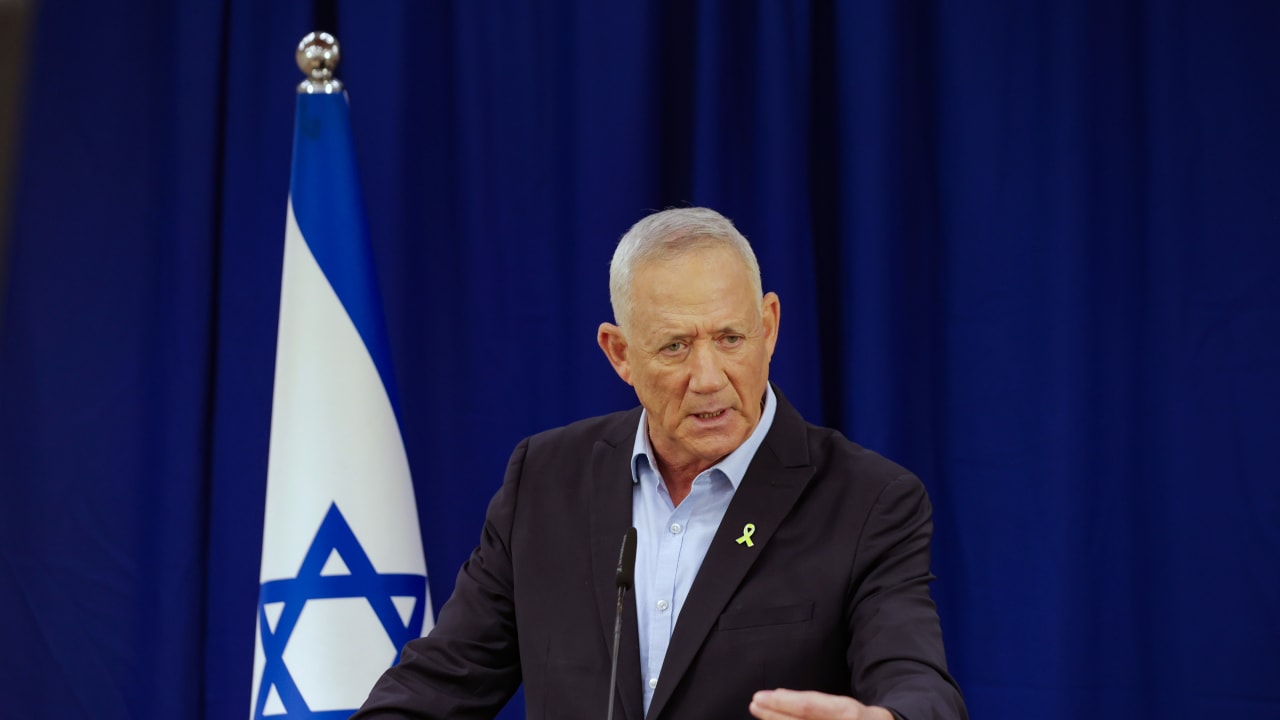
It’s been an eventful week in Israeli politics – yet again. After being written off following a prolonged collapse in the polls, Benny Gantz and his Blue and White Party have reemerged as a relevant political force. New surveys show the party once again crossing the electoral threshold and gaining momentum. A bold, controversial, and pragmatic stance has catapulted Gantz back into political significance.
The core message is deceptively simple: Gantz remains committed to defeating Prime Minister Benjamin Netanyahu and sending the current extremist government packing. But he does not seek a return to the era of narrow coalitions – unstable arrangements held hostage by small factions, prone to paralysis and political blackmail. Instead, Israel needs a “government of moderates,” more precisely a government of consensus, that excludes extremists on both the Left and the Right.
Gantz went further: He became the first opposition politician to announce that if the public again produces the grim scenario in which Netanyahu assembles a narrow coalition, he would join a national unity government, provided it excludes extremists.
The Blue and White platform
Blue and White has been explicit about what this means. Israel needs a government without Itamar Ben-Gvir and his bigoted Otzma Yehudit party – and without dependence on the Islamist party Ra’am for a parliamentary majority.

Gantz’s sharpest critics have tried shaming him as “racist” for refusing to rely on Arab parties. Yet given the security challenges Israel has faced since October 7 and the multi-front wars that followed, placing the government’s fate in the hands of a party founded on an Islamist political ideology is a risk many Israelis find untenable.
Mansour Abbas, Ra’am’s chairman, is a remarkable figure: a model of moderation and coexistence. But many in his party are not cut from the same cloth. Some openly echo Palestinian anti-Zionist rhetoric, delegitimizing Israel as a Jewish state.
Those of us who served in the “Government of Change” led by Naftali Bennett and Yair Lapid learned this the hard way. Extremist parliamentarians from Ra’am repeatedly blocked legislation essential to national security and civic cohesion: opposing scholarships for discharged soldiers; vetoing Gantz’s call for all citizens, including Arabs, to perform military or national service at 18; and objecting even to Keren Kayemeth LeIsrael-Jewish National Fund tree-planting in the Negev.
Gantz is telling Israelis an inconvenient truth. Although the Left has attacked his message fiercely, his honesty resonates with most of the public. Polls suggest that roughly 80% of Israelis are weary of a political system that rewards polarization and division.
This stand should be judged alongside Gantz’s record on civil rights. He and Blue and White have forcefully championed equal rights for Arab citizens, decrying third-rate policing and the gaps in infrastructure, education, opportunity, and healthcare between Jewish and Arab Israelis.
Gantz is the only major politician to insist that Arab citizens be included in national service at 18, a policy that would dismantle some of the few remaining discriminatory practices. And once a coalition of 61 based on a Zionist majority is formed, there is no reason to disqualify Ra’am from participation in the government.
Israeli politics of division
The deeper truth is this: Today’s extremist government is hemorrhaging support because Israelis are exhausted by the politics of division. But the 10 or more mandates that have shifted from the coalition to the opposition cannot be taken for granted. They would evaporate if moderate right-wing voters feared renewed dependence on Ra’am.
That miscalculation, by politicians like Gadi Eisenkot, risks driving voters back to Likud and perpetuating today’s toxic dynamic, in which extremists threaten to hijack the Third Jewish Commonwealth.
The time has come for Israel’s voters to do something different. We need a broad government of moderates to confront urgent challenges: universal service; restoring respect for the separation of powers and trust in the judiciary; rebuilding the Galilee and the Gaza border communities; convening a commission of inquiry into October 7; restoring Israel’s international standing; and confronting crime, especially in Arab communities. Experience teaches that a narrow coalition cannot get this done.
On these issues, a vast majority of Israelis agree. If Netanyahu prevails again, Ben-Gvir’s power will only grow. He is likely to demand the Defense Ministry, and Netanyahu is likely to capitulate. The country cannot endure another four years of policies that drive Israelis apart while turning the Jewish state into an international pariah.
Israel needs unity and renewed common purpose. Gantz is the politician who most credibly embodies that aspiration. That is why his campaign is gaining traction.
This is not the first time Gantz has played the role of the comeback kid. His instinct to do what is right for the country, even when politically costly, has hurt him before. Yet he remains one of Israel’s most trusted leaders – one who can still speak across party lines, listen, and be heard.
Israel stands at a turning point. In a fractured society facing existential threats, only a broad-based coalition inspired by Gantz’s statesmanship can muster the legitimacy to enact difficult but necessary reforms. Extremists may shout the loudest, but they cannot govern a country in trauma or bring the diverse people of Israel together.
The writer is a professor of public policy at Tel Aviv University. He served in the 24th Knesset as chair of the Environment, Climate, and Health Subcommittee.