I learned about the Israel–Diaspora gap before I learned the words for it.
My Savta (grandmother) used to record episodes of Sesame Street on VHS cassettes in the US and bring them back to Israel when I was a kid. At the same time, I would also watch the Israeli version with my siblings. There were times when the Israeli and the American versions were identical, with only the language differentiating them. But there were also episodes that were totally Israeli.
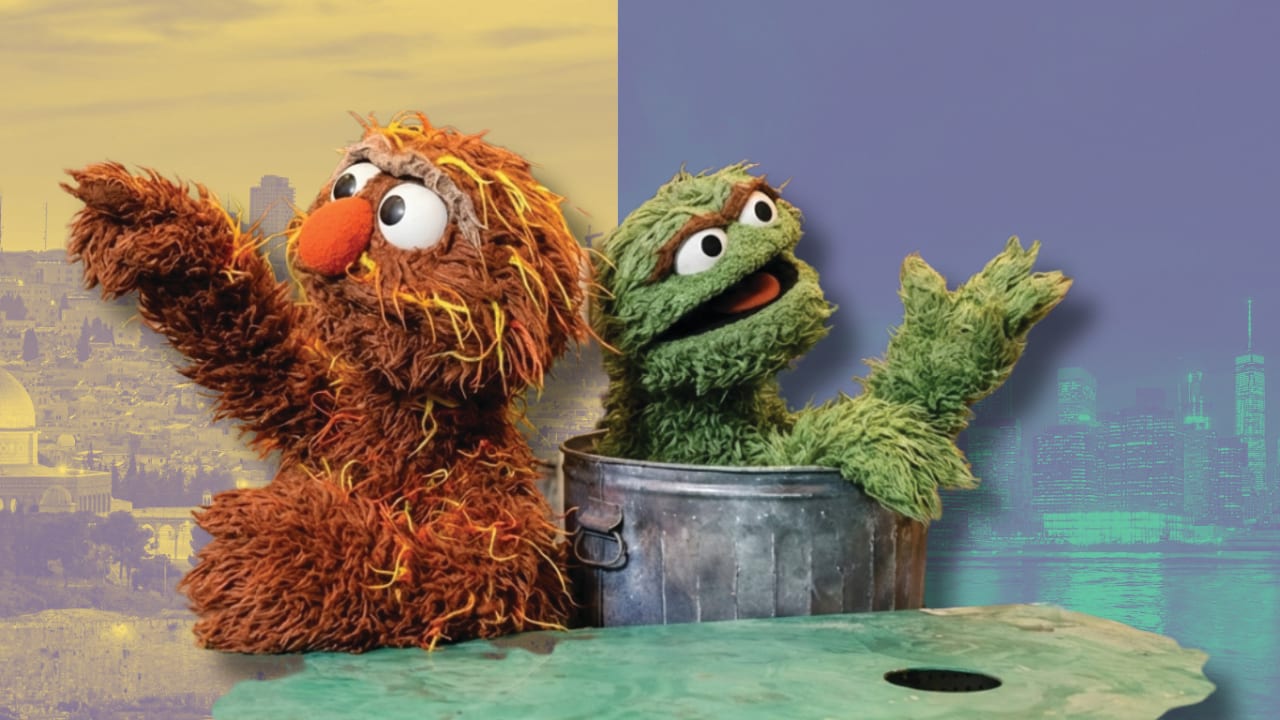
Oscar the Grouch was the humorous creature residing in a trash can in the US version. In the Israeli version, he didn’t exist. Moishe Oofnik took Oscar the Grouch’s place; he was a similarly grumpy character, but he represented an Israeli version of himself and did not live in the same type of garbage can.
Parallel societies
The pair represented two parallel societies. It feels, in a way, like Moishe and Oscar represent people like me (though I hope to be a cheerful version of them): being a rough Israeli, with Oscar’s chutzpah and Jewish values.
I was born in the United States, and so were all of my grandparents. I sound American. I have lived most of my life in Israel and still do. I speak daily with American Jews, and again and again I hear the same sentence spoken with completely different assumptions behind it.

“Why doesn’t Israel just do X?” an American Jew asks. It sounds obvious.
“Why don’t American Jews just move to Israel?” an Israeli asks. There is so much antisemitism there.
Each question makes sense inside the life of the person asking it. Each fails to grasp the pressure the other side is living under.
This gap keeps widening because Israelis and Jews outside Israel consume different media.
Diaspora Jews are immersed first in American media. They absorb the language of US politics, campus life, and culture wars. Jewish media often comes as a second layer.
Israelis consume Hebrew media with its own pace, codes, traumas, and reflexes. A smaller group follows international news closely, usually in English, often only during moments of crisis. Many do not.
So, most weeks, the two sides are not reading the same investigation. They are not responding to the same op-ed. They do not share the same facts, or even the same emotional context. Then they meet online and accuse one another of being ignorant, cruel, or detached.
They were never arguing from the same text.
Collision of two realities shaped by different voices, languages, rules of engagement
This is not a disagreement. It is a collision between two realities shaped by different voices, different media, different languages, and different rules of engagement.
One concrete expression of this divide is intellectual familiarity. Most Israelis have never heard of the authors whose books about Israel are widely read and debated in American Jewish communities. At the same time, American Jews are largely unfamiliar with the thinkers who shape Israeli public debate today, whose essays, podcasts, and books structure how Israelis argue about war, democracy, religion, and identity.
Each side assumes the other is engaging with the same literature. They are not.
Even the figures who dominate Israel-related speaking circuits at American Jewish galas are often relatively unknown to everyday Israelis, while the thinkers Israelis read, quote, and argue with daily rarely appear on American stages. Each community amplifies a different version of intellectual authority.
I know this because I have translated both ways.
For more than a decade, I wrote about Jewish life outside Israel as a beat Israelis needed to understand. I spoke with rabbis, activists, athletes, writers, artists, and community leaders from large and small communities. I tried to show Israelis that Diaspora Jewish life is deep, complex, and consequential. Slowly, it worked. A readership formed. Israelis wrote back. They asked questions. They disagreed in ways that were productive.
WHEN I moved to The Jerusalem Post four years ago, my audience shifted. My readers became Diaspora Jews and non-Jews deeply engaged with Israel. I found myself explaining Israel: our politics, our security reality, our social tensions, and how the October 7 massacre reshaped Israeli society.
And then I watched the same misunderstanding repeat itself in conversation after conversation.
A friend of mine who lives in a settlement in Judea went to speak on American college campuses. His daughter asked him anxiously, “Aren’t you scared to go? Haven’t you seen the news?” He looked at her and said, “We live in Israel.”
This is the longest war Israel has ever fought. Israelis calibrate danger differently.
The exchange is almost funny, until you see what produced it. His daughter understands American campuses through headlines, social-media clips, and viral outrage. He understands them as an Israeli shaped by air-raid sirens, funerals, reserve duty, and the constant hum of threat. Both are responding to real pressures. They are responding to different ones.
After October 7, Israelis experienced another shock. They began to feel antisemitism directly.
Many Israelis grew up facing enemies who were openly anti-Israel, anti-Zionist, and anti-Jewish all at once, often backed by rockets, bombs, or propaganda. There was a belief that sovereignty had ended the classic Diaspora condition. A Jewish state meant safety.
Then Israelis traveled abroad and found themselves treated as pariahs. Protesters in modern dress recycled ancient anti-Jewish slogans. Israelis watched people use euphemisms and moral language to justify hostility toward Jews. For many, it was a new kind of vulnerability. They were not being targeted for a policy position or political argument. They were being targeted for being Jewish.
This realization cut deeply because it challenged a core Israeli assumption: that sovereignty ends the old story. It does not. It changes the narrative, but it does not erase the reflex in parts of the world to treat Jews as a problem.
Today, two communities share fears but live under different daily pressures. Israelis live with war and survival. American Jews live with exposure, social risk, and isolation. Each feels misunderstood. Each has evidence.
That is precisely when media matters most, because media defines what “everyone knows.”
This is where I think again about Sesame Street.
Israelis and American Jews still share history, family, religion, humor, and fate. But we watch different shows. We interpret reality through different frames. We argue as if the other side read the same article and watched the same footage. They did not.
So, I return to an idea I once had, which now feels urgent. Imagine a magazine published weekly or monthly, simultaneously in Hebrew and English, with identical content. The same investigations. The same interviews. The same photographs. One editorial table with two languages. Not just shared content, but also shared assumptions about what kind of reality is being described.
The goal would not be agreement. The goal would be shared ground.
Imagine a six-month experiment in which opinion leaders in Israel and the Diaspora read the same package. They would still disagree. They would still bring different instincts and values. But they would begin their arguments from the same paragraph. They could not claim ignorance of what “the other side” saw.
Start small. Publish one major investigation each month in both languages at the same time. Pair it with two responses: one Israeli, one Diaspora Jew. Convene a structured conversation around that shared text. Repeat it. Make it routine.
My grandmother’s VHS tapes gave me an unexpected gift. They showed me that different versions of the same story can still feel like home. They also taught me that small shifts in language and framing can profoundly shape how we see the world.
In a moment when Jewish solidarity is under unprecedented strain, the absence of shared sources is no longer an abstract problem. Israelis and American Jews can choose to read together again, or they can continue arguing across a divide neither side fully understands.