Monday, 17 November 2025, the village of al-Jaba’ near Bethlehem. A group of settlers with covered faces attacked a car with stones and clubs. Inside were a one-year-old girl, her four-year-old sister, their mother, and their uncle. The attackers also torched two cars parked nearby, burned three others, and stoned five homes in the village.
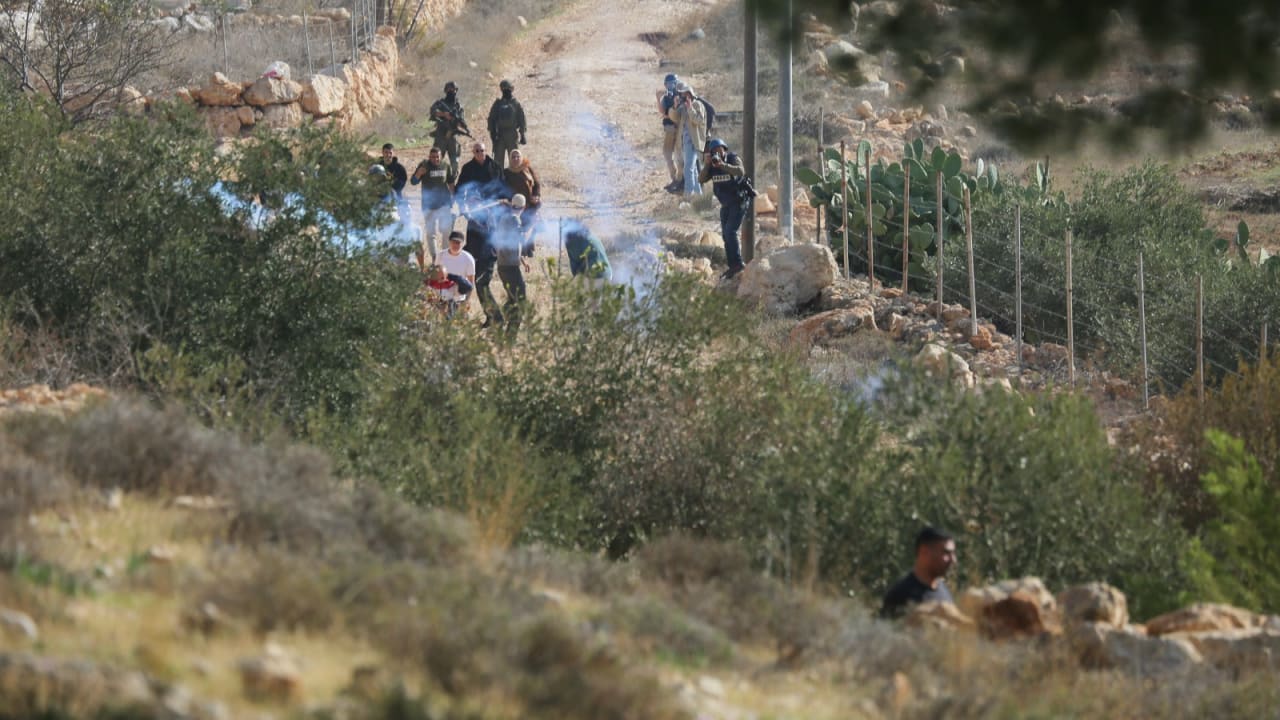
Friday, 10 October 2025, Beita, near Nablus. Dozens of settlers and soldiers attacked Palestinian farmers harvesting olives, using clubs, stones, tear gas, and live fire. About 80 farmers and journalists were injured, including one person who was shot. During the attack, settlers beat to death a dog that was tied to a fence, torched 12 vehicles, and vandalized six more.
These two attacks are a tiny example of the organized pogroms being carried out in the West Bank on a daily basis. B’Tselem has documented such attacks for years. Yet the past two years have seen a sharp spike in the degree of violence and the frequency of the attacks, now amounting to thousands of incidents.
UN Office for the Coordination of Humanitarian Affairs (OCHA) documented more than 1,770 attacks involving harm to people or property in 2025 alone. This included violent raids, sometimes carried out by dozens of settlers, many of them armed; burning fields and uprooting trees; stealing livestock; torching homes and property; throwing stones; and even the shooting and killing of Palestinians in broad daylight, at times on camera. Yet Israeli politicians continue to claim, year in and year out, that there is no such thing as “settler violence.”
In a sense, they are right. Anyone who follows these incidents closely and sees the dynamics on the ground understands that labeling “settler violence” is an understatement for these organized pogroms. In fact, the term is used to deflect responsibility for what is really happening.

The dozens of outposts from which the attackers emerge are established with the knowledge and encouragement of state authorities and in many cases with explicit, institutionalized support.
Typically, the authorities provide the outposts with electricity and water infrastructure, pave access roads for them, and allocate government budgets. The ATVs and drones used by settlers in attacks were distributed by Finance Minister Bezalel Smotrich and National Missions Minister Orit Strock. The weapons used to attack and threaten Palestinian residents are supplied by the military.
Attacks carried out by members of settler "security squads"
Many attacks are carried out by members of settlement “security squads” and by settler-soldiers enlisted in the regional defense units – military units composed of settlers from the area. Just last week, a settler-soldier entered the village of Deir Jarir on an ATV, fired his military-issued gun in the air, and then deliberately ran over a young Palestinian man praying by the roadside.
Members of organized militias, often with military weapons and in army uniforms, operate routinely throughout the West Bank. They set up checkpoints, drive farmers off their land, and attack Palestinians. The complete immunity they are granted by all state systems enables them to continue terrorizing Palestinians, who know they have no way to protect themselves or their property without risking death.
This model, of unchecked state-armed militias operating in coordination with the military and backed by all branches of government, has succeeded, according to B’Tselem’s monitoring, in driving 45 Palestinian communities out of their homes over the past two years.
It has ethnically cleansed hundreds of thousands of dunams (1 dunam = 0.1 hectares) throughout the West Bank of Palestinians, where any Palestinian entering them risks arrest or attack. New outposts are springing up in mass in these areas, taking over Palestinian land and, over time, receiving formal recognition as settlements.
In this way, the shared overarching goal of the settlers, the military, and all state systems is fulfilled: ethnically cleansing more and more areas of Palestinians and enabling Jewish takeover of the land. All this is carried out in broad daylight, with no attempt at concealment.
The writer is the spokesperson for B’Tselem.