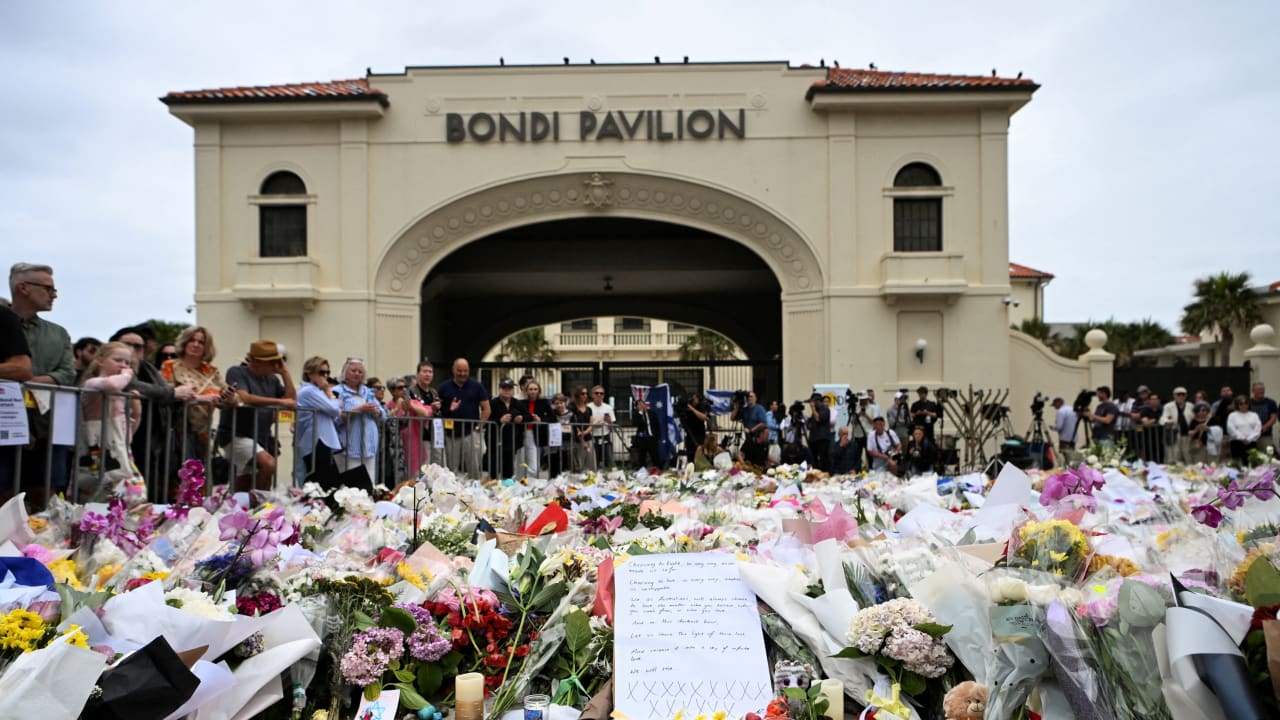
Bondi Beach – a location once known around the world for sun-soaked vacations and holiday celebrations – now bears the weight of 15 souls ripped from this world. On December 14, as thousands gathered to celebrate Hanukkah, bullets tore through the celebration. Fifteen holy lives were stolen in an instant. Dozens were wounded. The community has been forever shattered.
But seven days later, something extraordinary unfolded on that same blood-soaked sand. Twenty thousand people flooded back to the very spot where terror struck.
They stood in strength and solidarity. They did not mourn in hiding or convene in a quartered-off location. They came back to the very spot that terror sought to extinguish Jewish light.
Rabbi Yehoram Ulman, father-in-law of the slain Rabbi Eli Schlanger, offered these words: “In this world, we only have questions,” he told the vast crowd. “In the next world, we have answers.” And then, with defiant hope: “They started, but we got the last word on Bondi Beach.”
But why did they choose to return to the same spot where just one week earlier, they had suffered severe trauma?

Returning to the spot of trauma
This week’s Torah portion, Vayechi, offers an answer. After Jacob’s funeral procession, Joseph’s brothers are suddenly seized with fear. Would Joseph, now free from his father’s restraining presence, exact revenge for their betrayal 22 years earlier – when they threw him into a pit and sold him into slavery?
An interesting question is what brought about this sudden fear of retribution? The commentators come up with a stunning answer: On the journey back from the funeral, Joseph had made a detour to the very pit where he was left to die decades earlier.
The brothers thought he was planning an act of vengeance. But they misread the situation.
Joseph hadn’t returned to relive the act of cruelty; he came to recite a blessing. According to the Midrash, he proclaimed: “Blessed are You, Hashem, who performed a miracle for me in this place.”
Rather than anger or revenge, Joseph expressed gratitude. Rather than viewing his years of slavery, false imprisonment, and separation from family as punishments, he saw them as necessary steps on the ladder of his life that ultimately led to his role as the viceroy of Egypt.
“Although you intended me harm,” he told his brothers in verse 50:20, “God intended it for good, so as to bring about the present result – the survival of many people.”
Joseph would have been justified in harboring anger, resentment, and grudges toward his brothers.
However, the opposite happened. Joseph’s courage and willingness to confront his past – with gratitude and humility – allowed him to come full circle and experience healing.
Certain modern trauma-focused cognitive behavioral therapies align with this approach. These modalities help people to no longer view themselves as being defined by their trauma, but rather as empowered by it to make positive change for themselves and others.
IN 1956, terrorists stormed into Kfar Chabad and murdered five young students and their teacher. The fledgling community, populated by survivors of Stalin and Hitler, faced collapse. Fear paralyzed them. Should they abandon the village?
They waited for guidance from Rabbi Menachem M. Schneerson, of righteous memory. A telegram soon arrived, consisting of three Hebrew words: “Behemshech habinyan tinacheimu – By your continued building, you will be comforted.”
That very night, the village elders decided: a new school would rise on the exact spot where the blood was spilled. The place of death would birth new life, new learning, new purpose.
This pattern echoes across Jewish history. When antisemitic attacks began plaguing Australia in 2024, Rabbi Eli Schlanger – the beloved chaplain who would later be murdered at his own Hanukkah celebration – gave his community a prescription. “In the face of darkness, the way forward is to be more Jewish, act more Jewish, and appear more Jewish.”
He lived those words. Never without his hat and jacket, the markers of a hassidic Jew, he displayed his identity proudly. Over Hanukkah, his car was topped with an illuminated hanukkiah, publicly sharing his Jewish joy and inspiring pride in others.
And when the bullets came for him, his message didn’t die with him. It multiplied a thousandfold.
Premier of New South Wales Chris Minns stood before those 20,000 gathered souls at the vigil and launched an unprecedented initiative: “One Mitzvah for Bondi.” A secular government official calling on an entire state to perform good deeds – to flood the world with light in response to darkness – had never before been seen in Australia’s history.
He understood what Joseph understood, what the Rebbe understood, what Rabbi Eli Schlanger lived and died proclaiming: You don’t defeat darkness by acknowledging its power. You obliterate it by bringing more light.
This is not about denying pain or explaining away tragedy. We cannot rationalize it, justify it, or make sense of it. However, we can choose what comes next.
We can let trauma define those spaces forever. Or we can redefine them with blessing, with building, with defiant acts of goodness. This is the Jewish way, passed down from Joseph to the Rebbe to Rabbi Eli Schlanger and now to us.
Rabbi Jonathan Sacks once recalled advice that the Rebbe had given him. When he said, “I found myself in a situation,” the Rebbe corrected him and said, “You never find yourself in a situation; you create a situation.”
May this wisdom – that we are never trapped by our circumstances – help us navigate the difficult times we’re living in. May we soon see true peace with the coming of Moshiach.
The writer, a rabbi, is the executive director of Chabad Columbus at the Lori Schottenstein Chabad Center.