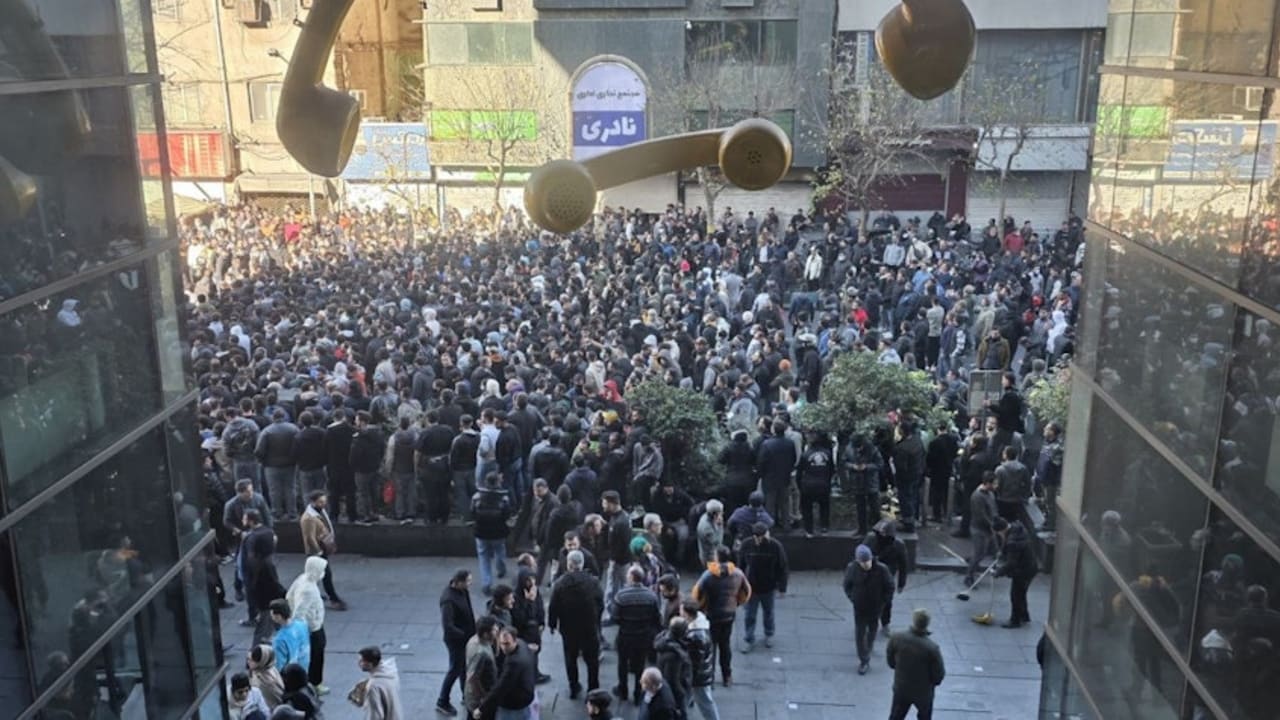
Protests are continuing across Iran, spreading beyond major urban centers into provincial towns and smaller cities that rarely make international headlines. This geographic reach is analytically important. It suggests unrest is no longer confined to familiar pockets of dissent but reflects a broader legitimacy challenge, one that the Islamic regime has struggled to manage with a coherent strategy.
Equally significant is who has joined. Iran’s traditional bazaari merchants, often pragmatic and risk-averse, have launched strikes in response to a collapsing currency and surging costs. University students are also in the streets.
The convergence of working-class protesters, the commercial middle class anchored in the bazaars, and educated youth is politically consequential. When these groups mobilize simultaneously, regimes face not only demonstrations but crises of legitimacy.
The initial spark was economic failure, but the movement has widened into something far more consequential. Years of corruption, ideological policymaking, and international isolation have produced cascading breakdowns. The rial’s collapse has erased savings, and inflation has made basic food and medication unaffordable. Yet what sustains the protests is not economic hardship alone; it is a widening perception of state failure, as basic services and household stability continue to erode.

Farmers have watched rivers shrink, wells run dry, and farmland turn barren after decades of corruption and politicized water policy hollowed out infrastructure. Entire rural communities have been pushed to the brink of displacement. Meanwhile, water rationing and dry taps have reached major cities, turning a basic service into daily uncertainty.
Energy mismanagement compounds the crisis; despite vast oil and gas reserves, rolling blackouts disrupt homes, hospitals, and industry, forcing millions to plan their lives around outages. In major cities, toxic air has become a major public health burden, contributing to an estimated 170 deaths per day.
Systemic failure of the Iranian government
These are not isolated problems. They are symptoms of systemic state failure that has prioritized ideology, regional ambition, and regime survival over competent governance. Slogans such as “Neither Gaza nor Lebanon” reject the regime’s priorities and its commitment to ideological expansion abroad while domestic needs go unmet. What most distinguishes the current movement, however, is its language; direct, unapologetic, and increasingly explicit about political alternatives.
From Shiraz to Mashhad, demonstrators chant “Javid Shah (Long live the King),” “This is the final battle, Pahlavi will return,” and “The Shah will return to the homeland, and Zahhak will be overthrown,” invoking a mythical tyrant as a metaphor for Supreme Leader Ali Khamenei. These are not merely nostalgic whispers; they function as political signals about preferred alternatives.
For nearly five decades, the Islamic regime tried to erase the Pahlavi era as illegitimate. Yet many of the voices invoking it belong to a generation born after the revolution. For them, “Pahlavi” often functions as shorthand for a secular, competent state, and as a rebuke to clerical rule.
Crown Prince Reza Pahlavi has taken on a unifying role as the transitional leader, offering Iranians a vision of secular, inclusive governance. In recent statements, he has repeatedly emphasized that any future system must be chosen by the Iranian people through a national referendum. Meanwhile, the proposed Cyrus Accords envision a post-Islamic Republic Iran at peace with its neighbors, including Israel, cooperating on water, energy, and technology.
These developments require a strategic recalibration in Western capitals. For too long, Western policy toward Iran has rested on the assumption that the regime could be moderated through sanctions relief and diplomatic engagement. That assumption no longer holds. The Islamic regime in Iran is not a status quo power teetering between moderation and extremism; it is a brittle theocracy in decline, facing an organized and increasingly determined citizen movement.
This places the West at a moment of decision. Western governments must stop treating regime stability as synonymous with regional stability. That means refusing to legitimize violent repression, amplifying Iranian voices rather than official narratives, and imposing real consequences on those responsible for abuses. It also means ensuring Iranians have access to communication tools that allow them to organize, document, and speak to the world.
A new Western strategy could begin with clarity by recognizing the Iranian people’s right to demand regime change. Engagement should extend beyond rhetorical support to substantive political coordination. Western governments should establish channels of communication with the opposition leader and treat the opposition as legitimate stakeholders in Iran’s future. This does not mean dictating outcomes; it means ceasing to treat the Islamic Republic as Iran’s inevitable horizon.
This time, the choice is clear. Iran’s future is being written by its own people. The question is whether the world will listen and help them turn the page. The protests unfolding in Iran are about governance, national identity, and the right to choose a future. When a population openly declares both what it rejects and what it aspires to, it signals something more than anger; it signals readiness.
Bahram Vahedi is a water and environment researcher and strategist, with a focus on Iran. Follow him on X: @vahediBahram
Aidin Panahi is an Energy and Industrial Policy expert focused on Iran. Follow him on X: @Aidin_FreeIran