
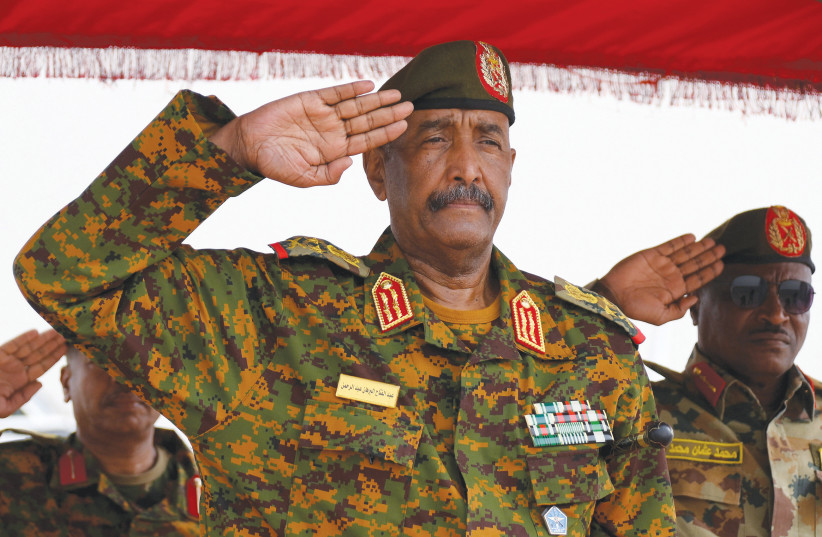
In an article recently published in The Wall Street Journal, Lt.-Gen. Abdel Fattah al-Burhan, Sudan’s leader and head of the Sudanese Armed Forces (SAF) tried to present his vision of the war raging in Sudan since April 2023. One point caught attention – his reference to normalization with Israel: “In 2021, Sudan took a historic step by joining the Abraham Accords. We believe that peace and cooperation are the only path toward a stable Middle East and Horn of Africa.”
This reveals that normalization has become a tool used by a military leader seeking international legitimacy amid a war that has caused the world’s worst humanitarian catastrophe in 2025, with more than 12 million people displaced. Sudan witnessed a popular revolution in 2019 that toppled President Omar al-Bashir after 30 years. A transitional government was formed, but Burhan and his partner, Rapid Support Forces (RSF) leader Mohamed Hamdan “Hemedti” Dagalo, led a military coup in October 2021. Less than two years later, violent fighting erupted between the army and the RSF, continuing to this moment.
But Burhan is not alone in this game. Hemedti has positioned himself, similarly, expressing support for normalization on multiple occasions. Even as he wages a brutal war marked by documented atrocities in Darfur, RSF representatives, including Nasreddin Abdulbari, a leader in the RSF-founded government, have waved normalization as proof of pragmatism and openness to Western partnerships. The message from both sides is identical: “I am your man – I will deliver normalization.”
An old trick in new clothing
Sudan has taken steps toward normalization since October 2020 as part of the Abraham Accords. In February 2020, Burhan met Netanyahu in Entebbe, Uganda, sparking controversy. Ironically, he staged a coup less than two years later, revealing that normalization was never a national project but a tactical tool to gain Western support and consolidate military power.
This dynamic is not new. In January 2016, then-foreign minister Ibrahim Ghandour stated that normalizing relations with Israel could be discussed in exchange for lifting sanctions. Those attempts failed because they lacked popular credibility. Today, both Burhan and Hemedti repeat this approach under worse conditions, each presenting himself as a reliable Western partner while the country collapses.
Contradictions that cannot be hidden
What makes this moment more confusing is the contradiction between Burhan’s stated path and his actual alliances. While presenting himself as a partner ready to open to Israel, he has simultaneously built a network extending toward Iran and empowering radical Islamist currents within state institutions. Iran has supplied the Sudanese army with Mohajer-6 drones, and intelligence assessments confirm the expansion of Iranian arms smuggling networks into Sudan, despite international restrictions. In parallel, Islamist networks from Bashir’s regime have returned to decision-making positions, framing the war as an ideological confrontation.
This scene reproduces a system that represents a long-term threat to the region. The Islamist rise in security and military decision-making creates an environment capable of giving birth to a new hostile front on the Red Sea front that is neither stable nor controllable. Burhan governs through a military system, waging a war that has destroyed major cities and displaced millions, while Burhan rejects mediation initiatives and insists on a military resolution.
This alliance – reliance on Islamist networks alongside military cooperation with Tehran – reveals a difficult-to-hide contradiction.
Burhan presents normalization as a strategic option, while his actual alliances touch the core of what Israel and the entire region consider structural dangers: direct Iranian support, ideological influence within the military, and the possibility of the Red Sea transforming into an open security competition zone.
The legitimate question arises: Can a strategic relationship be built with a military partner who receives weapons from Israel’s primary regional adversary?
The paradox becomes more complex when we look at Burhan’s main allies: Egypt, his steadfast supporter, and Turkey, which supplies him with Bayraktar TB-2 drones, are going through one of the worst moments in their relations with Israel; Saudi Arabia links any potential normalization to the Palestinian issue.
Normalization without legitimacy
Israel may have valid incentives for peace, but under these circumstances, it is not in its interest to align with a system moving closer to Islamists and Iran, especially one tied to a figure under US sanctions and accused of war crimes.
That’s a connection Israel’s global reputation doesn’t really need now.
If Burhan were truly working for his country’s interest, he would realize that any breakthrough in regional relations in this complex climate would be difficult, and he would not pursue it as a personal way out. But he is the only party pursuing this file as a path to political salvation. The truth is that a step of this magnitude cannot be reduced to an individual decision. Normalization is not a card to be raised under pressure, but a sovereign path that needs an elected government and a parliament expressing the will of the Sudanese people.
What is happening today is an attempt without support, an initiative without internal acceptance.
The result is not peace or stability, but a distorted version of a deficient agreement that does not change Sudan’s position and does not transform war into a stable state; it deepens contradictions and postpones collapse without addressing it. Normalization at this moment becomes a maneuvering margin for a leader repeating an outdated approach at a moment when the approach itself has become part of the crisis, not a way out of it.
The writer is a Washington-based journalist, talk show anchor, and researcher with over a decade of experience covering Sudan, the Horn of Africa, and Middle East politics. She currently serves as the Arabic content editor at The Washington Institute for Near East Policy.