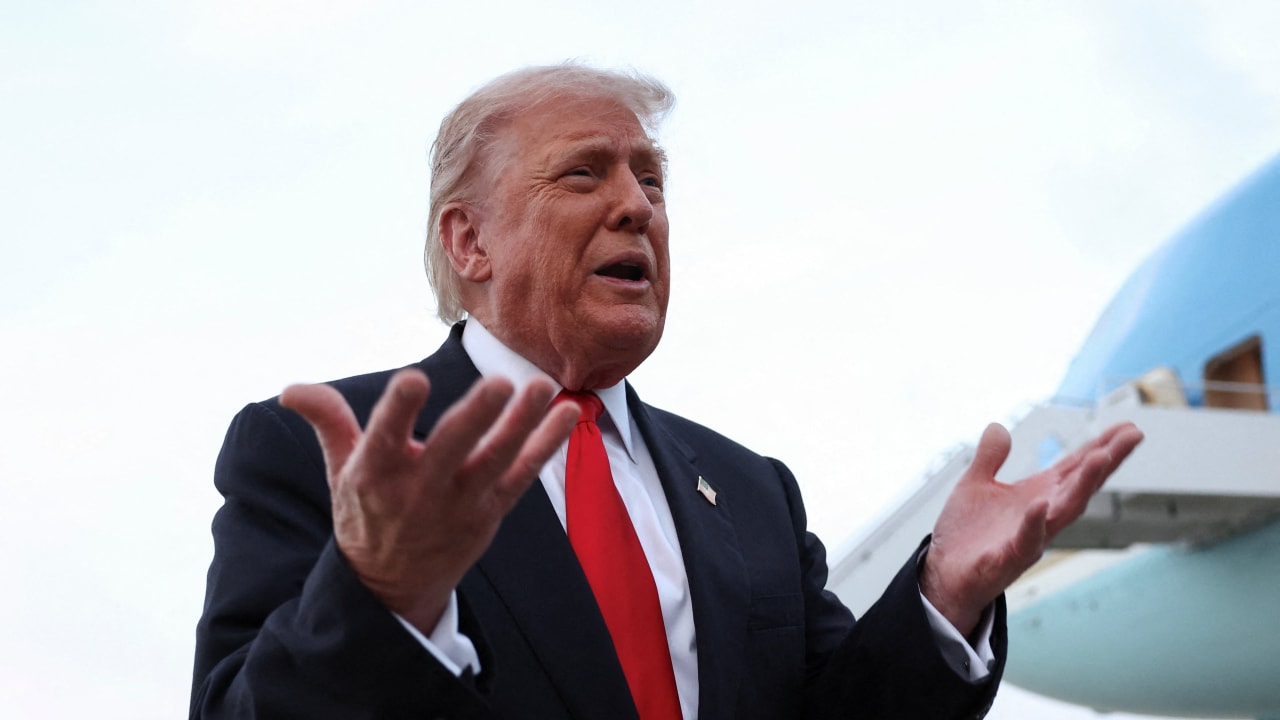
To caveat this piece, US President Donald Trump remains one of the strongest supporters of Israel ever to have occupied the Oval Office. His record speaks for itself: recognizing Jerusalem as Israel’s capital, moving the US embassy to Jerusalem, recognizing Israeli sovereignty over the Golan Heights, brokering the Abraham Accords, and, of course, helping to secure the release of the remaining hostages who were held in Gaza.
Israel owes him gratitude. But friendship, even the deepest kind, does not entitle interference in another country’s domestic affairs.
Trump’s letter to President Isaac Herzog this week, formally requesting a presidential pardon for Prime Minister Benjamin Netanyahu, crosses a line that should not be crossed.
In what appears to be an unprecedented step in modern American diplomacy, a US president has directly urged a foreign head of state to grant clemency to that country’s own leader.
The letter’s tone, urging Herzog to “fully pardon Benjamin Netanyahu… and end that lawfare once and for all,” mirrors opinions that Trump has expressed before. He described Netanyahu as a “decisive wartime leader” and argued that the ongoing trial “unnecessarily diverts his attention” from leading Israel through existential challenges.
While the words may resonate with those who see Netanyahu as the indispensable man to lead Israel, they nonetheless suggest an intrusion into Israel’s legal process.

A pardon is not currently on the table
The President’s Residence has already clarified that a pardon cannot currently be issued. Under Israeli law, such a decision can only be made before proceedings begin or after a verdict is delivered, neither of which applies today.
Moreover, pardons are initiated by a defendant’s request and typically follow an admission of guilt and expression of remorse. In Netanyahu’s case, he continues to plead not guilty to charges of bribery, fraud, and breach of trust. The trial, now in its fifth year, remains in the cross-examination stage.
The prime minister himself told Australian podcast host Erin Molan that he was not sure whether he would accept a pardon if Herzog offered one.
It is not for the US president, or any foreign leader, to call for the termination of this judicial process. Israel’s justice system, like America’s, is independent. Due process, for all its flaws, is absolutely fundamental to the democratic character of the state, regardless of whether one agrees with it, as took place during the months of protests against the judicial reform before the October 7 massacre.
There are, of course, precedents for international clemency efforts, but only in reverse. Foreign governments have occasionally appealed to the White House to grant pardons to individuals convicted under US law, such as in the case of financier Marc Rich, whose 2001 pardon by president Bill Clinton followed lobbying by foreign officials and was widely criticized at the time.
Nevertheless, The Jerusalem Post could uncover no known instances of an American president formally asking another nation to pardon one of its citizens. That makes this a unique case.
Trump’s defenders will argue that his letter comes from genuine friendship and concern for Israel’s stability. Indeed, he links his appeal to Israel’s need for unity after war and the ongoing hostage crisis.
His letter also reflects the views of some in Netanyahu’s coalition who argue that the trial has become a political distraction, preventing the government from functioning effectively. But friendship cannot override law. Nations must be bound by their institutions rather than personalities.
The comparison isn’t exact, but there is a long pattern of US presidents interfering in Israeli politics. Clinton has explicitly admitted that he tried to help prime minister Shimon Peres beat Likud leader Netanyahu in the 1996 election, which Netanyahu won. In a Channel 10 interview, he was asked if it would be fair to say he tried to help Peres win. “That would be fair to say,” Clinton answered. “I tried to do it in a way that didn’t overtly involve me.”
In 2015, the US State Department gave more than $300,000 to the nonprofit OneVoice Movement, whose US-funded infrastructure was later used by the V15 campaign to try to unseat Netanyahu as prime minister. A bipartisan Senate inquiry found no laws had been broken, but that the State Department failed to stop its grant from effectively aiding a campaign against Israel’s sitting leader.
That being said, Israel cannot afford to appear as though its judicial independence can be swayed by foreign appeals, however well-intentioned they may be.