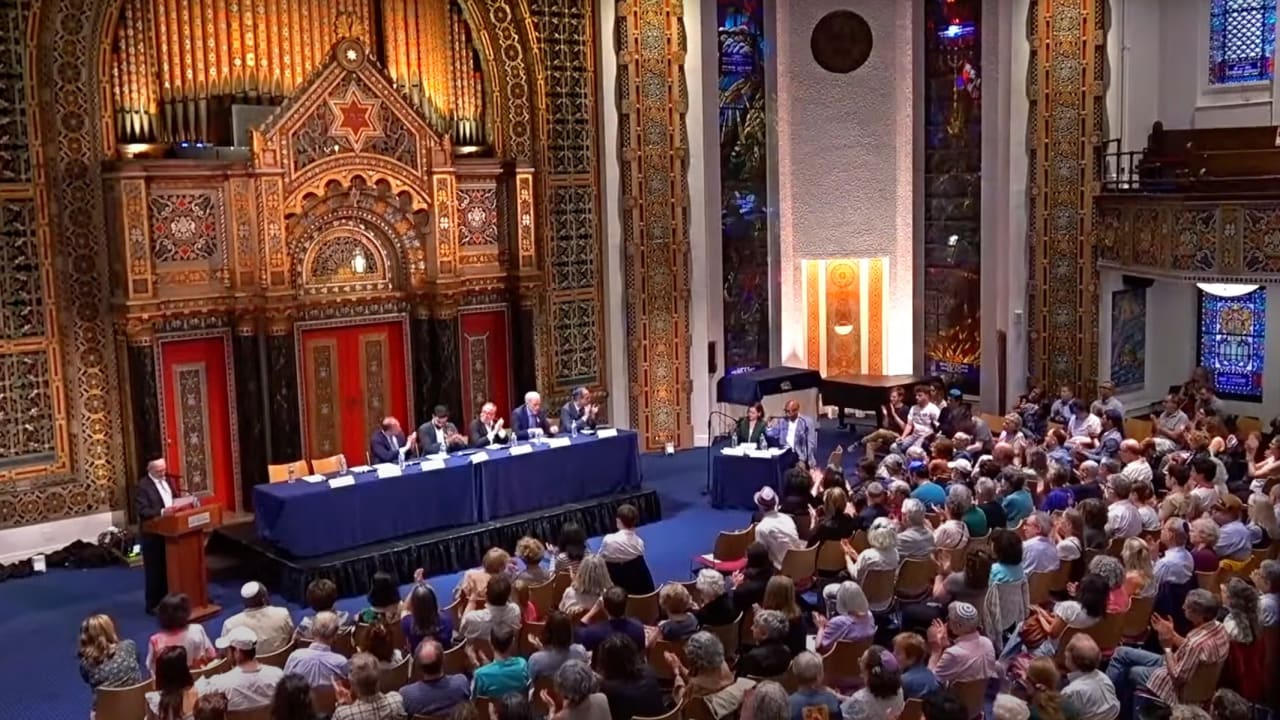
Once defined by Talmudic rigor and prophetic courage, the American rabbinate has become paralyzed by prestige and fear. What began as a sacred calling has devolved into an industry of moral management and polite press releases. As antisemitism explodes and Jewish insecurity deepens, too many rabbis have chosen comfort over conscience, substituting activism for Halacha and sentiment for strength. The time has come to restore a rabbinate unafraid to judge, to lead, and to tell the truth — five minutes early, not five minutes too late.
From Talmud to TED Talk
The job description of a rabbi did not begin as a sermon or a social media clip. It started as hora’ah — the act of rendering law and conscience, of translating the eternal into the immediate. A rabbi was once a posek, a jurist of the soul. Today, too many are motivational speakers with a title.
The Shulchan Aruch defines who may issue rulings, and Maimonides warns that one who does so without mastery of the law is “foolish, wicked, and arrogant.” Yet in much of American Jewish life, the rabbinate has drifted from jurisprudence to performance. Seminaries select for charisma, fundraising, and optics. The pulpit has become a platform — a stage for personality, not a seat of judgment.
This transformation began when American Judaism, in its liberal denominations, redefined the rabbi not as a jurist but as a social worker of faith. The result is a class of leaders fluent in politics but illiterate in psak. Instead of Talmudic analysis, we get press statements about “shared values.” Instead of the authority to decide, we get the anxiety to offend.
There’s a difference between a rabbi who teaches Torah and one who tweets about tolerance. The former is a teacher of law; the latter, a manager of public mood. And law — fundamental Jewish law — requires courage, not consensus.

The essence of hora’ah is decision, not dialogue. You can’t crowdsource revelation. But American rabbinic life, built on boards, donors, and committees, now functions like a consultancy. The question is no longer “What does Halacha demand?” but “What will the membership tolerate?”
Somewhere along the way, we traded Talmud for tone.
Whiskey and watered wine
A real rabbi once intoxicated the soul with the sharp burn of Torah. Today, we get the equivalent of a watered-down sermon — something sweet enough to sip on Yom Kippur, forgettable by Neilah. A watered-down rabbi doesn’t get you drunk on Torah; he gives you the hangover of moral confusion.
It’s like the difference between whiskey and club soda. One stings, burns, and wakes you up. The other numbs you. The modern American rabbinate has become the club soda of Jewish life — safe, sparkling, and utterly without bite.
This isn’t about religiosity or piety. I’m not a Shomer Shabbat Jew, and I don’t pretend to be. When I don’t follow something in Halacha, it’s not because I’m rationalizing — it’s because I don’t want to. But I don’t lie about it. The problem with much of the liberal rabbinate is not leniency; it’s dishonesty.
They turned Judaism into a brand of American moral liberalism — replacing Mosaic law with progressive platitudes, dressing up secular activism in tallitot, and mistaking Democratic politics for Jewish ethics. Reform and Conservative Judaism could have modernized without sacrificing the halakhic backbone that enabled Jewish continuity. Instead, they hollowed it out.
It’s not that non-Orthodox rabbis can’t be learned — many are deeply so. But they were taught to apologize for their tradition before teaching it. They fear being “too Jewish.” They want to prove that Judaism is compatible with modernity, forgetting that Judaism survived by refusing to be absorbed by it.
What America now calls “rabbinic leadership” is often a credentialed class of professional Jews more concerned with influence than inheritance. They’ve mistaken the role of rabbi for influencer — the same way a motivational coach borrows therapy language to sound profound. It’s branding, not binding law.
And what happens when rabbis stop ruling and start branding? The people stop listening.
The fearful rabbinate and the great silence
The last decade exposed this failure in brutal clarity. When antisemitism began to metastasize across campuses and cities, most rabbis treated it as a public relations issue, not a spiritual one. When Israel was demonized in the public square, they organized “listening sessions.” When Jewish students were harassed, they issued joint letters and press releases.
The data tell the story: 9,354 antisemitic incidents in the US in 2024, the highest ever recorded, with 58% directly tied to Israel or Zionism. On American campuses, antisemitic incidents rose 84%. In New York City — the largest Jewish community outside Israel — Jews were the victims in over half of all hate crimes. And yet, the pulpits stayed polite.
Even the rare moments of moral courage — like Rabbi Elliot Cosgrove’s recent warning that New York politician Zohran Mamdani “poses a danger to the security of the Jewish community” — arrived late, after years of rabbinic hesitation. And when over a thousand clergy signed a national statement condemning Mamdani’s record, Cosgrove declined to sign his own. The fear of seeming “partisan” outweighed the fear of being silent.
This paralysis isn’t new. It echoes the rabbinic establishment’s failure before the Holocaust — when many European rabbis urged calm rather than migration, preferring loyalty to the societies that would soon betray them. Today’s American rabbinate, in its fear of “dual loyalty,” repeats the same mistake in different clothing.
But the silence isn’t confined to rabbis. The entire American Jewish leadership class — federation heads, CEOs, institutional elites — has been afflicted by the same disease: fear disguised as dignity. They were too afraid to speak during Roosevelt’s silence. Too scared to oppose the Iran deal. Too frightened to confront antisemitism in universities, unions, and media. And even after October 7 — when Jews were butchered in their beds — too many still could not summon the moral clarity to stand, unequivocally, for their own people.
Fear has become their theology. They tremble not before God but before donors, journalists, and Twitter mobs. They mistake diplomacy for dignity and press releases for prophecy. They’ve turned Judaism into an HR department for Jewish anxiety.
What began as a fear of seeming “too Jewish” has metastasized into a paralysis of conscience. In their effort to appear loyal to everyone, they’ve become loyal to no one — not to their people, not to their faith, and not to the covenant that bound us at Sinai.
The accusation of “dual loyalty” was always a lie — an antisemitic weapon meant to shame Jews out of self-defense. True loyalty means fidelity to justice, truth, and the Jewish people — wherever they live, and whatever flag they hold.
The rabbinate’s fear of that accusation is not humility; it’s cowardice. It is the cowardice of comfort — the spiritual rot of those who prefer the illusion of influence to the responsibility of leadership.
Five minutes early
Judaism doesn’t need to become Orthodox to become honest again. It requires a rabbinate unafraid of its own texts, unafraid to teach, judge, and decide. It requires leaders who understand that Torah is not a branding exercise, but a civilization — and that the purpose of a rabbi is not to comfort the comfortable, but to command the conscience.
A real rabbi, like a shot of whiskey, should burn a little on the way down. It should wake you up. That’s what law is supposed to do.
The next generation of Jewish leaders must rediscover that bite because soft sermons and viral hashtags will not save the future of American Jewry. It will be saved by courage — the courage to say what’s true, to act before it’s too late, and to once again make the rabbinate a seat of judgment, not a stage for applause. If there is to be a renaissance in Jewish leadership, it begins with an end to this great silence. The standard must be simple: issue psak five minutes early, not five minutes too late.
Adam Scott Bellos is the founder and CEO of The Israel Innovation Fund, home to Wine on the Vine, Herzl AI, and Project Maccabee. His forthcoming book, Never Again Is Not Enough: Why Hebraization Is the Only Way to Save the Diaspora, charts a bold vision for Jewish cultural and linguistic renewal. Bellos writes widely on Jewish leadership, identity, and the rebirth of Zionist thought in the twenty-first century.
He believes the Jewish future will be built not in institutions that apologize for being Jewish, but in vineyards, classrooms, and code—where courage, creativity, and Hebrew once again become the language of our destiny.