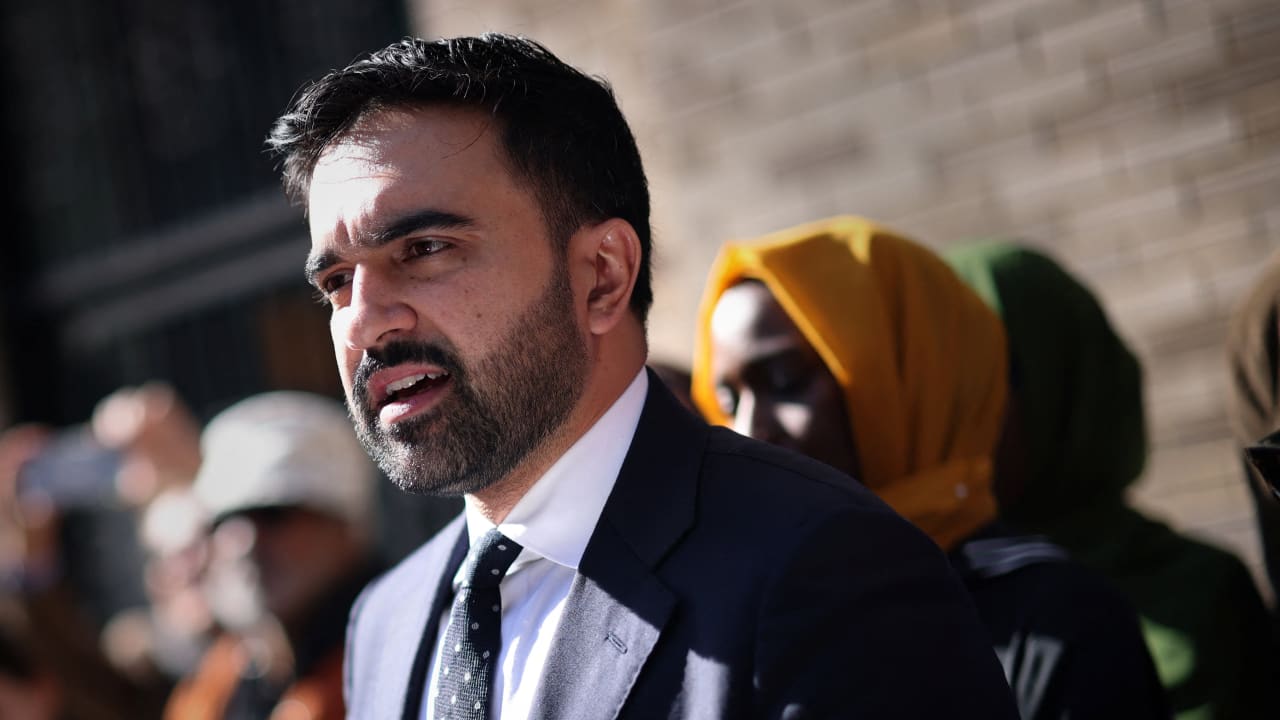
The “Weekend Update” segment of a recent Saturday Night Live episode featured an interview with a fictional New Yorker, Rhonda LaCenzo, about her anxieties over Zohran Mamdani potentially becoming the city’s next mayor. Many of her objections to Assemblymember Mamdani were rooted in unambiguous Islamophobia. Yet, while she referred to him as a “hipster jihadist,” nowhere did the sketch address substantive concerns about his stance on Israel and the way his positions and words feed Jewish anxiety.
Admittedly, that may have been too much to expect from an SNL comedy sketch. However, the segment left me worried about the conflation of hateful anti-Muslim bias and legitimate alarm over Mr. Mamdani’s anti-Zionist views.
Muslim-Jewish relations
As a congregational rabbi, I have spent 25 years involved in initiatives bringing American Muslims and American Jews together. We share so much in common: Not just our founding narratives of Abraham, Sarah, Hagar, Isaac, Ishmael, and Joseph but also our more recent experiences as immigrant populations who looked to and came to America as a land of opportunity and religious freedom.
Both communities have known the challenges of acculturating without assimilating and integrating while maintaining our unique ethnic and religious heritage. We have also both known bigotry and exclusion. I believe it would be an extraordinary achievement for New York City, the most culturally diverse metropolis in the world and one that prides itself on such diversity, to elect a Muslim mayor.
Legitimate concerns
However, Mr. Mamdani’s candidacy concerns me greatly. If he fails to appreciate the power of his bully pulpit as a candidate to ease or heighten the Jewish community’s fears, how can we expect him to embrace that power if elected? Does he still not understand that anti-Israel rhetoric has generated a sharp spike in antisemitic violence?

For Jewish New Yorkers, the issue of security hits especially close to home. Some have been attacked on the street. Our institutions, regular targets of bomb threats, have been transformed into fortresses of bollards, screening devices, security personnel, and off-duty police officers. And thank God we have them.
Recently, immediately following the implementation of the first phase of US President Donald Trump’s 20-point Gaza peace plan and the exchange of the 20 surviving Israeli hostages for more than 2,000 Palestinian prisoners, Hamas reemerged into the open as a menacing presence on Gaza’s streets, publicly executing its Palestinian rivals.
When asked in an interview with Fox News whether Hamas needed to surrender its weapons, Mr. Mamdani refused to answer. So he was asked again. And again, he dodged the question. Only the next night, during a mayoral debate, did he finally concede that yes, Hamas must disarm in fulfillment of the ceasefire deal.
He claims he does not believe Israel should be a Jewish state because he does not think any nation should preference the needs of one religious community over another. Yet that assertion fails to acknowledge the historic and geographic realities that made and still make a Jewish state necessary – that few countries were willing to take in Jewish refugees before, during, and after the Holocaust, and that Israel remains a vital refuge against rising global antisemitism today.
While Mr. Mamdani can muse about the countries surrounding Israel on all sides renouncing their Muslim character, it sounds ridiculous to the point of comical. No Jews I know are asking for that. We just need a secure Israel and a sense of safety for our community.
The Johnson Amendment
In 1954, then-US senator Lyndon B. Johnson championed a bipartisan amendment to the tax code, prohibiting houses of worship from politicking on behalf of candidates. Given that last July, the Internal Revenue Service effectively nullified the ban, some have asked me whether I will urge congregants to vote for a particular candidate in the mayoral race.
I believe the Johnson Amendment was an invaluable extension of this country’s separation of religion and state, preventing candidates and their powerful allies from co-opting the pulpit as an arm of their campaigns and insisting clergy remain focused on issues in a non-partisan, balanced fashion so we can critique both Left and Right from an uncompromised moral footing.
While I will not tell people who I think they should vote for, I will continue to examine, through a Jewish lens, issues of concern I hope my congregants will consider when they enter the voting booth. The physical and emotional well-being of the Jewish community should be a priority among them. For me, entrusted with the leadership of a major metropolitan Jewish institution, it is my highest priority.
I pray it will be one of our next mayor’s as well.
The writer, a rabbi, is the Peter and Mary Kalikow senior rabbinic chair at Congregation Emanu-El of the City of New York.