
Many long years ago, The Jerusalem Post published a column under the heading of “Cornucopia.” The column dealt mainly with the extraordinary generosity of Diaspora Jews who keep sending huge sums of money for projects in Israel.
It was estimated that if all the donor plaques on the walls of hospitals, universities, schools, yeshivot, museums, public libraries, and other institutions were laid end to end, from the northern tip of Israel to the south, there would not be sufficient space to accommodate them.
As proud as we are of Israel’s achievements as a nation, and of the achievements of individual Israelis in science, medicine, academia, music, sport, economics, literature, art, entertainment, and more, much credit is due to Diaspora Jews who, for more than a century, have been financing projects in the Holy Land and continue to do so – especially when times are tough.
Such investments in Israel’s future have always been important, but particularly now, when so many countries are imposing economic sanctions against Israel and refusing to import “Made in Israel” products. The effects are being felt in every Israeli export industry, which also means fewer funds in government coffers, and less to distribute in various categories of social welfare.
Some philanthropic foundations have left trust funds or other provisions for Israel to continue after the founders of those foundations are no longer in the land of the living.
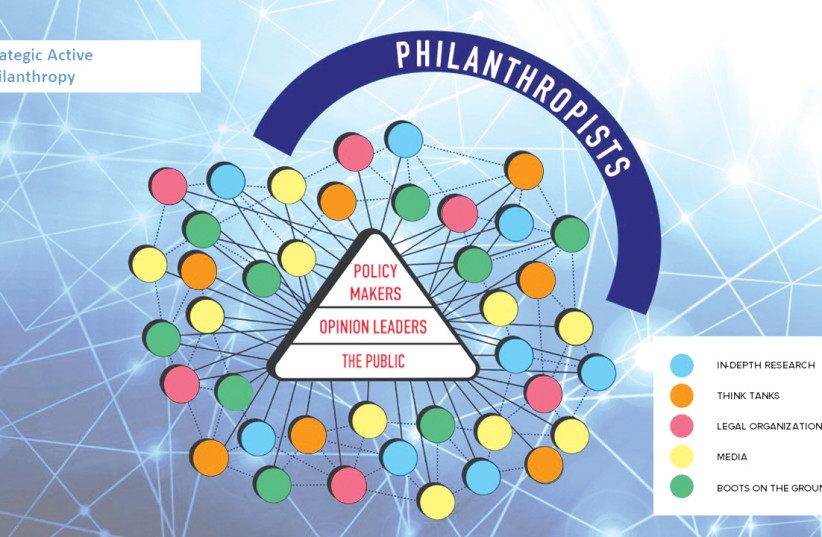
An example is the Jack, Joseph and Morton Mandel Foundation, which has given tens of millions of dollars to Israel. The three brothers are no longer living, but the foundation continues to exist, and, as part of the emergency war effort, donated NIS 210 million to Israel. Most recently, it donated $26m. to the Weizmann Institute to help speed up the replacement of laboratories and buildings that were destroyed or damaged by an Iranian missile.
Mandel Foundation President Prof. Jehuda Reinharz said that the foundation works out of a sense of Zionist vision and duty to help the major institutions of the Jewish people. It recently donated NIS 55m. toward the construction of new homes in the Gaza Strip.
All of Israel’s universities, museums, hospitals and various cultural and social welfare organizations are supported by Diaspora Jewish organizations, foundations, and individual philanthropists, in addition to which many institutions have Friends associations, mainly in the US but also in other countries.
■ AMONG THE many beneficiaries of the generosity of Diaspora Jewry is Yad Sarah, which is now making inroads in the Swiss Jewish community.
At the gala inaugural dinner of the Swiss Friends of Yad Sarah, which was held in Zurich at the end of August, $1.4m. was raised in support of rehabilitation and healing in Israel, as well as for families of hostages and victims of the war.
Among the speakers at the event were Daniel Levin, board member of the Liechtenstein Foundation for State Government, a key figure in hostage negotiations, and philanthropist Aaron Frankel, who matched whatever was raised from the 200 people who attended.
Philip Bendheim, member of the Yad Sarah International Board, whose family has long supported health projects in Israel, also helped to inspire donations.
These funds will help to expand Yad Sarah’s efforts since October 7, and will provide mobile oxygen units and home recovery equipment.
Levin spoke of some of the challenges faced by negotiators, and Frankel, who is chairman of the International Board of Yad Sarah, but also supports a variety of Israeli endeavors in different fields, underscored the importance of giving.
■ IT TAKES a lot of courage and patience to come from Herzliya or Tel Aviv to Jerusalem on a Thursday night, which is the weeknight on which families of hostages hold mass demonstrations, which cause tremendous traffic congestion.
But several of the guests invited to a ceremonial dinner for Fiji Prime Minister Sitiveni Rabuka, which was hosted by the Friends of Zion Museum (FOZ), managed to get there on time. It wasn’t difficult for Kosovo’s chargé d’affaires, Ines Demiri, Guatemalan Ambassador Ava Atzum Arévalo, International Christian Embassy Jerusalem (ICEJ) President Juergen Buehler, who all live and work in the capital, but it was a little more complicated for Nepali Ambassador Dahn Prasad Pandit, Australian Ambassador Ralph King, Estonian Ambassador Andres Vosman, and Dan Oryan, director of the Department of Civic Diplomacy at the Foreign Ministry, as well as for others who don’t live in Jerusalem.
Prior to his appointment, Vosman, who last week presented his credentials to President Isaac Herzog, served as deputy director-general of the Estonian Foreign Intelligence Service, and prior to that held various positions in the Ministry of Defense and at NATO.
The event was in celebration of Fiji having officially opened its embassy in Jerusalem. Rabuka and Prime Minister Benjamin Netanyahu inaugurated the embassy the previous day, when Rabuka was also feted by Foreign Minister Gideon Sa’ar.
Other countries with embassies in Jerusalem include the United States, Guatemala, Honduras, Kosovo, Papua New Guinea, and Paraguay. Negotiations for Liberia to open an embassy in Jerusalem are progressing.
Fiji’s ambassador to Israel, Filipo Tarakinikini, was previously head of Fiji’s permanent delegation to the United Nations.
Rabuka was honored by FOZ as have other global leaders who support Israel, but especially honored has been the president or prime minister of every country that opens an embassy in Jerusalem. Each of these leaders has been presented with the FOZ Award, a menorah, Israel’s national symbol.
In the absence of FOZ founder and president, Mike Evans, the award was presented by FOZ Director Nir Kimhi and FOZ General Manager Daniel Voiczeck.
In a video presentation Evans noted the significance of Fiji’s decision and praised Rabuka for his firm and determined support for Israel at crucial moments, for opening the embassy in Jerusalem, for publicly expressing his support for Israel’s right to defend itself, and for condemning the October 7 attacks and reiterating his commitment and support for Israel’s security and right to self-defense.
It was not the only award that Rabuka received that night. There was also one from ICEJ – the Cyrus Award – named for Cyrus the Great, who liberated Jerusalem and contributed to the rebuilding of the Temple.
Buehler said that Rabuka had the spirit of Cyrus. He also quoted from the Book of Genesis where God said: “I will bless those that bless you and curse those that curse you,” and told Rabuka that he would be among those who will be blessed.
In accepting the awards, Rabuka hinted, without actually saying so, that indigenous Fijians might be descended from the lost tribes of Israel.
Fiji has always been very close to Israel, he said. In Fijian folklore, there is the tale that the first Fijians came from a faraway land. When Christian missionaries first came to Fiji, they were surprised to discover that all the Fijian males were circumcised – this without ever having heard of Abraham or having seen a Bible.
Rabuka also mentioned that when he had apologized to Papua New Guinea Prime Minister James Marape for his inability to attend PNG’s 50th anniversary of Independence reception, and told him the reason why, Marape said “You are doing the right thing.”
■ PHOTOJOURNALIST Sarah Davidovich, of Maariv Yerushalayim, who in addition to being a good photographer is also an expert driver, saw the chaotic traffic situation as she emerged from the event and immediately proceeded to direct traffic, which she did more efficiently than traffic police.
Cars that were literally stuck, and whose drivers were nonplussed about the direction in which they should move – if at all possible – were instructed by Davidovich, who managed in a brief period of time to have all the cars moving.
It was hardly surprising. Anyone who has been in her car when she is driving in a congested area knows her ability to weave in and out of traffic, without breaking any speed violations or grazing any other car.
■ THERE HAVE been many debates as to whether Israeli high school students should be sent on group trips to Poland. Those against argue that Poland is an antisemitic country, and that there is no reason for Israeli students to go there to be harassed and possibly subjected to violence. Those in favor of sending students say that it’s important for them to visit the death camps established by the Germans on Polish soil, and to mingle with Polish students to exchange ideas and to reduce and even disprove all the negative things that one side has heard about the other.
Proof of the validity of the latter argument takes place annually in Czestochowa, arguably the most Catholic city in the world outside of the Vatican, and famous for its Black Madonna.
A group of close to 200 Israeli students was in Poland this month, not only to visit the camps and in some cases to get a concept of family roots, but also to clean up the Jewish cemetery in Czestochowa, to meet with Polish students, to learn some words in Polish, to teach some Hebrew words to Polish students, and to dance the hora together.
Their time in Czestochowa was jointly facilitated by the Association of Czestochowa Jews in Israel and the Adulam Foundation in Czestochowa.
According to Hagit Buchwinder and Gila Wenig, two of the guides who accompanied the students, it was a very positive experience, in which the students felt that they were doing something active to preserve the memories of the Jewish community of Czestochowa.
The students were from the Shimon Greenhouse Multidisciplinary School in Petah Tikva and the Hey Municipal School from Haifa.
While the students of one school cleaned the cemetery, students of the other school met with their Polish peers at the Slowacki High School and found much to talk about, and to help improve mutual understanding of each other’s culture and history. They came away with the impression that fraternity and love between Poles and Jews is possible, and that a small thing can become a big thing.
One student said: “As a Jewish girl living in the Land of Israel, I was privileged to see Poles helping to commemorate the memory of Jews.”
Alon Goldman, Israel chairman of the Association of Czestochowa Jews, said: “These meetings allow students to learn about the long-standing shared history of the two peoples in Czestochowa and between the two nations, Poland and Israel, with openness, tolerance, multicultural understanding, and positive cooperation.”
As is the case in many relationships between Jewish Israelis and their peer groups in other countries, government policy does not necessarily filter down to the masses. The same goes for Israel. On an individual basis people relate to each other, even when the governments of their respective countries are at loggerheads.
This can also be seen in relations between Israelis and Palestinians. While it is true that there are Palestinian terrorists, and there are Jews who terrorize Palestinians, there are those on both sides who share each other’s pain, who have formed friendships with each other, and who last Friday placed a full-page advertisement in Haaretz calling for an end to the war.
The advertisement, placed by the Parents Circle-Families Forum, contained some 180 signatures of Israelis and Palestinians who have lost loved ones. Their message reads: “We members of the Parents Circle-Families Forum, Israelis and Palestinians who have lost loved ones, know there is no other way. Stop the killing. Stop the cycle of revenge. It is time to sign an agreement. It is time to choose peace and reconciliation.”
In Jerusalem, last Saturday night, there was a much larger crowd than usual calling for the release of the hostages, but one man from Kibbutz Holit, close to the Gaza border, got into an argument with another demonstrator.
The kibbutznik was angry that as the second anniversary of the carnage that took place on October 7 approaches, the rallies around the country are being held solely on behalf of the hostages who are still in Hamas captivity in Gaza, and little or no mention is made of all the children who were murdered.
The other demonstrator, who was holding a plaque with the portrait of a hostage, mistook the kibbutznik for someone opposed to a deal that would bring the hostages home, and screamed at him.
“My son is serving in the reserves,” he shouted back at her. “Why are they talking only about the hostages, and not the children?”
On October 7, Holit, which was all but destroyed, lost 15 of its 180 members – albeit not children. But in other kibbutzim, children were cruelly slaughtered.
■ WHEREVER THERE is a Chabad Center in the world, the directors waste little time in getting to know the mayor, legislators, ministers, the prime minister, and the president.
Thus it came as no surprise last week to see Rabbi Yisroel Goldberg, the director of Chabad of Rehavia and Nahlaot in Jerusalem, hobnobbing in the lobby of the Crown Auditorium in the Jerusalem Theater with US Ambassador Mike Huckabee, who was the guest speaker at an event hosted by the Michael Levin Base for Lone Soldiers and women in Civilian National Service.
Even though the last of the rebbes in the Chabad dynasty, Rabbi Menachem Mendel Schneerson, widely known as the Lubavitcher Rebbe, died in 1994, all Chabad directors and their assistants see themselves as emissaries of the rebbe, as does Australian mining magnate and philanthropist Rabbi Joseph Gutnick, who, in line with what the rebbe told him, advocates the Greater Israel movement, and has written a book under the title of Make Peace.
Goldberg presented the book to Huckabee, who showed interest and promised to read it and to strengthen his commitment to advocate for a safe Land of Israel.
When Chabad of Rehavia and Nahlaot moved from its King George Avenue premises to a larger venue not far away, it turned its former storefront Chabad Center into an IDF lounge for soldiers to come and relax, learn a little about Judaism, pray together if they wish, and benefit from other Chabad services.
■ GISHA, an Israeli not-for-profit organization, which works to protect the freedom of movement of Palestinians, last week sent an urgent letter to Defense Minister Israel Katz, IDF Chief of Staff Eyal Zamir, Attorney-General Gali Baharav-Miara, and COGAT head Maj.-Gen. Ghassan Alian.
Cosignatories to the letter are the Association for Civil Rights in Israel, HaMoked: Center for the Defense of the Individual, Adalah, and Physicians for Human Rights – Israel.
In their letter, the organizations demanded the immediate cancellation of the displacement orders issued by the Israeli military to residents of Gaza City. They emphasized that these orders are manifestly illegal and are being implemented in an area where famine has already been declared. The orders target a population that is exhausted, starving, and deeply traumatized, with nowhere to go and no safe place to seek shelter.
The orders seek to compel approximately one million residents to squeeze into a severely overcrowded area in the southern Gaza Strip, in another blow to the civilian population. According to reports, following criticism from the military advocate-general, what has been designated as a humanitarian area was expanded on September 12 from less than 12% to about 21% of the territory. However, Israel is not guaranteeing adequate living conditions there, the signatories to the letter stressed.
According to the organizations, the orders amount to forcible transfer – a war crime and a crime against humanity – and even constitute a step toward ethnic cleansing, especially in light of statements by government officials expressing intentions for permanent Israeli presence in Gaza.
The organizations wrote: “Forcible transfer of a protected population, whether through use of force, threat of force and intimidation, or by creating living conditions that are unfit for human existence, including starvation, violates international humanitarian law. Each of the above measures constitutes a violation of the law.”
The organizations concluded their letter by calling on the Israeli authorities to immediately cancel the displacement orders; allow displaced persons to return to their homes; end the systematic destruction being wrought; and significantly expand access to humanitarian aid throughout the entire Strip, including northern Gaza.
■ THE ISRAEL Women’s Network is seething with anger and indignation over a letter sent to all the principals and management of religious seminaries for girls by rabbis of the National-Religious movement. Among the signatories are rabbis Dov Lior and Shmuel Eliahu.
The letter urges the people in charge of the seminaries to do all in their power to prevent the young women in their charge from enlisting in the IDF, and to refuse to allow IDF representatives to enter the premises of the seminary.
“Instead of presenting all the options available to the young women after they graduate, and allowing them to choose for themselves which path is best for them, this is yet another attempt to silence women’s voices, to limit their freedom of choice, and to isolate them from the opinions of Israeli mainstream society,” the women’s network charges.
Furthermore, according to the network, “The events of October 7 prove once and for all how essential it is for women to serve in the IDF, in the air, on land and on sea, and in every sector of the defense forces.”
■ WELL-KNOWN artist and former member of the Post’s editorial staff Heddy Breuer Abramowitz has been included in the exhibit “Proverbs, Adages and Maxims” now on display at the Heller Museum, Hebrew Union College, 1 West 4th Street, New York. The exhibit is already open to visitors, but the official opening will take place on Thursday, October 16, 5 p.m.-7 p.m. Readers who will be in New York at that time are invited to attend.
Breuer Abramowitz is one of 57 artists who are exhibiting, and is one of one of four Israeli artists who are participating.
Meanwhile, back home in Jerusalem, she is participating in a group exhibition, “A Reason to Get Up in the Morning,” which opened recently at the Social Space Gallery in the former President Hotel at 3 Ahad Ha’am Street.
The artists have scheduled a gallery talk for English-speakers at 10:30 a.m. on Tuesday, September 28. Visitors to the exhibition can have their portraits sketched and added to the ever-changing dynamics on the wall.
greerfc@gmail.com