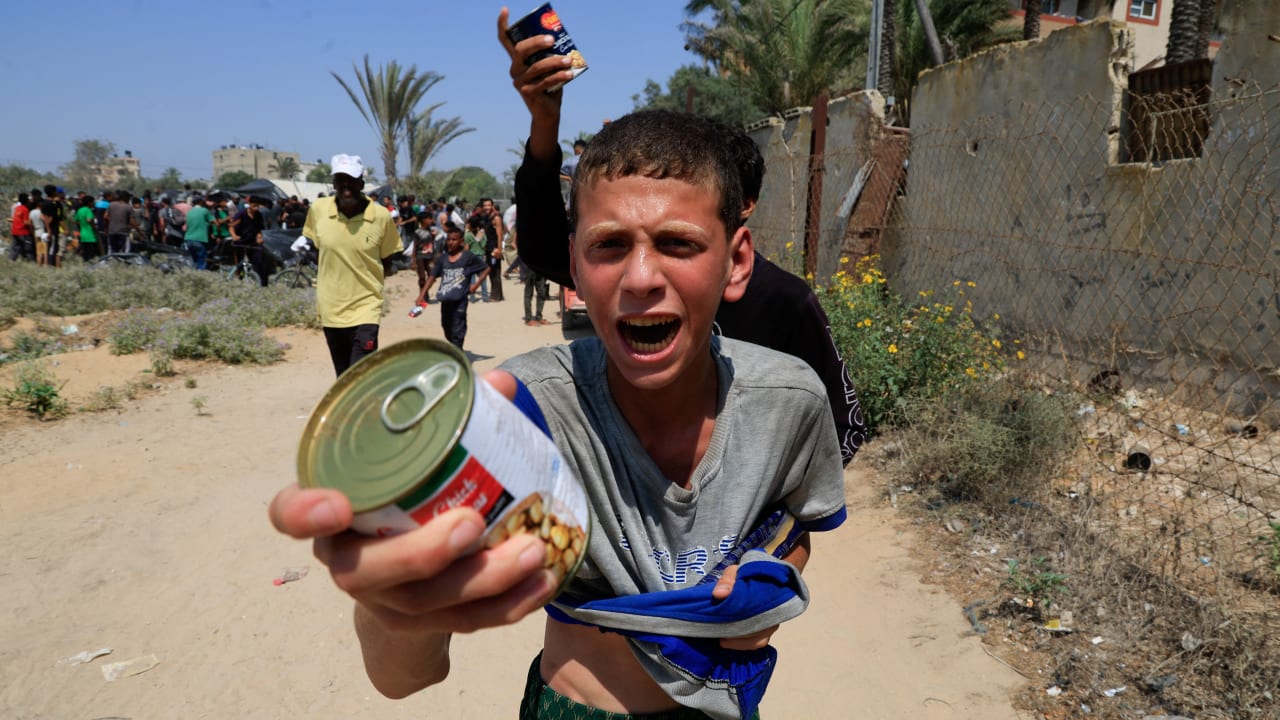
One of Hamas’s greatest achievements, with Al Jazeera’s help, is the complete monopoly in framing and visualizing what happens in Gaza. The basic, almost ever-present frame is that of Gaza’s complete destruction. More recently, the continuous messaging that the people of Gaza are starving dominates the news coming out of the Strip. Many of the international media sites buy into the story of starvation in Gaza as they turn the theme into major headlines.
Yet how true is this claim? Looking at the visuals shown on Hamas’s al-Aqsa media site and TV station is probably the best way to check its veracity. Clearly, Hamas’s media site has every interest to match its messages of widespread starvation with visual material proving it.
Watching Hamas's media site
Tuning into the station on Tuesday, July 29 at 4:10 p.m. for one hour, one quickly realizes that there are other matters that concern Hamas. The interview with an expert on military strategic affairs does not bode well for the claim of starvation. The interviewer, in gray-blue Islamic dress, looks well-fed. Her makeup is striking. It raises the question of how Hamas, which is so concerned over the welfare of “its” people, can afford cosmetics in the face of widespread starvation? Even more disconcerting: How can Hamas procure cosmetics in a completely besieged Gaza?
The interviewee is certainly on the lean side, but his excellent literary Arabic prose he uses to analyze the visuals of Israeli airstrikes that appear during the interview, and his loquacious arguments about how the resistance is winning against a superior military force, show little sign that he’s suffering from prolonged hunger. You would think that prolonged hunger affects one’s ability to focus on a subject.
The same can be said of the media experts in the terrorist organization who are responsible for the messages, in excellent Hebrew, and the formidable graphics shown in the background during the interview with the military expert. They were addressed to the “Zionist entity” soldiers: “If you want to live, give up your arms,” appears on one message.

“Being a prisoner is better than dying. You will be treated well” is another, in an obvious attempt to augment the depleted ranks of Israeli hostages the organization holds and which is Hamas’s major card in assuring its existence. The visuals show the better-fed Israeli hostages released from Hamas captivity.
Starvation and death in Gaza
Starvation looms larger in the next interview with Hamid, an expert on international law and human rights. At this point, most of the interview descends into garble, whether because it is jammed or because of my poor Internet connection. The visuals, however, are unaffected and flash in quick succession: One shows about six people mourning a corpse in a shroud.
Three of those closest to the camera are women in clean Islamic dress, as three men stand behind them. All seem adequately fed and dressed. This is followed by a very distressing visual of an emaciated child.
Again, it is remarkable that everyone in the child’s immediate vicinity – including the mother, the nurse holding him, and other medical personnel – looks normal and is attentive. Absent the child from the frame, you would have a scene typical of any health institution in Gaza or elsewhere.
Toward the end of the interview with Hamid, slow-moving visuals of two emaciated and deformed babies are shot from every angle possible as the hands (presumably of a health worker) slowly move the joints of each of them. This is followed by yet another emaciated and deformed child on an ambulatory bed being accompanied by about 10 persons. None of them show any signs of malnutrition and seem well-kempt and neatly dressed, despite the looks of distress and worry on their faces.
Then, a white new shroud, presumably of a baby (considering the shroud’s small dimensions) is placed on a rug on a new cobblestone entrance to the hospital.
As the interview with the expert on human rights comes to an end, a spate of military propaganda films are aired – first by the Hamas military wing Izz al-Din al-Qassam’s propaganda department, then by the parallel Islamic Jihad’s Siraya al-Quds. The terrorists shown from the chest down appear preparing booby traps or burying them on the roads in the hope that they will detonate against Israeli forces.
Once again, their nimbleness at work and their physiques do not indicate any signs of malnutrition. What follows are very blurred scenes of the detonation of booby traps against presumably Israeli troops and vehicles.
The reason Hamas and the other terrorist organizations are fighting is clearly the theme connecting the spate of visuals and videos that appear afterward. Again, mourners are seen following a shroud: once again, a milieu of men and women, some lean, others less so, but none that conjure scenes reminiscent of Somalia or Darfur.
Then there’s a change of scenery. People against the background of destroyed homes are interviewed. Their message is one of victory and steadfastness in “staying put” in the homeland. Once again, no sign or indication of hunger.
The hour ends with a demonstration of about 200 people in the Israeli Arab town of Umm el-Fahm. What most of them have in common is that they seen carrying pots and pans in their protest against hunger in Gaza.
After one hour of viewing Hamas’s al-Aqsa channel, the findings are telling: Four emaciated and deformed babies, and at least a hundred normal-looking Gazans, men, women, and children.
Is this the tale of widespread hunger? Test the proposition yourself on al-Aqsa TV (www.seraj.tv). After all, visuals can be understood in any language.
The writer is a professor emeritus at Bar-Ilan University in political science and Middle East studies, and a senior researcher in the Jerusalem Institute for Strategy and Security.