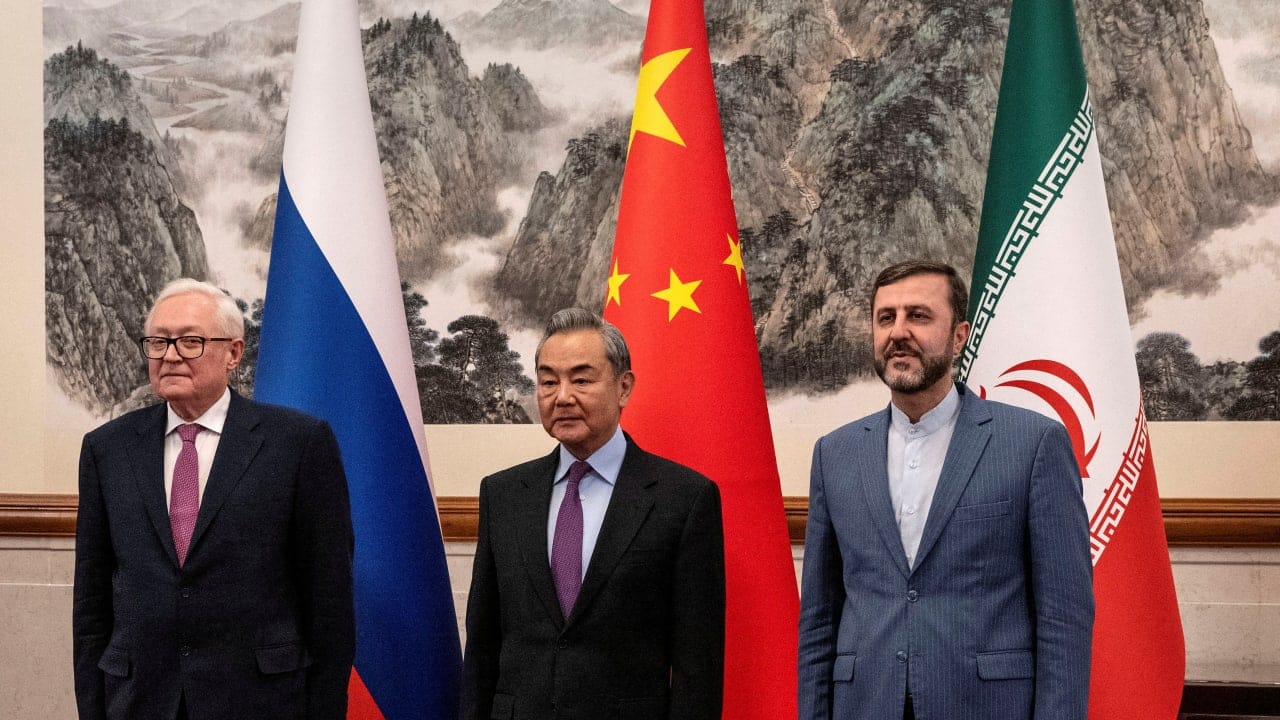
In war or truce, the Israel-Iran crisis will test China’s power play with the United States.
The conflict has left Beijing a diminished “strategic” partner in Tehran. It has shown that participation in Chinese-dominated international forums alternatives to Western-led institutions – such as the BRICS+ grouping and the Shanghai Cooperation Organization – does not provide a secure shield from armed actions by America and its allies.
While the Iranian leadership likely expected the Chinese to offer a level of support that went beyond simple words of condemnation of US and Israeli bombings, Beijing sat idly by during the confrontation.
Chinese President Xi Jinping has limited cards to influence the evolving dynamics between Israel, the US, and Iran. The multipolar world he champions, as opposed to the unipolar one led by the US after the end of the Cold War, is actually still far from reality.
China's dilemma in the Middle East
China must now decide how to cope with the new scenario in the Middle East. If the Israel-Iran conflict drags on, despite US President Donald Trump’s attempts at an extended truce, and the Chinese leadership comes to the Iranians’ aid, it will end up fueling global disorder, which is harmful to China’s economic recovery.

Conversely, if China avoids backing Iran materially, its image of a rising superpower capable of assisting friends and partners in the “Global South” – a key plank of its foreign policy – will suffer a hard blow.
Such a dilemma commands caution. In the event Xi opts for more proactive support, the direct supply of weapons to Iran would be a major turnaround for China.
Beijing had been a main arms supplier to the Iranians in the 1980s and 1990s. International penalties and China’s desire to avert a regional conflict over Tehran’s nuclear program have led to a diminution in direct weapons sales. Reports indicate that the Islamic Republic has ordered materials from China for its ballistic missile program and is seeking to buy other advanced Chinese weaponry, such as the J-10C fighter jet.
Some Chinese refiners have already faced disruptions in receiving Iranian crude due to US sanctions over Tehran’s nuclear and missile program. It is likely that the Trump administration would react even more strongly if Beijing were to arm Iran with fourth-generation aircraft. The move would inevitably irk Sunni powers, such as Saudi Arabia and the United Arab Emirates, which are China’s most important partners in the Persian Gulf region and geopolitical rivals of predominantly Shi’ite Iran.
More indirectly, China might provide Iran with geospatial satellite imagery for air defense and missile targeting. It seems Israel has not been able to take out all Iranian ballistic missile silos, meaning Tehran might still respond to Israeli attacks with around 1,500 surface-to-surface projectiles.
The US government has alleged that the Chinese are supporting Russia’s attacks in Ukraine in the same way, while India said on Friday that China gave Pakistan “live inputs” on the positions of Indian forces during the recent four-day war between Delhi and Islamabad.
There is another option on the table. The US and its allies have accused China of helping Russia’s operations in Ukraine with dual use items, such as chips and integrated circuits, which can be used to fabricate arms systems such as drones. Beijing denies it, but it might do the same with Iran with a high degree of plausible deniability.
The Iranians could also press the Chinese to go “nuclear” to prevent any new offensive from Israel, by threatening Prime Minister Benjamin Netanyahu and the sale of rare earth minerals and magnets to his country.
Like many other nations, including America, which covers the bulk of Israeli weapons imports, Israel is likely to rely on China for some rare earth elements, as Beijing dominates this sector’s global market. Rare earths are crucial for various industries, including advanced weaponry, while Israel lacks the capabilities and infrastructure to produce and process rare earth elements independently.
Wait and see remains the most probable alternative for China. Xi has said his country is ready to play a “constructive role,” which would require efforts to restrain the Iranian partner. Beijing already had a part in facilitating the conclusion of the defunct 2015 Iran nuclear pact aimed at limiting Tehran’s nuke activities, and proposes to revive it, as reiterated on Saturday by Chinese Foreign Minister Wang Yi.
The Israeli ambassador to Beijing has not ruled out Chinese mediation. However, if Israel remains on the offensive, China will not be able to rein in the Iranians, while it will not have diplomatic room for maneuver if Trump continues to monopolize the negotiating process with Tehran, as it seems.
The writer is a journalist and analyst covering foreign affairs and defense issues. He is a contributing writer to the South China Morning Post and ThinkChina, and was previously vice-editor-in-chief of AsiaNews, based in Italy. His writings have also appeared in multiple publications.