
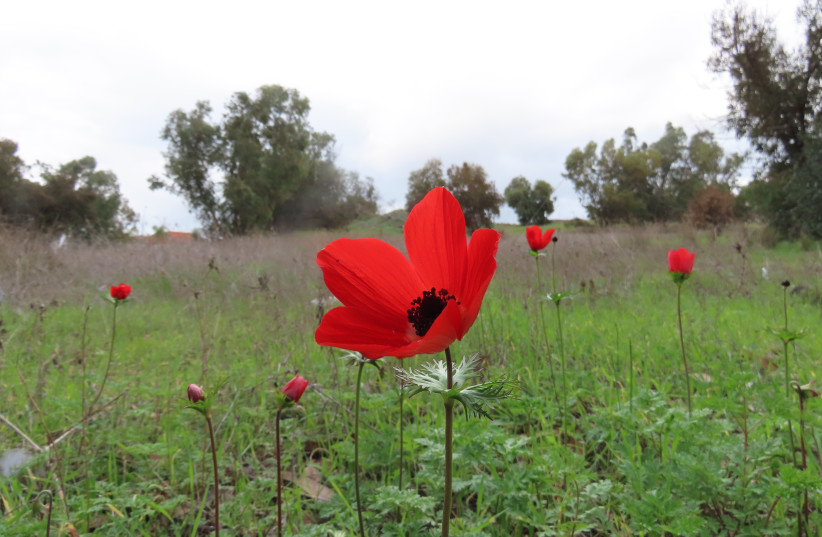
It’s a remarkable flower, the national flower of Israel: a glowing red bloom with delicate, eye-like petals and a bold black center, that blossoms all across the land – in the hills of the Galilee, the streets of Tel Aviv, and among the ancient stones of Jerusalem. Perhaps most strikingly, it blooms along the border with Gaza.
This flower is the kalanit, the anemone – one that grows where pain lives, and does not disappear.
On October 7, I went to bed in Los Angeles to sirens on my screen, a music festival turned massacre, rising death tolls, and names of kidnapped people. My heart was silent/bleeding. The world had shifted. Kibbutzim burned. Children were taken, even beheaded. Entire communities uprooted. Among them: Kibbutz Nir Oz.
The world shattered. We felt broken, lost, hopeless. Our strength turned into despair. Then, something else happened: action.
At the time, I was leading Yozma Heart Action, a student initiative rooted in compassion for the elderly. Yozma means “initiative” in Hebrew and I believed we had to act, even from across the world.
Our Yozma Heart Action group at Milken Community School in Los Angeles formed a connection with Kibbutz Nir Oz, where many members and founders were either kidnapped or murdered. We met survivors on Zoom. Shlomo, one of them, shared his story. We continued with letters and handmade gifts, a small reminder that they are not alone.
October 7 destroyed many lives and landscapes. But as the one-year mark approached, we searched for a way to hold the pain, to honor it, to respond to it. Then, I remembered the flowers.
The kalaniyot, they are still there. Yet even they struggled to bloom.
That year, the Darom Adom (Red South) flower festival, where thousands around the world would travel to see these flowers bloom, was canceled for the first time in years. The air was too heavy, the land too scorched. Still, I knew: these flowers, like the people of Nir Oz, would return.
So we planted kalaniyot at Milken: In rows, in bunches, in soil, and in spirit. It was a symbol of hope, of healing; a promise of a future where red blossoms bloom in peace, on both sides of the border.
And then, just a few weeks ago, nearly 20 months after October 7 and a few days before Israel’s recent Operation Rising Lion, our senior class from Milken traveled to the Gaza border area. We stood on scorched earth. We saw where kalaniyot had once bloomed.
These flowers are memory. They are resilience. They are hope.
A few days later, I stood in Kiryat Gat with my classmates, joining Nir Oz’s daily protest to bring the hostages home. Face-to-face with survivors from the worst hit kibbutz on October 7, even released hostage Ada Sagi, we listened. Displaced from their homes, their stories engraved in sorrow, they welcomed us into their temporary homes like family.
One student asked a kibbutz founder: “Do you think kibbutzim can still exist on the Gaza border in a post–October 7 world?” He smiled. “Of course. There is no other way. We will return and we will live. We will build our families again – we have to.”
They are using funds we raised at Milken, roughly $2,000, to restore their cemetery. To plant kalaniyot beside the graves of their loved ones, those who built and protected their kibbutz for decades. What we did at school, they are now doing at home.
That is the power of initiative – of Yozma. Even thousands of miles away, a group of teenagers with markers, soil, and Zoom became part of the story.
And we are not alone.
Honoring survivors, rebuilding Nir Oz, and planting resilience.
Since October 7, kalaniyot have appeared across Israel as emblems of unity and rebirth. At the Nova music festival site, red anemones now bloom for every victim. Artists have built entire installations, like Tears of Kalaniyot. In Tel Aviv, cafés like Otef serve food with purpose, donating proceeds to survivors of the Gaza border area communities to rebuild. Their symbol? The kalanit.
Even at my own high school graduation, I shared this story with my fellow graduates and their friends and families – in Hebrew.
So what do these flowers really mean? They mean connection. They mean we remember. They mean we choose life. And through it all, we must carry our roots.
From them, may we grow. May we plant. May we bloom. May we build.
May we be like the kalaniyot: Rooted in ancient soil, yet always reaching for the sun, stretching toward the future. May we carry our identities with pride and never be broken by fear.
I dream of a time when there will be peace. When every hostage returns home, to the arms of their family who never stopped praying; when the music returns to the places it was silenced and we will dance again; when sleep is undisturbed, and mornings begin with birdsong instead of blasts; when old wounds give way to shared roots.
In that vision, I imagine my great-grandfather smiling. Rabbi Akiva Kahen served as the chief rabbi of Rasht, Iran; a Jewish scholar in a majority Muslim country. He was a man of learning and conviction, rooted in Jewish tradition, yet respected by all who knew him.
However, after the Islamic Revolution of 1979, my family had to flee Iran. Like so many Jews, they shed their names, languages, and histories just to survive.
Yet, that same year, as the Middle East became a place of displacement and fear for many Jews, Israel and Egypt signed a peace accord. It was a spark of hope in a region scarred by conflict, proof that even amid deep division, a better future was possible.
This is the Jewish experience: moments of loss, and moments of hope. And what connects them? The power to know who we are. The power of identity.
The kalanit, like our people, grows where pain exists and does not disappear.
So my message to Jews around the world: You may struggle with the concept of a better future. You may feel hurt and powerless. You may feel far from the front lines.
However, you are not voiceless. You can plant. You can write. You can act. Speak up: share stories, shine truth, light the dark.
Give to those rebuilding lives and land. Learn our history, our language, our roots. Act: organize, educate, create. Celebrate: keep tradition alive through joy.
Lead in your community, on campus, in courage. Show up, not only when it is easy, but when it matters most.
The world we dream of is one where families living on the border of the Gaza Strip no longer flinch at the sound of Tzeva Adom (Red Color) sirens, with less than ten seconds to find shelter. It is a future where peace stretches across the Middle East, with nonstop flights from Tehran to Tel Aviv; where children run and laugh, in the fields of Kibbutz Nir Oz and all of the Gaza border communities, and see the newly planted kalaniyot blooming once more – red, radiant, and free.
That world begins with what we choose to do now. Let us be like the kalaniyot, rooted in ancient soil, alive in the ashes, always reaching for the sun.
Because even when the world feels broken, the kalaniyot still bloom, where pain lives, and do not disappear – not despite the pain, but through it.
Please consider donating to Kibbutz Nir Oz to help them recover and rebuild after the atrocities of October 7. Any amount is appreciated. To support their recovery, visit: https://my.givingtech.org/en/fundme/kibbutzniroz.
The writer is a recent high school graduate from Los Angeles.