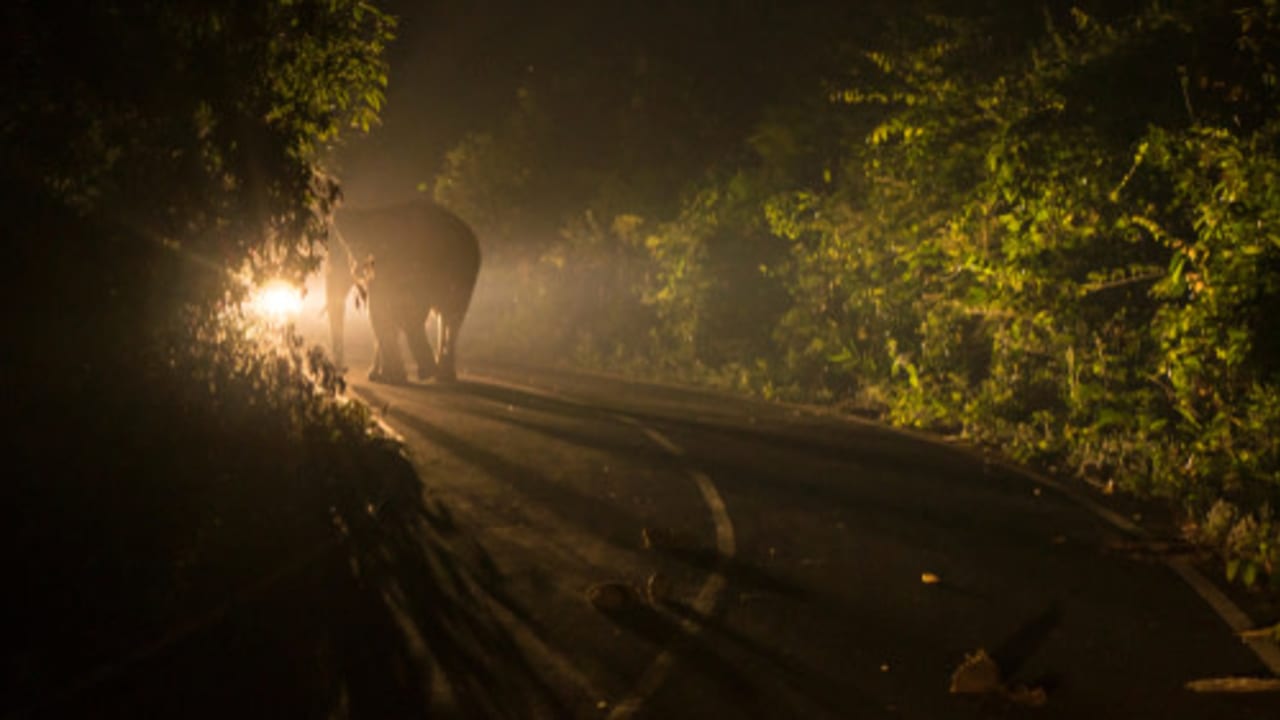
No, this giant elephant that “burst” into the frame is not a ghost, nor is it a hallucination or a strange vision—even if his appearance might be misleading. It is a rare African forest elephant, captured by a remote trail camera in Senegal’s Niokolo-Koba National Park for the first time in six years. In fact, he is likely the last of his kind remaining in the country.
The nickname "ghost elephant" refers to especially rare sub-populations of elephants in various parts of Africa that have become so elusive that no one is sure whether they still exist. A 2022 report from the Elephant Crisis Fund stated that “ghost elephants are refugees in their own homeland, moving stealthily between isolated patches of habitat. They vanish one by one—sometimes from old age, and sometimes due to conflict with humans.”
There he is!
The elephant in the photo, nicknamed Ousmane (named after a beloved local park ranger), was last seen in 2019 and was then believed to be one of a small group of five to ten elephants. Since then, no further living evidence had been observed. A recent DNA analysis conducted by the conservation organization Panthera in collaboration with Senegal’s Parks Authority (DPN) confirmed that he is likely the only individual remaining, although further studies are still underway.
As part of the effort to locate additional elephants, dung samples are being collected in the park, but so far no signs of other elephants have been found. “Elephants are under immense pressure in West Africa,” said Philipp Henschel, regional director for West and Central Africa at Panthera, to Newsweek. “Only a few isolated elephant populations survive in the region. Niokolo-Koba National Park, where Ousmane was photographed, is the last place in Senegal where this species still survives.”
However, Henschel emphasizes that not all is negative: “Since 2017 we’ve gradually increased protection of the park through a joint program with the local park authority. Detailed surveys are now underway to confirm whether Ousmane is truly the sole survivor. If that turns out to be the case, we will explore the possibility of bringing a herd of females to the park, to establish a new breeding population of African forest elephants in Senegal.”
Environmental organizations stress that there are no easy solutions to the plight of the "ghost elephants." Previous attempts to capture and relocate elephants to safer habitats have mostly failed due to their elusiveness, and there’s no guarantee they’ll remain in the new area. The preferred solution is the creation of large, protected reserves, in the hope that the elephants will find them on their own and feel safe there.
Still, there is reason for hope. Panthera notes that similar conservation efforts in the area have helped rare predator species recover—such as the West African lion (Senegalese lion) and the giant pangolin, which was recorded for the first time in 24 years. Perhaps in the not-too-distant future, Ousmane, the last ghost elephant of Senegal, will also have a vast backyard—and new companions.