
“It’s interesting the kind of people who live in Jerusalem. On the one hand, it’s a very provincial city; and on the other hand, it’s really an international city. It’s a crazy city – full of contradictions all the time,” says visual artist Sara Benninga during a conversation with her, contemporary artist Meydad Eliyahu, and me.
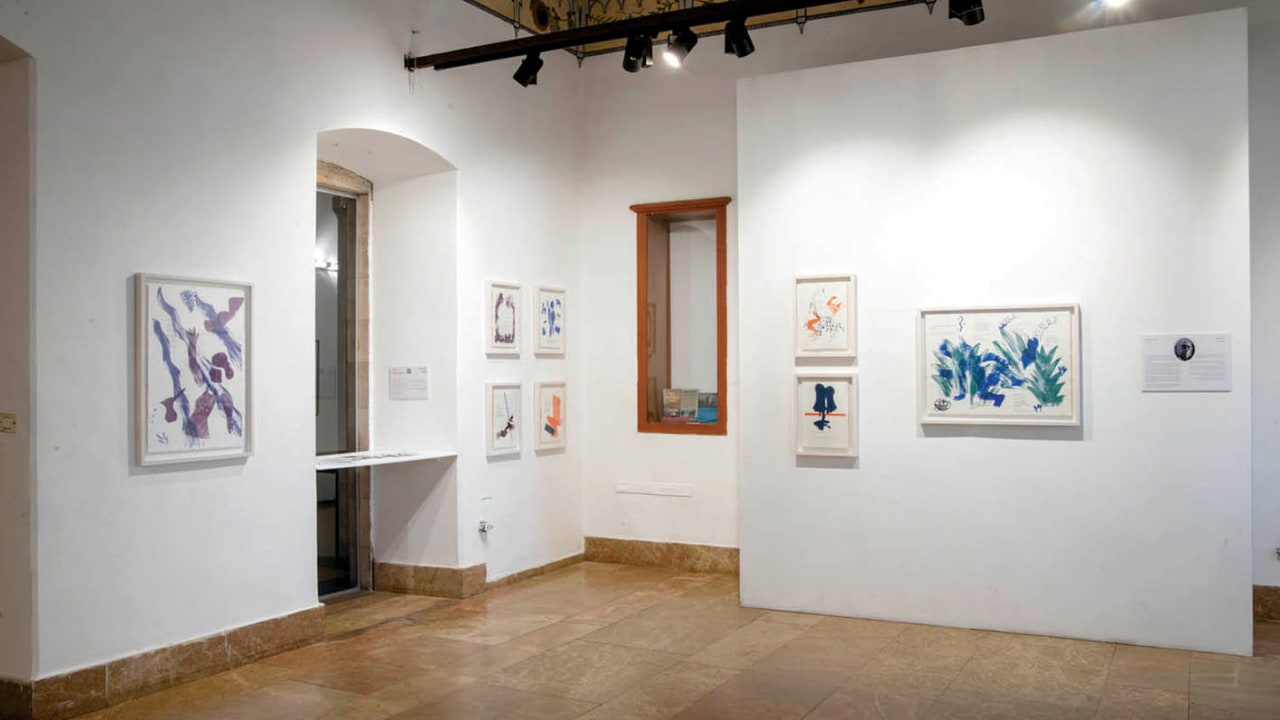
Such contradictions harmoniously pulse through the exhibition Poems as Invitations at the Jerusalem Biennale Gallery. The show features 20 meticulously crafted artistic prints by the two contemporary visual artists, in response to poems by three English-language poets – Robert Friend (1913-1998), Shirley Kaufman (1923-2016), and Dennis Silk (1928-1998) – who once called Jerusalem home.
These American-born writers lived and wrote in Jerusalem for decades, yet their voices remain largely unknown within Israeli cultural history – a gap that Lonnie Monka, curator of the exhibition, seeks to bridge.
Monka is the founder of Jerusalism – a group of writers who, since 2014, have aimed to deepen the connection between Israeli culture and English-language literature and showcase a diversity of local literary talent. In the heart of Jerusalem’s Jaffa Road, the unusual collaboration revives a lost conversation about what it means to belong to this city.

The beginning of Poems as Invitations
Poems as Invitations began when Monka invited Benninga and Eliyahu, two contemporary visual artists working in Jerusalem, to respond to the works of these poets. Presenting the two with a careful selection of publications, each was asked to choose 10 works.
“From those, each of us chose our own poems and narrowed it down – and what’s interesting is that we didn’t overlap in our selection,” says Benninga. “We already had a personal attachment to certain poems. I thought we were going to have to fight over which ones we worked with,” she recalls with amusement.
This natural division revealed how personally each artist connected to different aspects of the poets’ Jerusalem experience. For Benninga, the selection process was intuitive. “The poems spoke to me – they spoke to my experience as a Jerusalemite, but I also liked their visual imagery. I was already working even before I started the printmaking process.
“And that also says a lot about the kind of imagery that then came out of it because each one of us, already by just the first reading of the poems, connected to them,” she adds.
BENNINGA AND ELIYAHU didn’t simply illustrate these poems. As the exhibition title suggests, the poems served as invitations – openings into a creative dialogue rather than text to be visualized literally.
“We weren’t illustrating poetry,” Benninga emphasizes. Instead, they entered into what became a posthumous collaboration.
Walking through the exhibition, visitors encounter 20 works by the artists, each incorporating the words of a selected poem in masterful art prints, with subtle colors and diverse compositions. The visual language feels fresh, particularly for those familiar with either artist’s previous work.
Benninga’s prints feature figures and objects rendered in a charming, deeply naive style that feels both intimate and distinct – a remarkable feat, considering these were created using printmaking techniques new to the artist.
The somewhat archaic quality of her figures reveals a creative evolution that not only hints at her foundation as a painter but also suggests a new exploration of her Jerusalem roots. Her imagery doesn’t merely accompany the literary subjects; it harmonizes with them, manifesting the profound impression these words have made on her spirit, creating works that resonate and move viewers in turn.
Eliyahu’s works focus on surprising and abstract elements. His bright, fluid features move together to encompass the words of the poets but put them in the spotlight.
There is a lyrical quality to his carefully orchestrated compositions. With each one, we see lines, color fields, and shapes that vary dramatically in scale despite the relatively modest size of the paper. Meydad’s markings are like puzzle pieces you instinctively know should fit together – and while abstract in their foundations, each element comes into its own narrative, each telling a distinct story.
What’s most satisfying is the works’ cascading effect of invitation. Just as Benninga and Eliyahu were invited to converse with Friend, Kaufman, and Silk, using their poetry as a foundation, their resulting creations extend that invitation outward, drawing viewers into this dialogue that unfolds across time. Each artwork is a response and call, with an exciting and continuous loop of artistic conversation across decades.
FOR ELIYAHU, whose artistic foundation lies in the rigorous classical training of Israel Hershberg, the project offered an opportunity to embrace abstraction in new ways. “I played with the reconstruction of visual language; I started taking images apart,” he explains. “And I liked that in my works, some images can, in fact, be representative of more than one thing.”
The ambiguity he found in the poetry, particularly in the work of Dennis Silk, became a creative catalyst. “I was happy about the vagueness in some of the poems we chose – especially those of Dennis Silk. This is a quality you can work with once you understand it’s there. It’s not about specific language, words, or context. In that sense, my use of abstraction opened up. Like the poets, I communicated on a different level than words.”
Benninga found a similar resonance between poetry and visual art. “Any poem that touches me, it’s not the concrete or literal interpretation, but always something more than that – whether it’s a play with words or an image that emerges. It doesn’t always have to be written in the text but comes out in a visceral way.”
Drawing parallels between the two creative forms, she explains that this experience emphasized her own artistic process. “In terms of the creative act, I think there are a lot of similarities between poetry and two-dimensional painting, or printmaking in this case, because so often it’s more than just what meets the eye.”
It’s not literal, she says, adding, “I think that’s what strong imagery also does. In the studio, if I’m depicting a figure or depicting a person, really I’m creating a kind of space in which the viewer’s eyes and mind are wandering, and I want something to happen from that – from the act of looking at the image, or at the painting, or in this case, reading and looking at the print together.”

PERHAPS MOST poignantly, both artists describe finding unexpected, posthumous kinship with these poets. “I definitely felt like I discovered new peers, even though they’re no longer alive and creating,” Benninga admits. “I was happy to get to know these poets better. And also, I like their point of view.”
As a native Jerusalemite born to immigrant parents, she adds, “I felt less alone. Reading their poems, I really connected to their experience and thought they’re really giving words to the kind of feeling I used to have when I was growing up here, feeling like an outsider.”
This sense of uncovering hidden worlds and commentaries within Jerusalem resonates with Eliyahu’s experience of the city, too. “I feel we were not only discovering a diversity of voices but something stronger. This is something that still exists in Jerusalem.”
There’s a multiplicity conveyed vis-à-vis the city’s English literary world, which these artists discovered anew and share with us. And for both, this diversity is just as characteristic of Jerusalem’s cultural landscape today as it was for the poets whose works they engaged with.
“I live near Hamesila Park, and I think it’s one of the best places in Jerusalem because you see so many groups, and it’s peaceful,” Eliyahu observes. “Suddenly, you understand how much each one is representative of their own world.”
Walking through the exhibition, one encounters not just two artists and three poets but Jerusalem itself as a living character, which they themselves bring to life – its political tensions, religious complexities, and cultural nuances threading through both poems and prints.
Eliyahu adds, “There are some very direct poems, which, because of how they might be interpreted in a negative way, I had to think about how I feel using them; but at the same time, I felt I’m not going to cancel it because it’s not only negative. And there was a beautiful part of this because certain subjects that are present in Jerusalem, I would say many Israeli poets or artists sometimes might avoid, just because it’s not the right thing to do.”
THE WORKS illuminate subjects that might have been forgotten, offering contemporary residents and visitors new ways to connect with the city’s layered history. “Some of the poems I chose, I really related to because they raised questions and ideas that I feel are out of the discourse and should be brought back,” says Benninga.
Like Kaufman’s poem about the Green Line, for example. “It’s not a political manifesto; no, it’s a poem. But I thought, hey, that is something that can come back into the discourse, and this is a great opportunity because maybe when she wrote it, it was a bit simplified and naive. It’s about raising new questions and bringing back a discussion which has kind of gone missing.”
Poems as Invitations includes a collection of books by the three poets for browsing, but the artworks themselves manifest something unique: a visual-textual fusion where Benninga’s and Eliyahu’s contemporary perspectives – both artists raised in Israel – meet the immigrant experiences of poets Friend, Kaufman, and Silk. Their distinct artistic styles fill the gallery, fostering what Monka describes as “new ways of engaging with Jerusalem culture – connecting forgotten voices to today’s artistic community.”
What emerges is more than historical recovery. It’s a recognition that Jerusalem’s contradictions have always attracted and challenged those who try to capture its essence. In Poems as Invitations, visitors discover not just a life that existed in Jerusalem’s cultural past but an ongoing conversation about belonging, identity, and the potential of finding community across time.
Poems as Invitations runs through Nov. 14. Open by appointment at The Biennale Gallery (The Social Space), 161 Jaffa St., Jerusalem. Email jerusalism@gmail.com to request to see the exhibition.