
Iran unveiled what it claimed was a new missile city on November 10. Iran’s Islamic Revolutionary Guard Corps (IRGC) showed off the underground site, which includes ballistic missiles, cruise missiles, and their launchers. This came after Qatar’s recent attempts to mediate between the US and Iran, and after a meeting between US President Donald Trump and Qatar’s Prime Minister Mohammed bin Abdulrahman Al-Thani. The US has also carried out strikes on Iran’s Qeshm Island.
The site, which cannot be verified and may or may not be “new,” was shown on Iran’s Tasnim News Agency, which is considered close to the IRGC.
Iran’s Maj.-Gen. Ali Abdollahi, chief of staff of Iran’s armed forces, and Brig.-Gen. Majid Mousavi, commander of the IRGC Aerospace Force, toured the facility. The previous commander of the space force, Amir Ali Hajizadeh, was killed in 2025 in the conflict with Israel.
“Advanced missiles will surprise enemies with their battlefield impact,” Abdollahi said, according to Rudaw. Iran International reported that he also warned of retaliation beyond the Middle East if Iran faced renewed attacks.
“If the enemy makes another move against us, our response will extend beyond the region.”
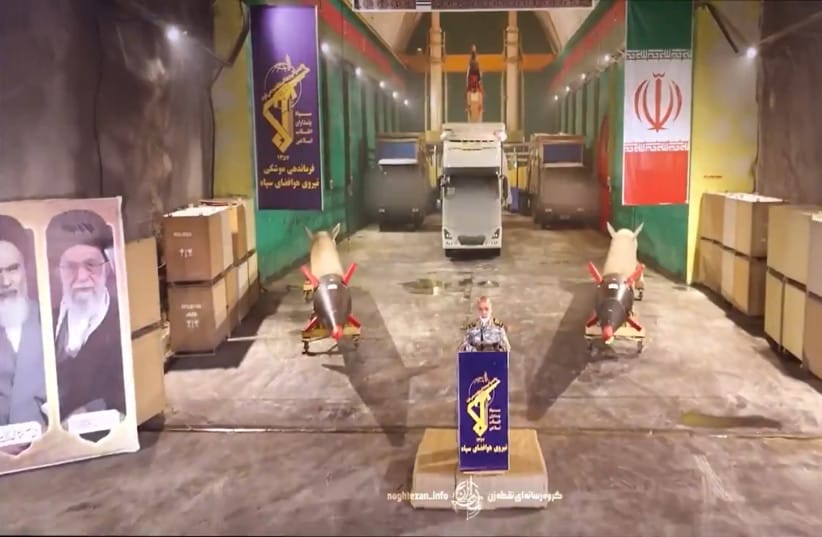
Missile city filled with medium-range ballistic missiles with boosters, warheads
Various online reports examined the images Iran showed. Osint613 noted that “Fattah-1 medium-range ballistic missiles appear to fill the underground missile city. Separately displayed maneuvering re-entry vehicles were observed alongside complete missiles fitted with boosters and warheads.”
Expert Tal Inbar also discussed the missiles online and what the photos showed. “Maneuverable RV for Iranian missile Khiber Shekan. It seems like the RV (re-entry vehicle) developed for Fateh-1. Frame from a new video released today by Iran,” he noted.
“At the underground ‘missile city’ there were also old missiles with the plain conic RV.”
A commercial truck also appeared, the kind civilians would use to move goods. The truck has a missile in the back that can be hidden, making it seem like a commercial truck on the road. The missile can be raised from the back to a launch position.
The unveiling illustrates Iran’s efforts to show that it has preserved its missile capabilities despite American and Israeli airstrikes. In March, Prime Minister Benjamin Netanyahu claimed that “after 20 days, I can tell you, Iran today has no ability to enrich uranium, and no ability to produce ballistic missiles.”
Iranian launch sites not destroyed, facilities dug up after war
Iran has spent years constructing underground missile storage and launch sites, known as “missile cities,” designed to protect its arsenal and enable continued military operations during a conflict.
During the conflict with the US and Israel, several claims said that many Iranian missile launchers were destroyed. It later turned out that “destroying” them included “corking” them inside tunnels. However, Iran was able to dig them out. This is one problem with the missile cities: it’s hard to destroy them deep underground.
IRGC spokesperson Brig.-Gen. Hossein Mohebbi said on November 7 that Iran had moved missile and drone production from aboveground facilities into underground complexes.
According to Tasnim, Mohebbi said the IRGC had gone beyond constructing underground storage facilities and was establishing “missile production cities” deep beneath the ground.
He claimed that Iran’s domestic expertise, large territory, and flexible production infrastructure would enable weapons manufacturing to continue even under heavy bombardment.
These claims come after repeated Israeli and American strikes that aimed to degrade Iran’s missile capabilities. During the 2025 conflict, Israel targeted Iranian missile launchers, storage facilities, and associated infrastructure.
Satellite imagery reviewed by Reuters in February 2026 showed Iran repairing missile bases damaged during the fighting, alongside efforts to reinforce or conceal sensitive military and nuclear facilities.
The new underground facility therefore illustrates that Iran wants to send a message. It is saying it still has dangerous missiles. The US remains optimistic that it can reach an agreement. Iran also appears optimistic.