On the sidelines of the United Nations General Assembly last week, and nine months after the bloodiest days of Iran’s January uprising, Iranian President Masoud Pezeshkian sat before an American television audience and offered his version of what happened.
Iran, he told Fox News, had published identification numbers and death certificates for around 3,000 people killed during the unrest, some 500 of whom he said were members of the security and police forces.
Reports suggesting far greater numbers had been killed were false, he insisted, while describing armed “instigators,” the “firepower of the rioters,” and demonstrations that had been “weaponized.”
It was familiar, Islamic Republic-style language. As protesters were being killed in January, Pezeshkian called on Iranians to separate themselves from “rioters and terrorists” and blamed the United States and Israel for encouraging the unrest.
Former supreme leader Ali Khamenei similarly accused protesters of acting as “mercenaries for foreigners.”
There is now another account of those weeks by the Iranians who were living through them, one that was recorded as events unfolded live.

A man drives through the streets in late December, filming himself as the rial crashes and anger over the country’s economic situation begins spilling out of Tehran’s bazaars.
“If you’re not going to do anything, you’ve got guns, so use them,” he tells the authorities.
“Shoot all 80 million of us. Get it over with. Then you can have the country to yourselves, you f*****g cowards.”
Another man speaks into his telephone about poverty, corruption, prostitution, embezzlement, and war. He tells whoever will eventually watch the recording that he no longer wants to live under such a system.
Neither appears to have any idea where any protests will lead. They are simply Iranians recording their anger over the dire economic situation. But what follows will change Iran forever.
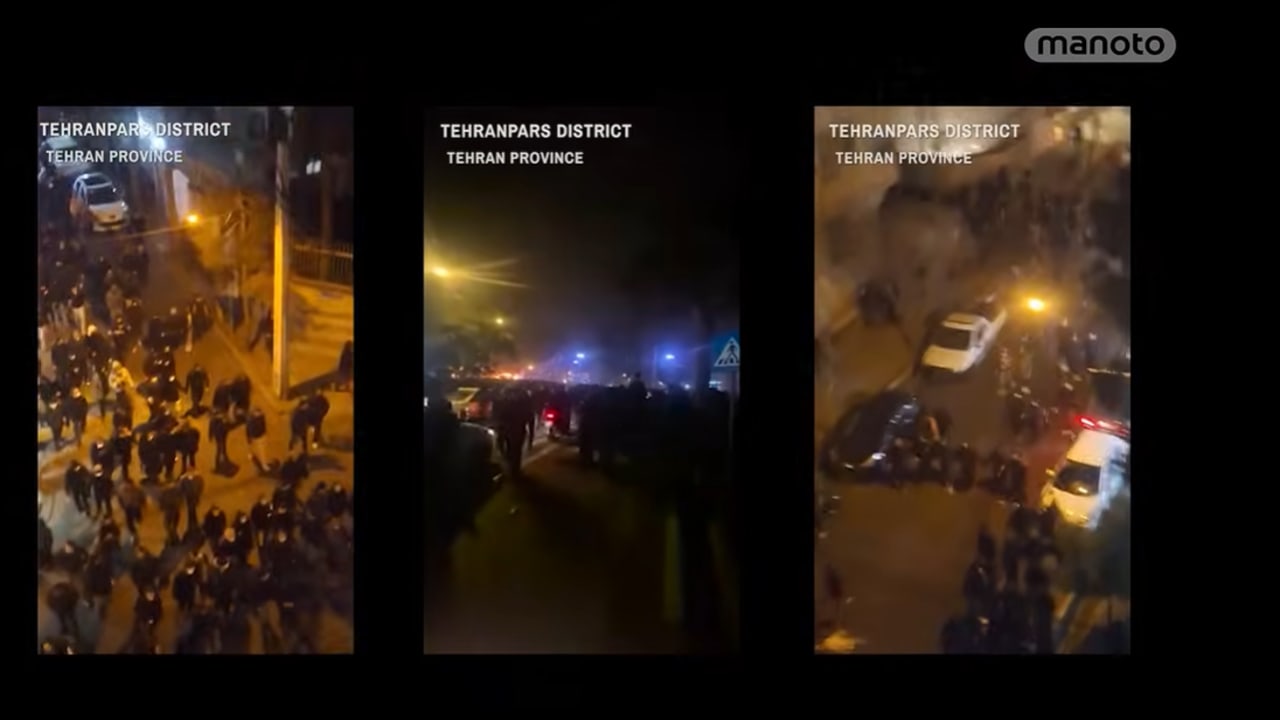
Those voices form the backbone of This Is Our Story, Persian-language news outlet Manoto TV’s four-part documentary on the uprising that began on December 28 and reached its most violent point on January 8 and 9.
A country records itself
For those of us reporting on the protests as they unfolded, the broad chronology is already painfully familiar.
Bazaar merchants began shutting their shops on December 28 amid the rial’s collapse and mounting economic pressure.
Demonstrations spread rapidly, and within days their character changed. Economic grievances remained, but protesters increasingly directed their anger at the Islamic Republic itself.
By early January, chants in support of the Pahlavi dynasty were being heard across cities, while people confronted security forces with cries of “shame on you.”
Manoto returns to those same days with an advantage journalists did not have at the time: the accumulation of months of footage sent from inside Iran.
The broadcaster says This Is Our Story was assembled from a vast archive of material filmed by ordinary Iranians, with reports around the documentary’s release putting the number of recordings reviewed at more than 10,000.
The four episodes stretch over more than seven hours and move through the first strikes and demonstrations, the mass mobilization of January 8, the killings and search for the missing, and finally the funerals and traditional 40-day mourning ceremonies.
What makes it remarkable is the way the cameras follow the change in mood, how the anger changes from economic desperation to demands for the end of the regime and the death of Khamenei.
In the early footage, people are angry and often remarkably relaxed about recording themselves. They complain about the economy, the authorities, and a political system they blame for their circumstances.
Elsewhere, crowds chant as water cannons and tear gas are used against them. The historic Iranian emblem of the Lion and Sun appears publicly, and calls for the return of the Pahlavis become louder, including “Javid shah” (“long live the shah”) and “Pahlavi barmigardeh” (Pahlavi will return) in reference to exiled Crown Prince Reza Pahlavi.
One chant heard in the documentary foretells what is coming: “This is the year of blood. Khamenei will fall.”
The demonstrations move through Tehran, Isfahan, Mashhad, and towns and cities across the country, and the phones move with them. No foreign television crew walks alongside these crowds here. The reporter is the man filming from his balcony, the woman recording from the pavement, the protester pointing his telephone down a road as motorcycles approach – it is a revolution documented in real time by Iran’s citizens.
In some videos, the person holding the camera talks constantly; in others, there is only breathing, gunfire, or the sound of people running.
This is citizen reporting in its most literal form.
When Iran went dark
Pahlavi had called for Iranians to pour into the streets at 8 p.m. that evening. Large crowds emerged across the country, and the Islamic Republic began cutting Iran off from the outside world.
Internet connectivity collapsed across multiple providers, while attempts to telephone Iran from abroad stopped connecting. At the time, The Jerusalem Post was among those trying to report through the darkness as videos arrived intermittently from Tehran and other cities.
The blackout became one of the defining features of the crackdown. Amnesty International said the communications shutdown severely hindered the ability of families, journalists, and human rights organizations to determine what was happening and later concluded that the authorities had used it while carrying out mass unlawful killings. Yet Iranians continued recording.
That is where the documentary becomes hardest to watch.
The confidence and chants of the earlier episodes give way to confusion. Finally, the regime saw the greatest legitimate threat to its 47-year-long rule, more so than any previous protests, and resorted to turning its guns on its own people.
People are running without knowing where the shots are coming from. Voices call out warnings about security forces positioned nearby. In Tehran Province, one recording captures warnings that the fire is coming from the direction of the Nasimshahr police station. Other footage shows people apparently being shot from behind as those around them desperately try to help.
There are no neat establishing shots and little of the order that comes with conventional news footage, such as in the ‘79 Iranian Revolution.
The person behind the camera frequently knows no more about what is happening than the viewer. That quality is precisely what makes some of these scenes so disturbing and Manoto’s documentary so powerful.
Anyone who has watched the raw videos recorded during the October 7 massacre in Israel will recognize something in the way fear is captured. The circumstances are entirely different, but the recordings share the same immediacy.
From the shaking camera and confused shouting to people trying to figure out where the danger is coming from, voices suddenly change when they understand what they are seeing.
Those moments offer no hindsight, and the person filming has no idea what the next minute will bring.
Later independent investigations established that this chaos concealed something much larger. Human Rights Watch verified footage of Iranian security forces shooting at protesters and found evidence of extensive killings across several provinces.
In one six-minute video from Police Station 126 in Tehranpars, it identified a security-force member firing an automatic weapon from the roof. In contrast, others fired toward protesters and apparently toward the person filming. Amnesty likewise verified security forces firing rifles and shotguns loaded with metal pellets from streets and rooftops, often toward protesters’ heads and torsos.
The phones had captured evidence of crimes against humanity while those behind them were still trying to survive.
Behind every number
The debate over how many people were killed continues.
Pezeshkian points to around 3,000 identified deaths. Human rights organizations have documented significantly larger totals or estimates, while other sources inside Iran have suggested considerably higher numbers, including medical figures who worked tirelessly in the hospitals around the country as the wounded and dead were brought in.
The communications blackout and the scale of the crackdown made establishing a definitive figure extraordinarily difficult.
The documentary’s most effective answer to that argument is found in the people whose names emerge from the statistics.
Alireza Rahimi was 26.
According to eyewitness testimony gathered after the massacre, he was shot in the back of the head in Tehranpars on January 8, collapsing into the arms of his uncle. He died after being taken to hospital. His family later searched among the thousands of bodies that had been brought into Tehran’s overwhelmed mortuary system before eventually identifying him.
Weeks later, relatives and neighbors gathered around his memorial on what should have been his 26th birthday. They applauded.
Another young Iranian whose story survived through this extraordinary citizen archive was Sanam Pourbabaei.
She was 26, a violinist and violin teacher from Lahijan in northern Iran. Witnesses said she was shot during the January 8 demonstrations and later died after being taken for medical treatment.
Her family then struggled to recover her body and was required to bury her under heavy security, according to accounts given after her death. But her story did not finish with the burial.
Later footage showed musicians playing pieces associated with the young teacher, transforming the mobile telephone from a means of recording violence into one of preserving memory.
The final episode of This Is Our Story is filled with scenes like this, and it is here that the anger overwhelms. The calls of Khamenei as a tyrant and the demands for his death are everywhere.
At the memorial for Saman Alaei in northern Iran, his sister holds her dead brother’s photograph while performing a mourning dance at his grave. Relatives join her, turning a funeral ritual into something both intensely personal and unmistakably public.
Other families clap rather than remain silent. Mothers speak directly to their dead children, while music plays beside graves.
In one of the documentary’s most heartbreaking moments, a mother addresses her son, Araz.
“When you were dying, Araz, how many times did you call out for me?” she asks. “And I wasn’t there.”
Another bereaved parent delivers a message aimed beyond the cemetery: “You may have taken our child’s life, but you cannot kill what he stood for.”
Another form of psychological terror followed the killings of January 8 and 9. Families moved from hospitals to forensic centers, trying to establish whether sons and daughters were wounded, detained, or dead.
Human rights organizations verified videos from all across Iran showing hundreds of body bags while relatives searched among them, crying and calling out names. In one scene, a citizen says on camera, “They have killed so many young people, they’re bringing in lorries.”
The people filming those scenes created an archive the authorities could no longer fully control.
Evidence preserved
Like the archive created on October 7, Manoto’s archive has gained importance beyond journalism.
This month, the Independent International Fact-Finding Mission on the Islamic Republic of Iran presented the results of its investigation into the crackdown.
It concluded that Iranian authorities had committed gross human rights violations during their suppression of the protests.
The report found that many of the incidents amounted to crimes against humanity, including murder, imprisonment, torture, inhumane acts, and other severe deprivations of liberty. The mission described the response to the nationwide protests as an extraordinary escalation in state repression.
That finding changes the way in which Manoto’s documentary should be viewed. These videos are testimonies, evidence, journalism, and now memories of those killed. They may also form part of the documentary record available to investigators examining how civilians were treated during those weeks.
The people who filmed them had little reason to believe, amid the Internet blackout, that somebody thousands of kilometers away would eventually watch their recordings in sequence.
Many were filming because they wanted somebody, somewhere, to know what was happening. Manoto has taken those fragments and placed them alongside one another.
The result deserves attention beyond the Iranian opposition community. For members of the US Congress, parliamentarians across the world, and diplomats and officials whose work involves Iran, This Is Our Story offers seven hours of primary-source material to examine the conduct of the Islamic Republic during one of the darkest periods in its recent history.
There may be arguments over exact casualty figures – most opposition figures cite 40,000, and US President Donald Trump claimed earlier this month close to 65,000 had been killed – but the evidence is there to be witnessed.
There is now an extensive visual record of security forces firing into demonstrations, wounded people being carried through streets, hospitals and morgues overwhelmed, and families searching for the dead – the crimes of the Islamic Republic.
The UN’s finding of crimes against humanity means the question of accountability should be part of an international movement to hold the Islamic Republic’s regime culpable.
That is ultimately where the importance of This Is Our Story lies.
The Islamic Republic shut down the Internet at precisely the moment when the outside world most needed to see inside Iran. Iranians struggled to communicate even with their own relatives, and still, people raised their telephones and pressed record.
They filmed the excitement of the first demonstrations, the chants, the confrontations and the growing hope that something historic was happening. They kept filming when the gunfire began, when people fell beside them and when the streets emptied.
Later, they filmed the hospitals, the bodies, the graves, and the mothers mourning children who had gone out one evening and never returned.
Many of those behind the cameras will never be known. Still, collectively, they have become the documentarians of their own revolution, witnesses to history; their testimony should be seen throughout the world.
Through the thousands of fragments they left behind, Iran’s citizens have ensured that the fear, confusion, courage, and horror of those days will outstrip any false narratives or numbers the regime tries to claim.
They were there. They recorded it. And now the world can see what they saw.