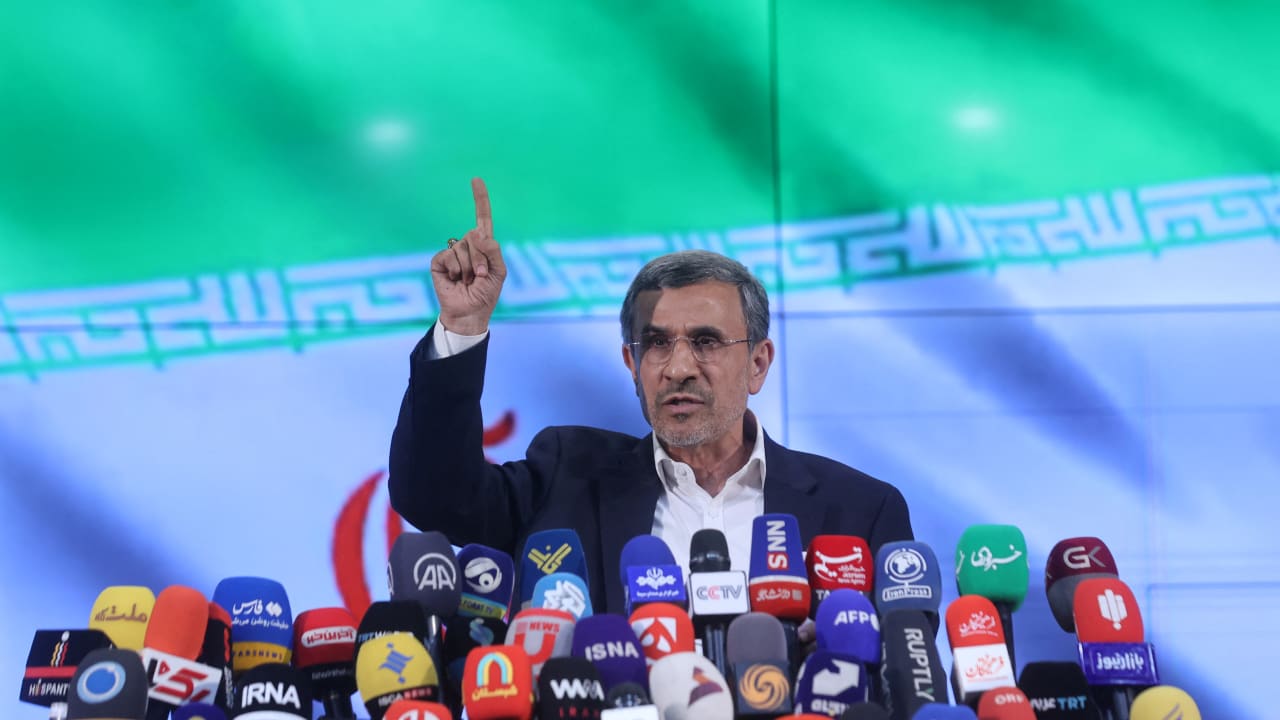
Former Iranian president Mahmoud Ahmadinejad is back in the news in a way few would have predicted. An early war goal of the Israel and US airstrikes against Iran on February 28 was to create a kind of regime transition and have Ahmadinejad return to lead Iran, The New York Times reported.
How this would have happened is unclear. With the death of Iran’s supreme leader, was it believed that Ahmadinejad had the religious clout to take the reins? How would he take over the presidency with Masoud Pezeshkian still in office?
What has raised some eyebrows is that Ahmadinejad was seen as an implacable foe of Israel, a key supporter of the nuclear program, and also a pusher of Holocaust denial. Why would anyone tap what seems like a far-right nationalist, populist figure to run Iran?
Some have argued that this was the Maduro scenario again, removing a foe of the US and bringing in someone who could make a deal. The question is whether Ahmadinejad was that type.
Let’s assume for a moment that the report is even partially accurate. We have to understand who Ahmadinejad is today and who he was.

Ahmadinejad was born in 1956 in a village in Semnan province, about a two-hour drive southeast of Tehran. He was from a pious and poor family that soon moved to Tehran. An exemplary student, he went to the Iranian University of Science and Technology in Tehran and studied engineering in the 1970s.
After the Iranian Revolution, he began to play a role in politics and served in political roles in northwestern Iranian provinces, which are Kurdish- and Azeri-majority areas. He became mayor of Tehran in 2003. He was seen as a natural opponent to Iran’s reform-minded president, Mohammad Khatami.
The Iranian nuclear issue is not new
Ahmadinejad came to power in 2005 in an election against Akbar Rafsanjani. Ahmadinejad won votes from the center of Iran, whereas Rafsanjani performed better in the periphery, minority-populated areas.
When Khatami left office, “The tenure of Iran’s pro-reform President Mohammad Khatami ended today as his successor Mahmud Ahmadinejad was formally installed as president,” Radio Free Europe reported. “Khatami came to power in 1997 with huge support, especially among youth and women, to whom he had promised more rights. In 2001, he was reelected with some 70% of the vote. However, many of his one-time supporters have criticized Khatami for failing to deliver on his promises. Other observers, though, say that during Khatami’s eight-year tenure, some positive changes took place.”
The year 2005 was a key time for Iran in the region. The US had invaded Iran after 9/11, and then it invaded Iraq in 2003, essentially putting US forces on two fronts with Iran.
Ahmadinejad sent then-US president George W. Bush a letter in 2006. During a press conference with then-UK prime minister Tony Blair at the White House in May 2006, Bush said, “Well, I read the letter of the president, and I thought it was interesting. It was, like, 16 or 17 single-spaced typed pages of – but he didn’t address the issue of whether or not they’re going to continue to press for a nuclear weapon. That’s the issue at hand.”
It was clear that the Iranian nuclear issue was a key challenge for the Bush administration. Meanwhile, the US was busy with the “surge” in Iraq.
Iran was threatening US troops in Iraq as well, with the use of special explosive devices called EFPs. By 2008, the US military would see a 40% rise in the use of these deadly weapons that were linked to Iran.
Ahmadinejad also went to the UN in 2005 to give the annual United Nations General Assembly speech.
“The Bush administration had seriously considered denying the Iranian leader a visa, an extraordinary breach of diplomatic protocol, after allegations of Ahmadinejad’s involvement in the seizure of the US Embassy in Tehran in 1979 and the 15-month hostage crisis that followed,” the Brookings Institution, a US think tank, reported.
At the time, “Tehran had just reopened its uranium conversion plant, the first step in its breach of an agreement with European powers to suspend worrisome nuclear activities and the revival of its ongoing standoff with the international community.”
As such, Ahmadinejad’s speech was closely watched.
“The speech can be credited with expediting the Bush administration’s effort to prompt action by the UN Security Council against Iran’s nuclear program, and with drawing new derision within Iran over Ahmadinejad’s claims of divine intervention during the speech itself,” the Brookings report said.
Ahmadinejad alienated the US and the West. The nuclear program wasn’t the only thing. He also engaged in questioning the Holocaust or denying it. Accounts by survivors of the Shoah were the “opinion” of “just a few,” he told NPR in 2009.
Ahmadinejad also compared the Holocaust to Israel’s policies.
“I can see that genocide is happening now under the pretext of an event that happened 60 years ago,” he said. “... Why should the Palestinian people make up for it?”
His speeches at the UN led to more scrutiny and harmed Iran’s image. Brookings, in an article about Ahmadinejad leaving office, said his last speech at the UN in 2012 was “replete with disjointed philosophical musings over the failings of the international system and the inequities of capitalism, but it contained little of the provocation that has brought the Iranian president such renown.”
By this time, Ahmadinejad had lost his clout among the religious clerics of Iran. He had once been tapped by Ayatollah Ali Khamenei to run a more centralized and robust presidency. But he had become weaker.
“Ahmadinejad eventually overstepped, and like each of his predecessors, his personal ambitions proved no match for a system constructed to ensure its own preservation and the unchallenged prerogative of the supreme leader,” Brookings reported.
“For the past 18 months, Ahmadinejad has been increasingly marginalized within the Islamic Republic, reduced to playing a convenient foil for intra-elite skirmishing while Khamenei toys with the notion of simply eliminating the presidency altogether.”
By 2013, he was out of office, and it was a changed world. US president Barack Obama wanted to reach out to Iran. They were already pivoting, and appeasement of Russia and Iran would be crucial for US policy to get to a deal with Tehran. Ahmadinejad was not helpful in this.
By this time, the Iranian leader had become a kind of fetish and foil in the US. He was invited to speak at Columbia University. Some Americans wanted to meet him. He was seen as so bad, he must be good, or so the logic went.
US comedy skits mocked him, with one portraying him as gay. Apparently, the theory was that if his conservative views were mocked, this would defang him.
Ahmadinejad’s post-presidency has been more interesting. He was supposed to retire from politics and return to academia.
An outwardly modest man, he hadn’t appeared to profit much from his career. But he continued to dabble in politics in 2017 and 2020 and seek the limelight.
This must have chafed the regime, because he was briefly arrested in 2018 for “inciting unrest.” He became popular on social media, taking up various causes, including backing Black Lives Matter in the US.
He also commented on US sports. “When I was a student, I played two sports on the collegiate level: soccer and field hockey,” he wrote in 2019 when the University of Virginia became national champions. “I know the special feeling these young men have, and I congratulate them and their families on this achievement.”
He commented on the NFL and the University of Michigan. He even replied to comments about US sports. The entire odyssey of the former Iranian hardliner took many by surprise.
But Ahmadinejad wasn’t done yet. Somehow, he has turned up in the pages of the Times and was included in the Israeli and US plans for a future Iran. This has included stories that an airstrike was aimed at setting him free from house arrest.
He was reportedly wounded in the strike and has not been seen since, although he is reported to be alive.
Ahmadinejad was still useful as a potential opponent or critic of the regime, The Atlantic reported in March.
“It is possible that Israel or the United States wanted to kill Ahmadinejad, but aimed poorly,” the report said. “That would be peculiar, because it would mean that the United States and Israel placed near the top of its kill list a politician who was no longer a friend to the regime.
"The alternative possibility, that Narmak was bombed to free Ahmadinejad, raises other questions. Why free Ahmadinejad only for him to go into hiding after? Why free him at all, given how long he has been out of power?”