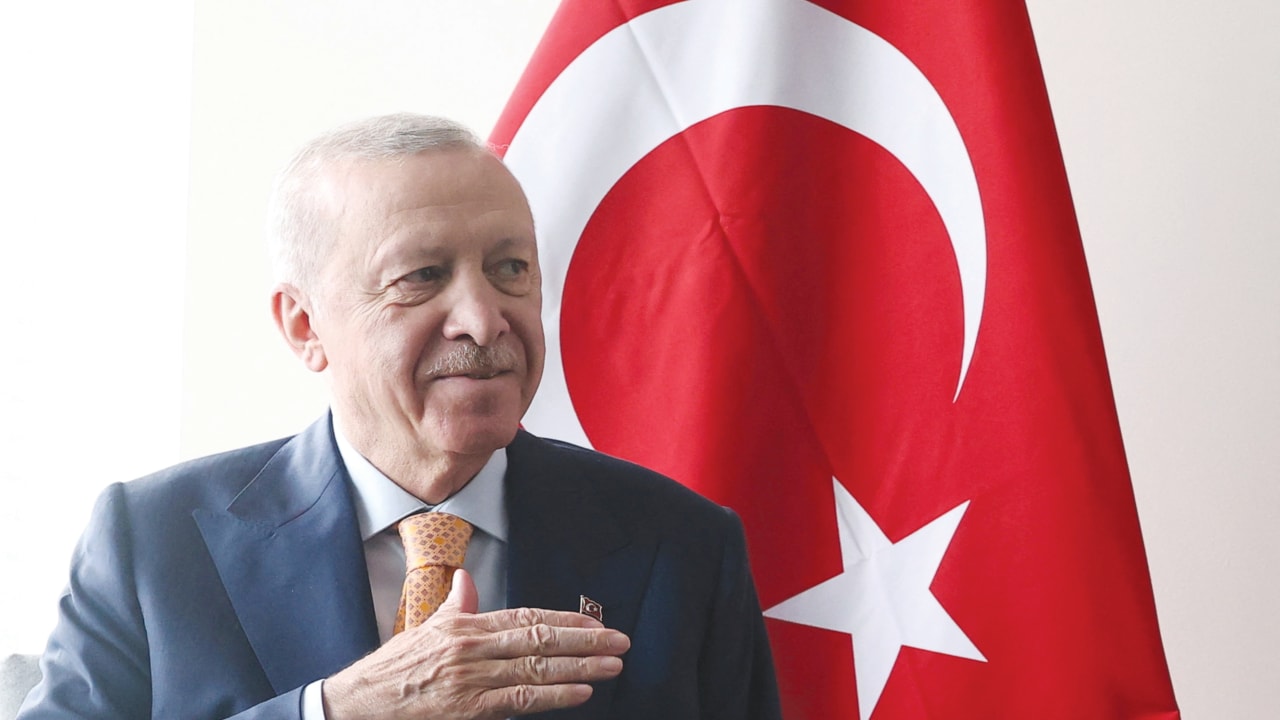
Prime Minister Benjamin Netanyahu this week ordered the Justice Ministry’s International Law Department to prepare a legal case against Turkish President Recep Tayyip Erdogan at the International Criminal Court. The case, according to several Israeli media reports, will focus on Turkey’s treatment of its Kurdish minority, and its ongoing support for and domiciling of Hamas.
The case is unlikely to have major consequences. Neither Israel nor Turkey has ratified the Rome Statute, meaning that neither recognizes the authority of the ICC. Israel’s move appears to come in response to a Turkish effort to secure an Interpol red notice intended to lead to the arrest of Netanyahu.
Still, the Israeli initiative is notable for several reasons. It is the first time that Jerusalem has sought to make use of Turkey’s treatment of its Kurdish minority as a counter-pressure tool against Ankara. Israeli ministers have made statements relating to this issue in the past, but nothing practical has resulted.
Instead, the latest move represents a picking up of the gauntlet by Israel in the field of lawfare. It is the first sign that Jerusalem aspires to do something more than play defense in this area. The Israeli initiative was enthusiastically hailed by several politically engaged, Turkish-born Kurds who spoke with this writer.
The initial maneuvers form part of a more general picture in which Israel and Turkey find themselves increasingly on a collision course across a broad spectrum of issues of strategic interest across the region. In addition to the lawfare field, the areas in question are: Syria, the eastern Mediterranean, Jerusalem and the West Bank, and the Red Sea/Horn of Africa.

In all these friction points, Israel and Turkey have clashing interests and ambitions. The emergent dynamic is zero-sum. Turkey’s extensive regional ambitions can only come at Israel’s expense, given the religious and ideological underpinnings of Turkey’s stance.
Erdogan and his party are making use of the powers available to them
This has been a long time coming. Prescient Middle East analysts such as my colleague, the late Barry Rubin, flagged the coming Israel-Turkey confrontation as far back as 2004, shortly after Erdogan’s Justice and Development Party (AKP) came to power.
Rubin did what Western observers of the Middle East don’t do often enough: listen carefully to statements by Erdogan, Ahmet Davutoglu, and other AKP leaders; read their writings; and extrapolate their likely behavior.
At the time, the bon ton was to see the AKP and Erdogan as likely to be moderated by the experience of government, or bound to be constrained by Turkey’s “objective” strategic interests. Subsequent events have shown that neither constraint applies.
Rather, Erdogan and his party are making use of the powers available to them to advance a regional strategy that comfortably combines a neo-Ottoman nationalism with an outlook deriving from Sunni political Islam.
Regarding the specific areas of tension: Syria is without doubt the most volatile and combustible. Turkey was a key element behind the victory of the Sunni Islamist regime now in power in Damascus.
Ankara is energetically engaged in building up the armed forces of the new regime. Israel is deeply suspicious of the long-term intentions of the emergent new power. Specifically, Israel is concerned at the possibility that Turkish assistance in rebuilding Syrian air defenses could impact Israel’s need to maintain freedom of operation over Syria’s skies, in order to act against Iran.
The Israeli air raid on Syria’s Abu Duhur Air Force Base on August 18 demonstrated Jerusalem’s determination to enforce its red lines in this regard. Turkish Foreign Minister and former intelligence chief Hakan Fidan, while in Damascus earlier this month, described Israel as the “greatest potential threat to Syria’s stability” and announced that Erdogan would visit Damascus “in the near future.”
Syrian sovereignty remains partial. Both Israel and Turkey are in de facto occupation of parts of the country, with diametrically opposed ambitions for its future.
The agreement ignores the maritime jurisdiction and continental shelf rights of Greek islands
Elsewhere, the eastern Mediterranean is similarly an arena for directly opposed Israeli and Turkish ambitions. Turkey, in a 2019 maritime boundary agreement with Libya, declared an exclusive economic zone extending from southwest Turkey to northeast Libya.
The agreement ignores the maritime jurisdiction and continental shelf rights of Greek islands, including Crete and Rhodes. In so doing, it also cuts directly across Israel’s and Greece’s own intentions regarding exploitation of gas resources in this area, and their plans to lay a power cable linking the electricity grids of Israel, Cyprus, and Greece.
In a statement issued on September 24, the Turkish defense ministry explicitly stated that it was “closely monitoring military developments on the island of Cyprus,” and that cable-laying on “our continental shelf must be coordinated with our country in advance… unauthorized activities… are not permitted.”
Regarding the West Bank and Jerusalem: Israel is also cognizant of Turkey’s continued maintenance of an active Hamas office in Istanbul. This office has a track record of direct operational activity, including violent attacks, in the West Bank. The activities of the Turkish Cooperation and Coordination Agency (TIKA) in the West Bank and Jerusalem are also of concern.
Israeli intelligence notes that TIKA funds and supports religious and social institutions closely affiliated with Hamas and Muslim Brotherhood networks in the West Bank. Alongside Turkish efforts to play a role in Gaza and Lebanon, Jerusalem sees all such efforts as part of a Turkish attempt to build influence and leverage in areas that have direct impact on Israel.
In the strategically vital maritime corridor of the Red Sea and the Horn of Africa, Israeli-Turkish competition is reflected in alignments with rival local forces. Israel recognized Somaliland as an independent country in December 2025 – the first UN member state to do so.
Jerusalem plans to build a military base on Somaliland’s territory to observe and counter Houthi activity on the other side of the Bab el-Mandeb Strait. Turkey, meanwhile, strongly opposes Somaliland’s independence and maintains a major training base in Mogadishu, Somalia’s capital.
Ankara has also signed agreements for oil and gas exploration off Somali waters, creating an additional potential point of tension.
A review of all the relevant information, alongside the stated goals and ambitions of the Turkish government, indicates that the Israeli-Turkish contest across the region is one of the most important geopolitical realities of the emerging Middle East.
The net result of the dramatic events of the last three years appears to be the weakening (though not the destruction) of the Iran-led regional alliance, and the growing sense among all regional players that anything resembling a Pax-Americana in the region is largely defunct.
In the changed power environment deriving from these developments, powerful local players are seeking to extend influence. Turkey is weaponizing the forces of Sunni political Islam in a manner that, in some ways, is reminiscent of Iranian practices. Opposition to Israel is an inherent and integral element of this strategy. Further and increased friction seems inevitable. Watch this space.