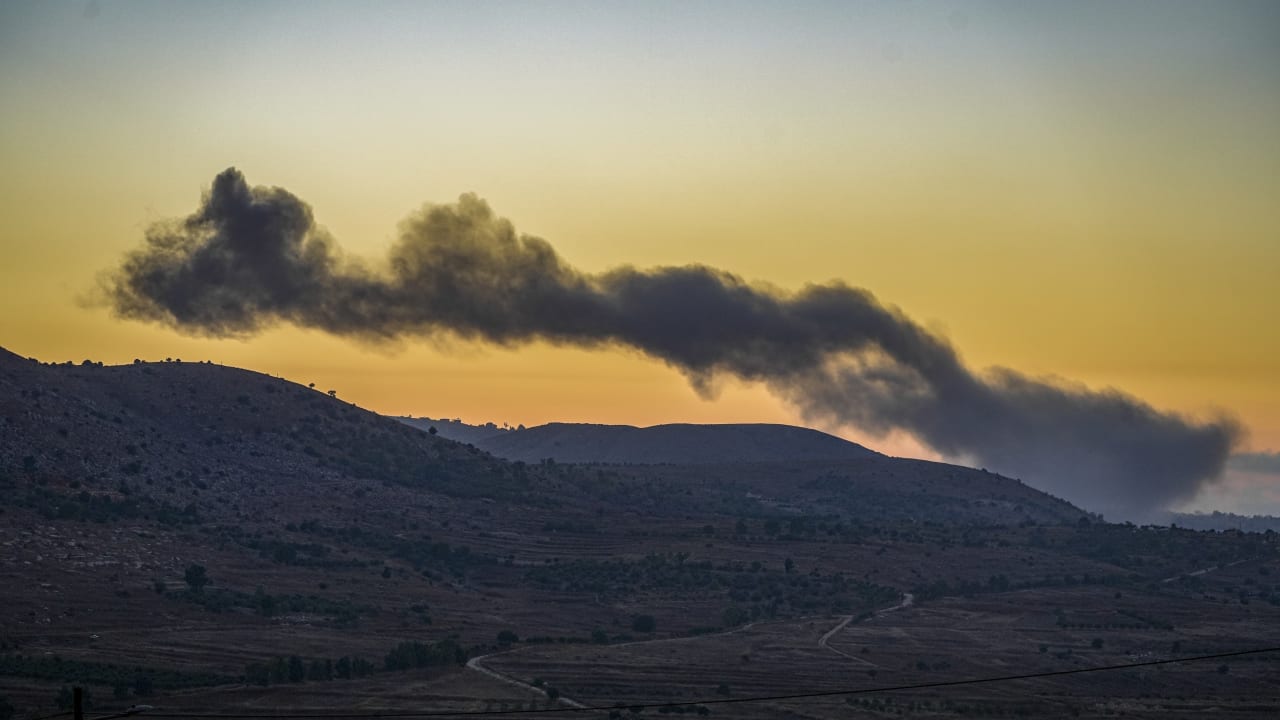
Hezbollah lost another key stronghold in Lebanon recently. The IDF said on September 3 that it had cleared the Ali al-Taher ridge.
The 36th Division “operated in recent weeks to clear and neutralize the two underground routes in the Ali al-Taher Ridge area in the Security Zone. The soldiers achieved operational control of the ridge area, both above and below ground, and cleared the area of terrorists. Some of the terrorists were eliminated, while others fled the area.”
The military added that the operation was ongoing: “Upon completion of the operation, the IDF will adjust its defensive posture in accordance with the situational assessment… Following operations in the underground routes over the past several weeks, their capability to carry out terror attacks against Israeli civilians and IDF soldiers from within the routes has been neutralized.”
The site was well-known and large. It “contained command centers, weapons storage rooms, generator rooms, living quarters, showers, and a kitchen, which enabled the terrorists to manage combat and remain underground for extended periods of time.
“The infrastructure is a strategic underground network that was built over two decades and funded and planned by the Iranian terror regime,” the IDF reported.
Fall of Ali al-Taher ridge gains international attention
The fall of this Hezbollah stronghold has been spotlighted around the world.
France24 noted: “Israel has seized the strategically placed Ali al-Taher ridge in southern Lebanon from Hezbollah fighters, Defense Minister Israel Katz said Friday. The Iran-aligned Shi’ite group did not confirm losing the highland, which sits around 10 kilometers from the border with Israel and was pummelled by Israeli strikes in recent weeks despite a ceasefire.”

The report added that “the Iran-aligned Shi’ite group did not immediately comment.”
Defense Minister Israel Katz noted that “the mission was completed and the tunnels were cleared of terrorists.”
Reuters described the site as “the Ali al-Taher ridge in southern Lebanon, which is named after a Shi’ite Muslim scholar whose shrine sits at its summit,” saying that it “has become one of the most contested pieces of ground in the Israel-Hezbollah war. The cluster of hills is not especially large. But what it overlooks in southern Lebanon – and what Hezbollah is suspected to have built beneath it – thrust it to the center of the fight between Israel and the Iran-backed terror group.”
What can we learn from all this?
Hezbollah sought to turn this into a key facility over the last decades. Reports indicate that the terror organization had Iranian support in doing so.
In essence, the Islamic Republic was constructing a kind of Hezbollah “Maginot Line” on Israel’s border. That was a line of concrete fortifications, obstacles, and weapon installations built by France in the 1930s to deter invasion by Nazi Germany.
The well-known problem with a static defense line is that it can be breached.
When the original Maginot Line was built, it was full of hi-tech defense equipment meant to address the challenges faced in World War I and modernize the trench system to turn it into a kind of futuristic battlefield of interconnected bunkers with deep facilities for soldiers to sleep and live in. It was impenetrable.
However, with the guns at Singapore or Aqaba in 1917, the weakness was in the rear. The weakness of Ali al-Taher wasn’t in the rear; it was that Hezbollah simply can’t hide underground forever.
Over time, the IDF has been able to defeat it.
It took around 1,060 days, if one counts from when Hezbollah began its attacks on October 8, following the Hamas attack the day before. The war with Hezbollah has seen a lot of limited fighting and slow movement, with some ceasefires and some escalation over the last years.
This isn’t a rapid war of maneuver. The IDF, for instance, captured the Crusader Beaufort fortress within a day or two in 1982, whereas it took until late May 2026 to take it this time.
What changed?
Israel no longer fights rapid wars of maneuver. The enemy doesn’t either. It had to be ground down in Ali al-Taher at a pace that was similar to WWI. Nevertheless, the victory over Hezbollah shows that the group’s investment in static fortifications underground won’t save it. What is currently saving it is the depth of Lebanon.
Lebanon isn’t a very big country. Iran is around 150 times larger. However, for Israel, Lebanon is large because the Jewish state is also a relatively small country.
Fighting wars these days, whether in the West Bank, Lebanon, or Gaza, is measured in villages. It is not more than a few kilometers of ground that the IDF wants to control as part of Israel’s new buffer zone doctrine of controlling parts of Lebanon and Gaza. In the West Bank, the concept isn’t to take control, but to carry out raids.
In the end, the Hezbollah Maginot Line fell in southern Lebanon. It has taken many years to uproot the infrastructure that was built over the last decades. Whether this means a victory is unclear.
Perhaps southern Lebanon becomes another security zone as in the 1980s: A buffer zone, such as the “Spanish March,” established around the year 795 by Charlemagne in the eastern Pyrenees in the zone between Spain and France. Time will tell.