
The presence of Hezbollah’s health organization in Zawtar al-Gharbiyah, one of the first pilot zones set to be made free of Hezbollah as part of a pilot in the Jerusalem-Beirut agreement, brings into question Lebanon’s willingness and ability to police these areas, according to an analysis published by the Alma Research and Education Center on Monday.
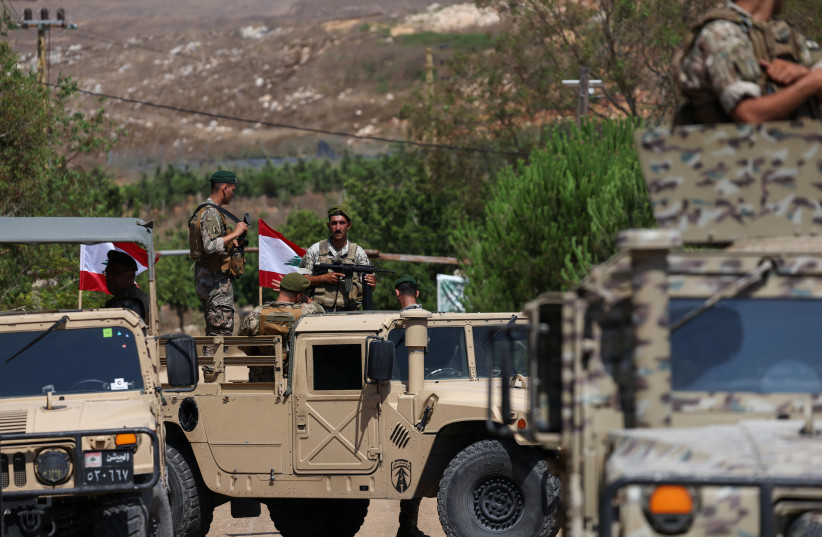
The Lebanese army began deploying in Zawtar al-Gharbiyah, one of three towns in the initial pilot phase of the agreement, last Tuesday after the IDF withdrew from the area, in one of the first tests of the US-brokered agreement.
Recent documentation in Zawtar al-Gharbiyah, including statements published by the group acknowledging its own presence in the zone, showed that Hezbollah’s Islamic Health Organization continues to operate in the municipality. The center stressed that this made it apparent that the return of Shiites to Southern Lebanon would mean the return of the terror group.
The town was heavily destroyed during the war against Hezbollah, according to Mayor Abed Ezzeddin’s comments to international media. More than half of the town was reportedly destroyed, with the buildings still standing heavily damaged by the war.
The Islamic organization was recorded recovering the bodies of Hezbollah operatives alongside the Lebanese Army, which would suggest the Hezbollah civil organization is being allowed to operate openly by the Lebanese Forces.
Civilian in appearance, terror driven in nature
Though civilian in its appearance, Hezbollah’s Islamic Health Organization operates under the terror group’s executive council and serves as a medical corps for the group during its operational activities. Additionally, the organization’s personnel and infrastructure served a dual purpose during the war, allowing operatives and weapons to be transported in ambulances and the construction of Hezbollah operation centers in clinics.
Dr. Moran Levanoni, a researcher for the Institute for National Security Studies, commented to The Jerusalem Post that it was unclear whether Hezbollah’s civil branches were explicitly banned from the pilot zones in addition to its armed fighters.
Levanoni acknowledged that the risk was impossible to eliminate entirely, conceding that some civil organizations could be exploited by Hezbollah for espionage or used as a front to facilitate the group's return. Given that some residents of the area are Hezbollah members, he said it was unrealistic to expect the group to be completely removed. Instead, the objective should be to ensure that Hezbollah cannot rearm there.
In addition to the center’s analysis, the Israeli newspaper Walla reported that it had learned on Tuesday that the Commander of the Lebanese Armed Forces, General Rodolphe Haykal, is coordinating with Hezbollah to avoid friction with the group.
The Lebanese Armed Forces have also reportedly greatly underachieved in the number of Hezbollah weapons it has seized, according to the sources, leading to fears that Lebanon will not be able to meet its end of the agreement with Israel.
Hezbollah has also accused the Lebanese Forces and Israel of not completely following through on the agreement. Hezbollah MP Hussein Hajj Hassan complained on Wednesday last week that the IDF had withdrawn only to the municipality’s outskirts, according to Arab media. He also stressed that Iranian funding was necessary to rebuild the town.