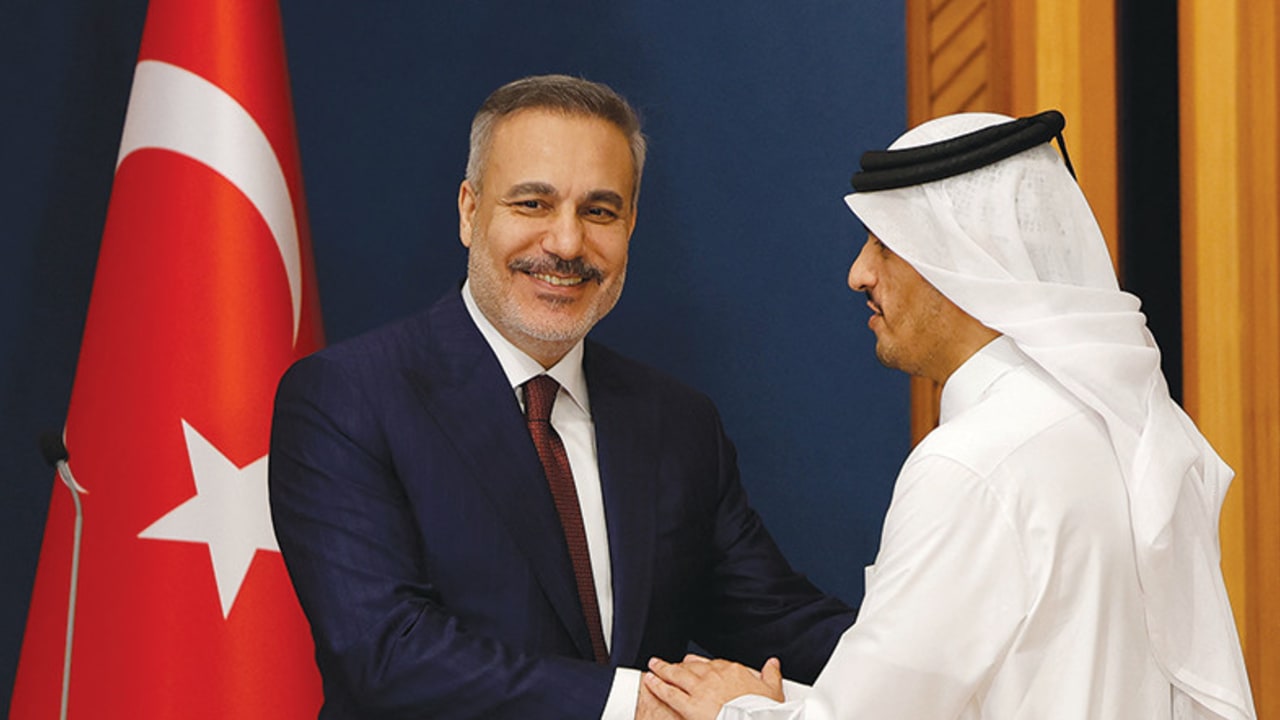
In the current strategic landscape of the Middle East, one of the most notable and insufficiently understood elements is the rising influence of Turkey, and of an emergent Sunni Islamic alliance of which it is part.
In this emergent bloc, Turkey, Qatar, and Pakistan are the core players. Efforts are under way to draw both Saudi Arabia and Egypt toward this axis.
Ankara’s role, and that of the gathering of which it is part, is notable in that it combines close relations with the United States and other Western powers with support for and exploitation of anti-Western Islamist forces on the ground as a key element of its power-building.
This is an alliance openly opposed to Israel. The language now routinely employed by senior Turkish officials with regard to the Jewish state leaves little room for misinterpretation.

Turkish officials call for struggle against Zionism
Turkish President Recep Tayyip Erdogan, in a recent speech, said that “the genocidal, occupying, expansionist ideology called Zionism threatens not only me, not only our party, not only our alliance; it threatens everyone.... When we struggle against Zionism, we are not waging this struggle for ourselves or for personal reasons. We are doing it for our own survival and for the survival of our nation.”
Turkish Interior Minister Mustafa Ciftci said in a June 6 speech that “just as we witnessed the liberation of Damascus, Aleppo, and Karabakh, God willing, one day we will also witness the liberation of Jerusalem.”
But while politicidal rhetoric is interesting to monitor, what matters most are the power plays and the strategy for building power on the ground used by Ankara and its allies.
In this regard, the potentially contradictory pillars of active support for Sunni political Islam and jihadi movements, and self-presentation as an ally of the West should be examined in detail.
Regarding the first aspect, Turkey offers active support to a variety of Sunni Islamist and jihadi authorities and organizations in the Levant and further afield.
The Turkish state is the key backer of the emergent Sunni Islamist regime of President Ahmed al-Sharaa in Syria. While Sharaa’s Hay’at Tahrir al-Sham movement was not a direct proxy of Ankara, the Turkish decision to maintain a Syrian insurgent enclave in northwest Syria against regime and Russian attacks made feasible Sharaa’s eventual march to Damascus and the destruction of the Assad regime.
Turkey, as a result, is the key external player in the new Syria. In an agreement signed on August 13, 2025, Ankara took on the role of training and shaping the new Syrian army and security forces. The goal is to build an army of 200,000 soldiers over the next five years.
Turkey linked to US sanctioned individuals
The new structures are dominated by Sunni Islamist commanders, including many directly linked to Turkey and including individuals designated for financial sanctions by the US Treasury Department because of their involvement in grave human rights violations.
These include Abu Hatem Shaqra, whose Turkish-linked Ahrar al-Sharqiya faction carried out sectarian killings in northern Syria during the war, including the brutal murder of a female Kurdish politician, Hevrin Khalaf, in October 2019. Shaqra is today a division commander in the new armed forces, with Ahrar al-Sharqiya redesignated as Division 86 of the New Syrian Army.
Other commanders of this type include Mohammed al-Jassim (Abu Amsha), a Turkish-aligned commander similarly sanctioned by the US Treasury Department in October 2023 for his involvement in kidnapping, extortion, and the forced displacement of Syrian Kurdish residents. Abu Amsha’s former Suleiman Shah Brigade is now Division 62 of the new army. And so on.
What is emerging under Turkish tutelage in Syria is a new phenomenon in the Middle East – namely, an Islamist-controlled state army.
Simultaneously, Turkey is the largest trading partner and primary economic anchor of the new Syrian regime. Turkish exports to Syria are at record levels, with the two countries targeting an annual volume of trade of up to $10 billion.
Elsewhere in the Levant, Turkey maintains an active Hamas office in Istanbul. This office and other Hamas facilities in Turkey play a direct operational role. That is, they are used to plan and direct attacks and to move funds. Hamas officials, up to and including the now deceased former head of the movement’s political bureau Ismail Haniyeh, travel (or traveled, in Haniyeh’s case) the region on Turkish passports.
In Lebanon, Turkey has been engaged in quiet and systematic influence building in recent years, centering on the Sunni northern city of Tripoli, and the Turkmen community in Akkar.

The recent statements by US President Donald Trump regarding a possible role for the Syrian government in Lebanon appear to reflect the influence that Turkish positions have on the highest reaches of the US administration. This influence goes via Special Envoy and US Ambassador to Turkey Tom Barrack, whose positions often echo those of Ankara. Special Envoy Steve Witkoff, meanwhile, also frequently adopts positions reflecting the views of Qatar, Turkey’s close ally.
Regarding regional alliances, Ankara has over the last decade developed a close strategic partnership with Qatar, encompassing economic, military, and diplomatic elements.
Turkey is a major importer of Qatari natural gas. Turkey maintains a permanent military base in Qatar. The two countries share the anomalous position of support for movements of political Islam across the region, together with close links and involvement with the US and Western countries.
The third component of this “strategic triad” (as a study at Qatar-supported Al Jazeera referred to it) is Pakistan.
Turkey is Pakistan’s fourth largest source of arms, as Islamabad seeks alternatives to the West for its source of weaponry (the main exporter of arms to Pakistan is now China).
Turkey maintains extensive investments in Pakistan and consistently votes with Islamabad on issues such as Kashmir in the United Nations. On the deeper level, the two countries share a similar orientation of nationalism with an Islamic coloration, and a trajectory of historic alignment with the West now turning into something else.
While not linked by formal defense pacts, Turkey, Qatar, and Pakistan have similar orientations and compatible and mutually beneficial capacities. Qatar’s vast financial reach, Turkey’s conventional military capacities, and Pakistan’s nuclear capability together form a powerful combination.
This triad is now presenting itself as an appropriate mediator in Mideast conflicts and the right partner for the US in the region for the period ahead (see Pakistan’s role in the US negotiations with Iran, which produced the current deeply problematic Memorandum of Understanding, as an example of the result).
In practice, the combination of support for political Islam and often for violent Islamist and jihadi organizations as a tool of power projection, combined with strong and deep links into Western systems and economies makes the current government of Turkey and its allies in Doha and Islamabad a major and emergent challenge both for Israel and for those wishing to assemble a coherent Western policy on the Middle East and beyond it.