
At this moment in time, it seems almost impossible that the presidents of Iran and Israel would sit alongside each other – and even more than that, shake hands.
But believe it or not, it happened 21 years ago and was widely reported in international media. It happened on April 8, 2005, in the Vatican. The president at that time, Moshe Katsav, was representing Israel at the funeral of Pope John Paul II, and then-president Mohammad Khatami was representing Iran.
The seating arrangements were alphabetical, in order of each country’s name. Thus, Iran and Israel were somehow seated next to each other, even though alphabetically, Ireland and Iraq came between them.
Khatami and Iraqi Prime Minister Ayad Allawi were alone; Katsav was accompanied by then-foreign minister and deputy prime minister Silvan Shalom; and Irish President Mary McAleese came with a delegation. Of the four officials, she was the only Christian, so that may have accounted for a slight change in seating, if at all.
The custom at such international gatherings is to shake hands with the people on either side. In this case, the handshakes may have extended to others in the same row, as well as to people immediately in front and behind.
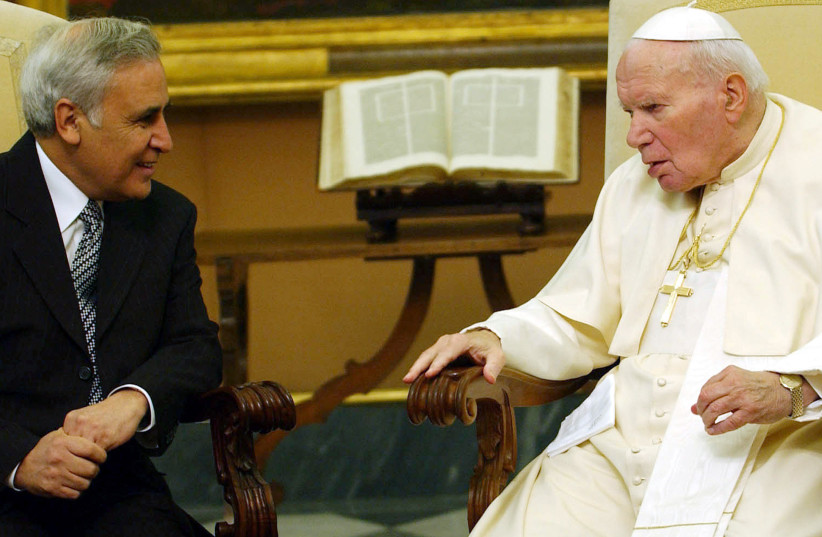
Whatever the case, the Israeli and Iranian presidents were seen shaking hands. Katsav, by the way, was born in Iran and came to Israel when he was five-and-a-half years old.
Recent Iranian strikes on Dimona
Just as Israel is searching for where Iran stores its enriched uranium, Iran, in its strikes against Dimona, is aiming for what is euphemistically known as “the textile factory,” but what is in fact believed to be Israel’s nuclear plant.
Its existence was revealed to the world in 1986 by peace activist Mordechai Vanunu, who worked there as a nuclear technician. He made no secret of his opposition to weapons of mass destruction.
Given its importance, it is no wonder that President Isaac Herzog, Prime Minister Benjamin Netanyahu, Defense Minister Israel Katz, and a slew of MKs headed for Dimona on Sunday to speak to Mayor Benny Bitton and to encourage the residents of Dimona to remain strong after a devastating attack and to continue to take all safety precautions.
While in Dimona, Herzog, accompanied by his wife Michal, made a point of visiting former hostage Segev Kalfon, who was in Hamas captivity for 738 days, and following his release, opened a coffee shop and bakery in Dimona.
Although Netanyahu calls mayors and regional council heads of all the places that have suffered hits and extensive damage from missiles fired by Iran or Hezbollah, Herzog has set himself a mission to visit as many of them as possible.
He has made it a point to visit especially the places in which large numbers of people have been left homeless. Both Netanyahu and Herzog were in Arad and Dimona.
In Arad, each spoke to Mayor Yair Maayan and to the citizens of the mixed city, where secular, haredi (ultra-Orthodox), and Bedouin residents live in the same apartment complex, respect one another, and help one another.
Arad has become an enclave for Gerrer Hassidim, who may have an easier time than most other displaced residents because these hassidim are reputed to be the wealthiest of all hassidic movements.
If the government is slow to govern and rehabilitate, the umbrella body of the Gerrer Hassidim, headed by the Gerrer Rebbe Yaakov Aryeh Alter, can provide new or “like-new” homes to members of his flock as quickly as possible.
Herzog has also visited impact sites in Tel Aviv and Beersheba and patients at Soroka Medical Center, where he has praised the medical staff, with particular emphasis on those who are not Jewish.
Aware of the alternative, people who have lost their homes and most of their contents have taken a positive attitude, while simultaneously charging that the government is shirking its responsibilities to the nation’s citizens.
Neglect of northern Israeli towns
In interviews given by residents of towns, villages, and kibbutzim on the northern confrontation line to online media platforms, it is frequently repeated that government promises have not been met.
Government funds have, to a large extent, been used for military requirements and to keep the government coalition intact, many say. Yet communities that for years have been targeted by Hezbollah remain vulnerable, and in some 90% of cases, according to reports by heads and other officials of local councils, are inadequately protected against missile attacks.
Kibbutz Malkiya, one of 10 kibbutzim near the Lebanese border, has no safe rooms. Most of the area’s residents were evacuated after Hamas’s October 7 massacre, but were told early this year they could return.
Some residents of Metula and Kiryat Shmona, whose homes had been damaged and later repaired, were attacked again but refused to be evacuated.
In 1974, the brother and sister-in-law of broadcaster and former Shas MK Yigal Guetta were murdered in a terrorist attack on Kiryat Shmona, where Guetta was born and raised.
Although he no longer lives there, he still has a strong emotional attachment to the northern town. He is dismayed when he returns to find that the security situation is the same as it was more than half a century ago, with few people having fortified safe rooms in their homes.
Repeated media reports state that more than 33% of Israel’s population do not have safe rooms, and most live too far away from the nearest public bomb shelter to be able to get there in time.
All over the country, NGOs, philanthropic foundations, individuals, and business enterprises have provided essential needs that, strictly speaking, were the government’s responsibility. Keren Kayemeth LeIsrael-Jewish National Fund has been a major contributor, as have United Israel Appeal, the Jewish Federations of North America, Evangelical groups, and various organizations, businesses, and commercial enterprises.
In addition, Ogen, which operates an interest-free multi-million-shekel loan fund, this week announced the expansion of its Yuval fund to support reservists currently serving in Operation Roaring Lion. Ogen is offering interest-free loans of up to NIS 50,000, without guarantors, to help families stay economically afloat.
Estimates on how long it will take to rebuild or repair destroyed and damaged neighborhoods range from two to five years. That’s a long time to be living away from one’s home, and it doesn’t augur well for the nation’s mental health.
The situation could be remedied much faster with the help of Eran Rolls, the founder and chairman of the Netanya-based Israel Building Center.
This construction institution could put aside current property development projects to help rehabilitate the places damaged by Iran and its proxies and to ensure that every community has sufficient bomb shelters and that every home in the North and South has a fortified safe room.
There are hardly any bomb shelters in Arab communities in the North and South. This is inexcusable, given how often communities in these areas are under attack. Surely funds sent by Diaspora communities could be earmarked for game-changing improvements in personal security.
Struggles of new immigrants
During a visit to the Ulpan Etzion immigrant absorption center in Jerusalem, Herzog was told by Jewish Agency officials that 60,000 new immigrants had arrived in Israel since October 7, 2023.
Previous experience has shown that not all immigrants adapt, and that many return to their countries of origin within five years of arrival. Some cannot find good jobs. Others cannot learn the language. The politics disillusion some – the reasons are many and varied.
So many apartments in all those tall towers that have been and are being built across the country will remain unoccupied, especially if the economy is in a downward spiral.
Agriculture and tourism have been immediately affected by the war. Even if potential tourists were not scared off by reports and photographs of attacks throughout the country, the cancellation of flights prevents them from coming to Israel.
The same goes for foreign workers. Even if they are willing to take the risks involved, they find it difficult, if not impossible, to get here.
Moreover, the same applies to participants in the annual International March of the Living, which, after the symbolic “rise from the ashes in Auschwitz-Birkenau,” continues on to Israel to celebrate the nation’s Independence Day.
As so many flights have been canceled, very few of the participants will be here to celebrate Israel’s 78th anniversary of independence.
For security reasons, Israel will not participate in the March of the Living this year either. The decision was taken with a heavy heart, because officials are well aware that for most of those Holocaust survivors who wanted to participate, this was probably their last opportunity to do so.
Still, their safety is of greater importance than their standing in Auschwitz as living witnesses of the Nazi-perpetrated genocide.
Every life is precious, so there is no real comfort in the fact that there have been relatively few fatalities, despite the number of ballistic missiles that have struck buildings, streets, and open fields across Israel.
Though the number of people who managed to reach shelters in time is truly miraculous, their survival is truly ever more miraculous.
Another miracle, which will soon be taken for granted, is human longevity. People are living much longer than they did as recently as half a century ago, and it’s quite common these days for people to celebrate triple-digit birthdays.
Among them is a woman believed to be the world’s oldest living Jewish person. She is Dutch-born Jerusalemite Mirjam Bolle-Levie, who celebrated her 109th birthday on March 20.
Letters from the Holocaust
A Holocaust survivor of Westerbork and Bergen-Belsen concentration camps, Bolle-Levie wrote many letters to her fiancé, who had preceded her to Israel before the war.
Still, she never sent them. She kept them in a box and brought them with her to Jerusalem following her liberation as part of a prisoner exchange deal in 1944.
Bolle-Levie never showed them to her fiancé, whom she married soon after her arrival, because she felt that there was no longer any need for him to read them. But she did not discard them.
About 10 years ago, the letters were published in book form under the title Letters Never Sent: Amsterdam, Westerbork, Bergen-Belsen. The letters cast light on many controversial issues that relate to the Holocaust, including the role of the Judenrat, the Nazi-appointed Jewish councils, which were forced to decide on the fate of Jews in ghettos.
Bolle-Levie said she harbored no hostility toward them, saying it is wrong to judge people in such situations. Israel was not all milk and honey for her. Bolle-Levie lost her son in the 1967 Six-Day War and, later, her daughter in a military accident.
But Bolle-Levie, though pained by bereavement, continued to believe that life is for living. She wears makeup and colorful, fashionable clothes – and until recently, did her own shopping. Following the book's publication, she traveled to the Netherlands for TV appearances and gained celebrity status.
Among Israeli philanthropists who are providing for instant needs and supporting the economy is business tycoon Yitzhak Tshuva, who, through the Delek Group and NewMed Energy, which he heads, has donated NIS 6 million to the IDF Widows and Orphans Organization.
The funds are primarily meant for the welfare of widows of soldiers and security personnel who were killed during the Israel-Hamas War.
This particular sum is the second installment of a NIS 10 million donation. It is a direct grant to widows to help them cope with economic and other challenges.
“There are moments when a society is tested not only by its strength, but by its heart and compassion,” Tshuva said.
“The families who have lost what was most precious to them carry a pain that words cannot describe.”
“It is the responsibility of all of us to be there for them – not only on memorial days, but every single day. Our donation is an expression of a deep commitment to stand alongside the widows of IDF soldiers and members of the security forces, to strengthen, support, and assist them in rebuilding stability, security, and hope,” he continued.
“This is a moral obligation of Israeli society toward those who have paid the highest price on behalf of us all, and we will continue to act so that they are not left alone – not now and not in the future.”
Zehava Gross Meydan, the chairwoman of the IDF Widows and Orphans Organization, underscored that many more families have entered the circle of bereavement.
She believes that Tshuva’s generosity will enable the expansion of support services for IDF widows and orphans. The organization’s CEO, Shlomi Nahumson, noted the significance of the donation, as it enables IDF widows and orphans to receive immediate assistance.
This coming Friday, March 27, is an important date on the calendar. It’s the annual start date for daylight saving time, introduced in Israel in 2000 by Natan Sharansky, then the interior minister.
Sharansky extended daylight saving by 37 days. Until then, it had been decided in accordance with the lunar calendar and Jewish High Holy Days.
The ultra-Orthodox were not happy about the change, but they were even more indignant when Sharansky announced that he intended to recognize civil marriages.
However, he wasn’t in office long enough to implement that decision. The upshot is that even the most secular of Israelis has to be married by a rabbi.
If one of the parties to the union is not Jewish, they must marry abroad. Some secular Jewish couples also go abroad to get married, but if they later want to get divorced, they have to do so in accordance with Jewish law.
There are some issues on which the ultra-Orthodox are flexible, and others on which they refuse to budge an iota. An example of flexibility: Those people who go through the ritual of selling their leavened possessions before Passover can now do so online.
This goes entirely against the grain of Jewish law, in which the sale of leavened products is a contractual arrangement in which each end of a handkerchief, a table napkin, or a pen is held by the two parties involved, and the name and address of the seller and the details of where the leaven is located are recorded.
The seller then signs a form in the presence of the person liaising between the seller and the buyer. The witness is also an intermediary in the transaction. In the digital age, that law will likely become obsolete, which makes one wonder what is purportedly “authentic Judaism.”
Several countries recall their ambassadors during wartime. Nearly all the resident foreign ambassadors in Israel, however, have remained. A retired Israeli ambassador, Yitzhak Eldan, who is the founding president of the Ambassadors’ Club of Israel, has commended them for remaining loyal to the profession and for their courage in deciding to stay, thereby demonstrating true friendship.
Some ambassadors are offering a lot more than friendship. Some are even offering blood. When the European Union’s Ambassador, Michael Mann, visited Magen David Adom's headquarters in Ramla this month, he donated blood before returning to his office.
Germany’s Ambassador Steffen Seibert visited the NYX hotel in Tel Aviv to learn about the emergency programs run by HaGal Sheli (“My Wave”) for displaced families.
Accompanied by HaGal Sheli CEO Yaron Waksman, Seibert observed counselors and volunteers working directly with children and parents, adapting surf therapy methods to a land-based setting.
They taught movement exercises and used surfboards to help restore self-confidence in an unfamiliar place during this period of crisis and uncertainty.
HaGal Sheli has considerable experience in using surfing as a therapeutic tool in helping people cope with and overcome trauma and PTSD. Its teams have been applying these methods in hotels in Beersheba, Jerusalem, and Tel Aviv.
Seibert commented afterward that it was wonderful to see children who had to leave their homes due to the threat of Iranian missiles having a good time and temporarily forgetting the war.
Waksman noted that the therapeutic tools currently in use were developed for over-the-ear use in various situations and were usually used in water, but were also effective on dry land.
Safety and security are major considerations when embassies select hotels for visiting heads of state, government officials, and other officials.
In Israel, the King David Hotel in Jerusalem has long been considered the country’s safest and most secure hotel.
Although many more modern, fully computerized hotels have been built over the past 25 years, none has yet equaled the King David’s reputation, which combines old-world charm and dignity with modern technology.
Thus, when Foreign Minister Gideon Sa’ar hosted Jean-Noël Barrot, France’s minister for Europe and Foreign Affairs, immediately following the latter’s visit to Beirut, the natural venue was the King David Hotel.
During their discussion, Sa’ar said that the Lebanese government was not taking any significant action against Hezbollah. This lacuna indicated that “Israel will continue to defend itself and its citizens and will act decisively against all those who seek its harm,” Sa’ar said.
Further into the meeting, the foreign minister proposed that France and the European Union declare Hezbollah as a terrorist organization and not just a military wing.
Before leaving Israel last Friday, Barrot told reporters that he had been to Lebanon to try to de-escalate the crisis and persuade Lebanon to enter into a ceasefire agreement.
Given the existing realities, he saw no sign of an end to the spiraling regional conflict. Nevertheless, Barrot pledged that France and its allies would continue to work to bring about the cessation of hostilities.
Just as Barrot arrived with his delegation to speak to reporters, before returning to France, a missile siren alert was sounded, warning that Iran had launched ballistic missiles at Israel. Barrot, his delegation, and the journalists all headed to a nearby bomb shelter to take cover.
German Foreign Minister Johann Wadephul had a similar experience a week earlier. He was already on the plane, preparing for takeoff, when he received an alert. He and his delegation deplaned and took shelter in an Israeli bunker.
Transportation Minister Miri Regev, who is also in charge of arrangements for the start of Israel Independence Day celebrations, wants to give the prime minister’s wife, Sara Netanyahu, the honor of lighting one of the beacons traditionally lit on Mount Herzl.
The prime minister’s wife may have many qualities that make her deserving of such a distinction – but not in an election year, where her beacon-lighting could be interpreted as being part of her husband’s election campaign, thereby turning a national festival into a political gimmick.
Rather than insult Mrs. Netanyahu by turning the issue into a political controversy, she could be given another Independence Day honor.
If US President Donald Trump turns up to receive the minted-in-his-honor special Israel Presidential Medal in appreciation of what he has done for the Jewish state, the actual presentation could be made by the prime minister’s wife.
Since this would be the first medal of its kind, and Mrs. Netanyahu shares the name of the first of the Biblical matriarchs, she would be an appropriate person to do the honors, and her dignity would remain intact.
The local media is over-occupied with former Fox media star Tucker Carlson, who is not the first well-known personality to change from a conservative pro-Israel stance to one that resulted in him being named “antisemite of the year.”
Carlson’s transition began following his dismissal from the Fox network in April 2023 and intensified after the retaliation by Israel following Hamas’s October 7 massacre.
Far from Carlson politically, but equally anti-Israel in many ways, is Sen. Bernie Sanders, who is trying to stop the US from selling arms to Israel. In the 1960s, Sanders, who is Jewish, was a volunteer on the Hashomer Hatza’ir kibbutz Sha’ar Ha’amakim in the North.
The 125th anniversaries of the births of two Jewish cultural icons, Kurt Weill in March and Mordechai Gebirtig in May, will be marked in cultural circles this year.
Weill, the son of a German cantor, fled to the US with the outbreak of the Second World War, but the Polish-born Gebirtig, who was one of the most prolific writers of Yiddish songs and plays, was murdered by the Nazis.
Among the people listed as this year’s recipients of the annual B’nai B’rith World Center-Jerusalem awards for journalists reporting on Diaspora affairs are Zev Stub of The Times of Israel and Tamar Ish of Shalom Channel 13 News.
Veteran editor, reporter, and non-fiction author Oren Nahari will receive a lifetime achievement award. Nahari recently stunned relatives, friends, and colleagues by revealing that he has ALS and can no longer propel himself without the aid of a walker.
The fact that he is gradually losing the use of his legs does not mean that he has lost his mind or his ability to speak.
Yet for two consecutive Saturday mornings, he did not broadcast his weekly radio spot on KAN Reshet Bet, which was used to chat about Iran and speculate on how long the war would last.
It was unfair to Nahari, who could have easily recorded the program in advance, and equally unfair to the people who look forward to his program each week – especially now that they know that he has a terminal illness.
Meanwhile, even before the award ceremony, Nahari will be celebrating the launch of the book that he wrote together with veteran military journalist Yoav Limor, in which they explore how wars have influenced and even changed the course of history.
The last war documented in the book is the Israel-Hamas War. But a second release of the book may include the war against Iran and its proxies.
The views expressed in this article are those of the author and do not necessarily reflect the views of The Jerusalem Post or its affiliates.
greerfc@gmail.com