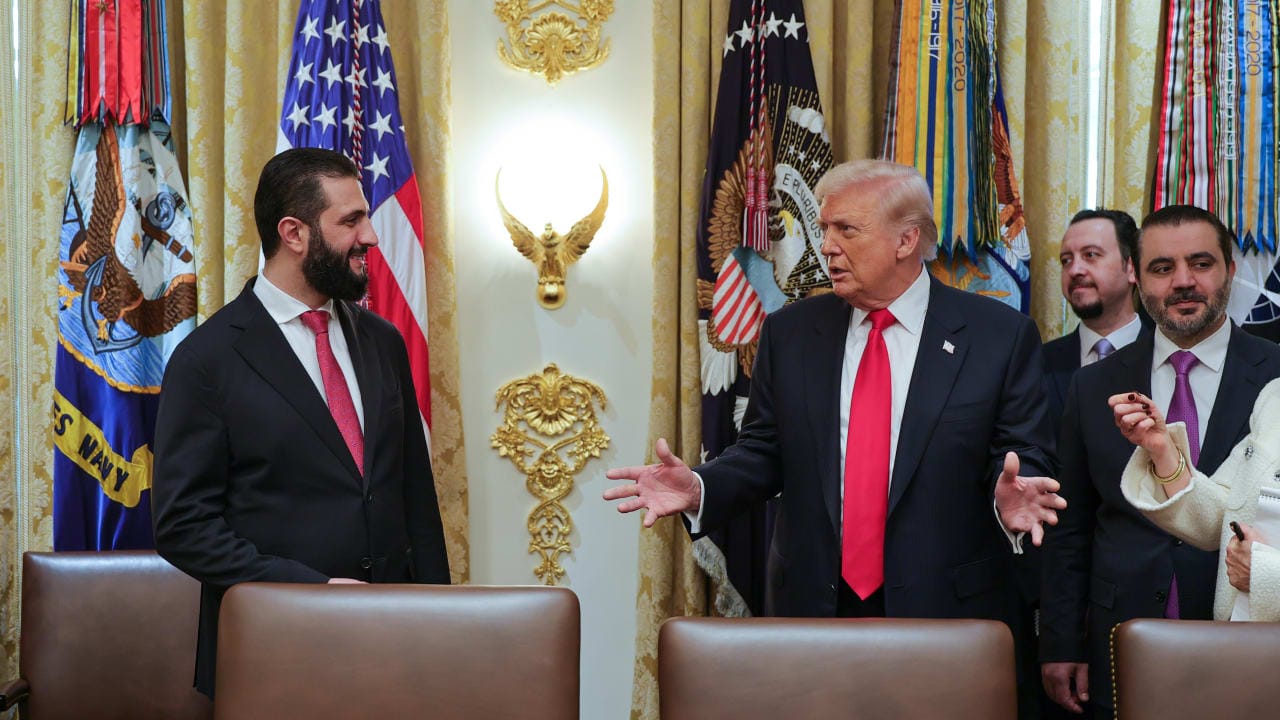
It was a photo few could have imagined even a year ago: the president of the United States shaking hands in the White House with a man who, not long ago, was wanted for terrorism and carried a $10 million bounty on his head.
Yet there he was on Monday – Syrian President Ahmed al-Sharaa – sitting beside US President Donald Trump in the Oval Office, flanked by the American and Syrian flags, as Trump declared that “we want to see Syria become a country that’s very successful, and I think this leader can do it.”
For Washington, the meeting represented a stunning reversal of decades of hostility. For Damascus, it was nothing short of a diplomatic resurrection. But for Jerusalem, the encounter was notable precisely because it did not include much about Israel – at least not publicly.
Most non-Israeli media outlets that covered the meeting – from The New York Times to Fox News – focused on Trump’s decision to lift sanctions, Syria’s possible entry into the anti-ISIS coalition, and the new US–Syrian partnership. Israel did not figure in the script.
The symbolism was clear: this was not an Abraham Accords-style regional breakthrough. There were no gestures toward normalization, no nods to peace. Instead, the meeting was cast as a bilateral reset – a pragmatic understanding between Washington and Damascus.

For Israel, that silence is both reassuring and troubling. Reassuring, because Trump did not attempt to force Israel into a premature Syrian reconciliation – Jerusalem needs time to gauge whether Sharaa’s turn toward the West is real or just a passing phase. Troubling, because Jerusalem was absent from a conversation that will reshape its northern frontier.
Sharaa has gone from hunted jihadist to President Donald Trump's guest in the White House
In less than a year, Sharaa has gone from hunted jihadist to Oval Office guest, albeit one ushered into the White House through a side door and without any fanfare. Once a senior commander in an al-Qaeda-linked militia, Sharaa led the rebels to victory over Bashar al-Assad after Israel decimated Hezbollah, which was propping up Assad’s regime.
Now, with US backing, Sharaa is positioning Syria as a stabilizing force in the region and a future investment destination. “Syria is no longer looked at as a security threat but as a geopolitical ally,” he told Fox News, pointing to energy and reconstruction opportunities for American firms.
Trump, for his part, appears fully on board. He waived for another 180 days the 2019 Caesar Act – once the toughest sanctions regime on Syria – and restored diplomatic ties broken since 2012. “We’ve all had rough pasts,” he said of his guest. “I think frankly if he didn’t have a rough past, you [he] wouldn’t have a chance.”
For Israel, the change is dizzying. After years of a weak, quarantined Syria – albeit one aligned with Iran and Russia – Jerusalem must now adjust to a Syria re-entering the international system under an American umbrella.
When the Fox interviewer asked whether Syria would follow the Abraham Accords and make peace with Israel, the question was carefully phrased: “The White House has said that President Trump would like Syria to join the Abraham Accords. The foundational principle of the accords is that Israel has the right to exist as a sovereign Jewish state. Is that something that you agree with?”
Sharaa ducked the question: “The situation in Syria is different from the situation of the Abraham Accord countries. Syria has borders with Israel, and Israel occupies the Golan Heights since 1967. We are not going to enter into negotiations directly right now; maybe the US administration with President Trump, will help us reach this kind of negotiation.”
Those words are telling. By invoking “occupation,” Sharaa reasserted a claim to the Golan, and he did it after meeting the US president, who recognized Israeli sovereignty over the strategic plateau in 2019. The Syrian leader’s phrasing suggested that he intends to test whether Washington’s recognition is truly irreversible and whether US re-engagement with Damascus can reopen a file Israel considers long closed.
While Trump and Sharaa were exchanging pleasantries in the Oval Office, lower-level American, Syrian, and Israeli officials have been quietly discussing mutual security understandings for months.
The talks center on preventing clashes along the border and on defining the limits of Israel’s current troop presence in southwestern Syria – positions the government says are temporary security measures taken to prevent hostile forces from moving close to the border after Assad’s collapse last December.
Jerusalem’s main objective is clear: formalize a buffer that keeps Iranian and Hezbollah forces well away from its border while preserving freedom of action for the IDF. US officials, meanwhile, are floating variations of past disengagement models that would include international monitoring while leaving the Mount Hermon high ground under Israeli control.
No agreement is near, but the very fact that Washington is brokering the discussions marks a striking shift. Reuters reported last week that the US is planning to establish a military presence at a Damascus airbase to monitor any future agreement.
But it was not Syrian-Israeli security understandings that made headlines following Monday’s White House talks. Rather, what the media focused on was that Syria would soon join a US-led international coalition to fight ISIS.
Sharaa told Fox News that Syria and the US “need to discuss these matters and get into an agreement about ISIS.” In some ways, that seems evident: just hours before Monday’s meeting, a Reuters report from Damascus quoted senior officials as saying that two Islamic State plots to assassinate Sharaa had been foiled in recent months – a reminder that Syria’s stability remains fragile.
For Israel, this is a delicate balance. A US-anchored Syria that curbs Tehran’s reach serves Jerusalem’s interests, but an overly empowered Damascus, newly legitimized in Washington, might soon seek diplomatic rewards – beginning with the Golan.
Trump’s moves fit a familiar pattern: bold reversals aimed at reasserting US influence in the Middle East and rewriting the script. By normalizing ties with Damascus, Washington hopes to pull a major Arab state out of Tehran’s orbit and re-establish a foothold in the Levant.
There is also the economic dimension. Reconstruction, energy, and infrastructure investments are being framed as the next stage of Syria’s rehabilitation – incentives meant to bind the country’s recovery to Western rather than Iranian or Chinese money.
Israel may quietly welcome parts of this shift. A Syria linked to Washington is far preferable to one beholden to Tehran. Yet Jerusalem must tread carefully. Once Damascus begins to enter the family of nations again, it will almost certainly try to parlay that legitimacy into diplomatic leverage – most likely over the Golan Heights.
That’s why Israel must be clear about its red lines: no Iranian or Hezbollah presence south of Damascus, and no ambiguity over the permanence of US recognition of the Golan as Israeli sovereign territory.
The Trump-Sharaa meeting marks another bend in a fast-changing regional landscape brought about by Israel’s actions after October 7.
For Israel, the moment demands both vigilance and imagination: vigilance regarding its security needs in a post-October 7 world, and imagination to explore how this unusual Trump-Sharaa relationship might ultimately transform Syria from an implacable foe to a stabilizing neighbor. Stranger things have happened; just look at the 1979 peace treaty with Egypt.
In the Middle East, yesterday’s pariah can become tomorrow’s partner. Yet Israel’s eyes must stay wide open, because that partner – given the volatility of the region – could become a problem all over again the day after. And this is especially true of Syria, given its fragmentation, fragility, and overall combustibility.