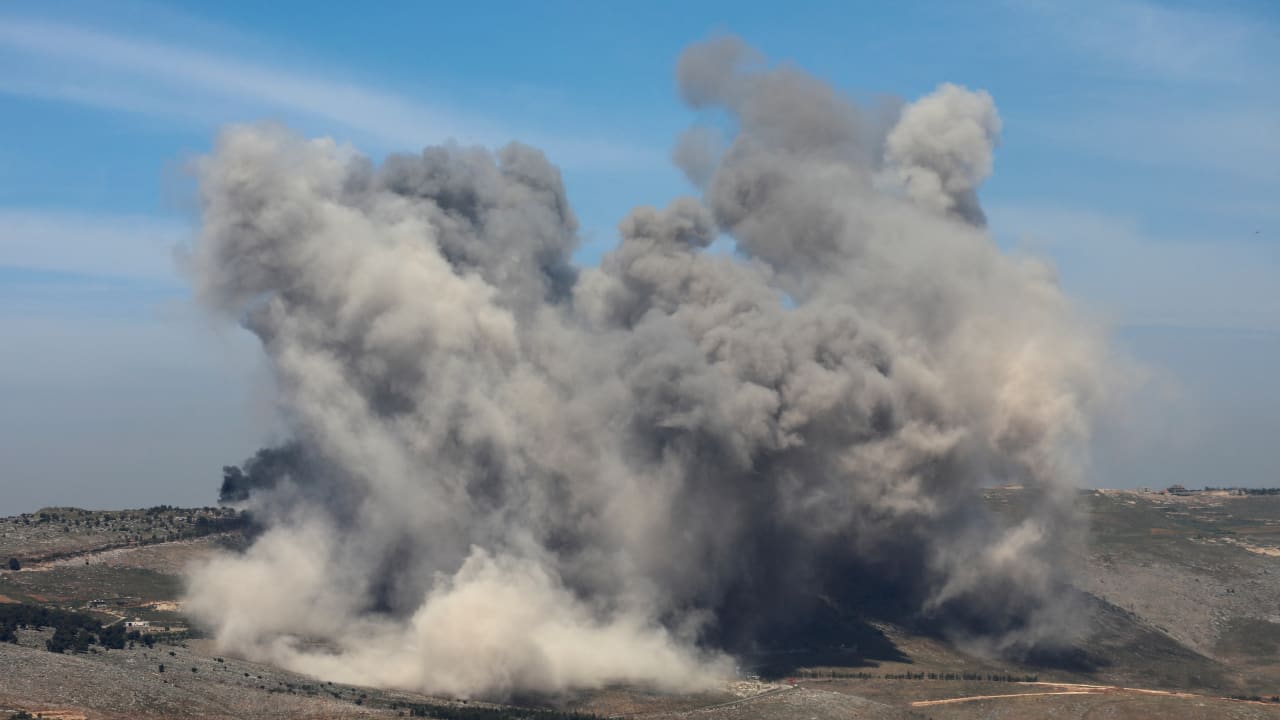
Lebanon wants Israel’s continued airstrikes to stop. Israel and Lebanon agreed to a ceasefire last November after the IDF dealt Hezbollah serious blows.
The ceasefire is ostensibly between Israel and Lebanon, and this covers Hezbollah, because it should mean that Israel’s airstrikes stop. Israel has asserted, however, that it has a right to continue striking Hezbollah.
Tensions are escalating.
“Lebanese President Joseph Aoun instructed the army on Thursday to confront any Israeli incursion into southern Lebanon after Israeli forces crossed the border overnight and killed a municipal employee, despite a US-brokered ceasefire,” Reuters reported.
The main reason the airstrikes are continuing is to prevent Hezbollah from regrowing its tentacles in Lebanon. The airstrikes likely also can pressure Lebanon to finally rein in Hezbollah and disarm it.

There was optimism this past spring that Lebanon would do the right thing. The new president, Aoun, and the new prime minister, Nawaf Salam, have appeared to want to disarm Hezbollah.
They talk a good game, and they have regional support to disarm the group as well. Arab states such as Saudi Arabia would like to see Hezbollah’s power reduced.
The problem with Aoun and Salam, however, is that they have been involved in Lebanese politics and affairs for decades. They are creatures of the state.
This means that even though they may want to do the right thing, they aren’t yet able to think outside the box. In essence, they grew up with Hezbollah having an illegal terrorist army controlling part of Lebanon as a norm, and they can’t see a way forward.
How are they going to use the army to disarm Hezbollah, when Aoun and Salam didn’t do it in the past in previous roles? Aoun is from the army, and Salam has long experience in diplomacy. They never achieved much for Lebanon, however, and they have yet to achieve again.
The difference now is that Iran and Hezbollah are greatly weakened. The Assad regime is also gone. This isolates Hezbollah.
Lebanon had tried to pave the way for disarming Hezbollah by first disarming some Palestinian groups. It was successful in disarming Palestinian groups linked to Fatah, the leading group in the Palestinian Authority.
Hamas did not disarm, however, and Fatah agreed to disarm based on an agreement with Beirut. As such, this showed how the government could disarm a group only as long as the group is willing to do so. The government has no experience taking guns when groups don’t want to hand them over.
This illustrates why Lebanon has a hard time facing Hezbollah and making its next move.
UN and US role in disarming Hezbollah
There was spotlight on Lebanon this week when US Deputy Special Presidential Envoy to the Middle East Morgan Ortagus was in Lebanon. She had been in Israel prior to going to Lebanon.
There is also focus on the UN and international organizations, as well as the role of the US and others in working on a mechanism that is supposed to aid Lebanon in finding Hezbollah arms and destroying them.
This has led to conflicting reports about Lebanon’s success. Lebanon claims it has blown up Hezbollah arms caches.
One report even claimed that Lebanon’s army had run out of explosives because it had destroyed so many Hezbollah arms using existing explosives. This seems far-fetched, but it feeds into the excuse factory that helps Lebanon avoid responsibility.
Another report said the UN and France had condemned Israel for an incident involving a drone and the UNIFIL peacekeeping force.
Meanwhile, “During a meeting with Army Commander General Rudolph Haykal at Baabda Palace in Beirut, Aoun said the attack was staged a day after a meeting by the ceasefire oversight committee, ‘which must not limit itself to recording incidents but act to end them by pressing Israel to respect the November ceasefire agreement and cease its violations of Lebanese sovereignty,’” Turkey’s Anadolu Agency, a state-run news agency, reported.
This entire sequence of events illustrates how Lebanon and Israel may be careening toward a new crisis. There had been a year of hope. It seems that Hezbollah will not disarm, however, and actually wants to not only resist but to return to control parts of Lebanon. This will take time.
Pro-Hezbollah media outlets in Lebanon, such as Beirut-based newspaper Al Akhbar, are in favor of Lebanon potentially confronting Israel over the airstrikes.
This shows how Hezbollah is playing its cards and is trying to wait out the strikes until Lebanon, or perhaps the US, tries to hold the Israeli attacks in check.