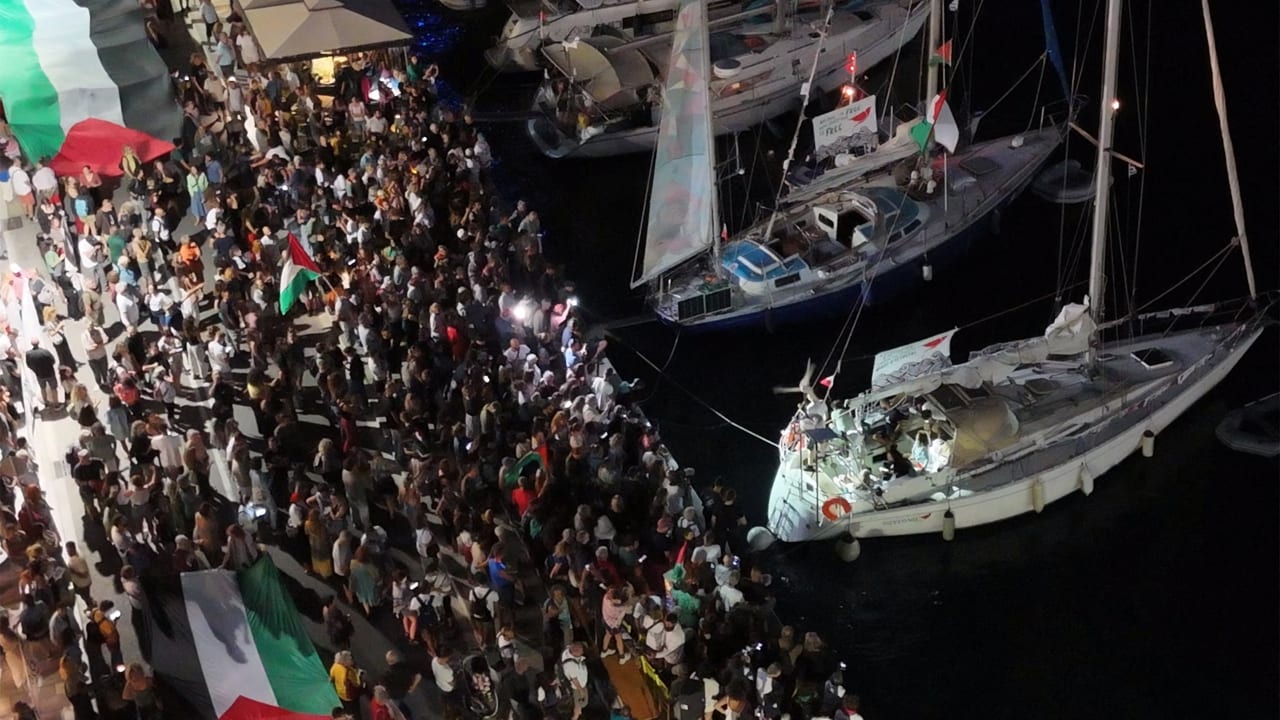
The Gaza-bound flotilla has reached waters off the coast of the Italian island of Pantelleria, according to vessel tracking data.
The flotilla is currently split into several groups, with the largest group of 18 vessels now near Pantelleria, around 2,000 km. (1,300 miles) from Gaza. Another group of boats is at the Sicilian port of Portopalo. A third group of only two sailboats has left the Greek island of Syros from the port of Ermopoulis to join the Global Sumud Flotilla.
The flotilla is supposed to gather somewhere in the Mediterranean to combine into one large flotilla that seeks to get to Gaza. Global Sumud members believe that they are helping by trying to break through what they call Israel’s “illegal siege” of Gaza.
The flotilla has suffered some challenges along the way. When the first group of around 20 ships tried to leave Barcelona on the last day of August, it encountered high winds and had to delay departure by a day. Then it stopped off the Spanish island of Menorca for two days. When it arrived in Tunis on September 7, its members paused for another week.
On September 14, the flotilla again began to depart the Tunisian port of Bizerte, heading east. The flotilla leaving Tunisia appeared to be down to around 18 ships after several suffered issues that caused them to become unseaworthy for the longer journey.
This kind of attrition is normal in any large flotilla. From the time of the Greeks, it has been common to have to leave vessels behind while traveling the Mediterranean.
The Spanish squadron of the flotilla, which left Tunisia on September 14-15, passed by Cap Bon on September 15. This peninsula has a pretty lighthouse built in 1875. It is around 20 m. high and can be seen at a distance of more than 25 km. (15 miles) at sea.
The ships then sailed east toward the Italian island of Pantelleria. This island was once held by Arab conquerors in the 8th century. Taken by a fleet from Aragon in the 14th century, it was sacked by the Turks and later taken by the Allies as part of Operation Corkscrew, prior to the battle to free Sicily.
The island is around 95 km. (60 miles) from Sicily and around 60 km. (40 miles) from Tunisia. The squadron of ships off of Pantelleria will now have to sail east toward Malta, where they may then decide how best to rendezvous with the squadron of vessels from Sicily.
According to the flotilla, there are around 17 ships in the Italian port of Portopalo, intending to join. These vessels left the Sicilian port of Augusta on September 14. They are the Italian contingent of the flotilla.
Portopalo, like Pantelleria, was important historically in terms of the liberation of Sicily from the Axis. The Allies landed at the shores of Gela and Pachino in July 19143. Portopalo, a large port, was helpful in the invasion.
The flotilla heading for Gaza is primarily composed of sailing vessels, many of them around 12-12 m. (40-50 feet) in length.
Some of the vessels are larger, though, such as the Estrella Y Manuel, a 17-m. (55-foot) vessel, which appears to have originally been a Spanish fishing boat.
There is also a large historic sailing vessel called Sirius. In addition, there are several pleasure craft, such as a vessel called Alma Explorer and another called Family.
The activists claimed that two of the vessels were struck by drones while off Sidi Bou Said near Tunis last week.
According to vessel tracking site Vessel Finder, the Alma Explorer boat is still near Cap Bon, while the rest of the contingent carried on to Pantelleria overnight.

Still a long way for flotilla to reach Gaza
Overall, the various squadrons of the Gaza flotilla have a long way to go to get to Gaza. From the Sicilian coast, they will still have more than 1,600 km. (1,000 miles) to sail. Even if they make a speed of 5-10 knots an hour, it will take them a week or more.
Their progress has been so slow in the first two weeks that covering such a distance will likely take them another two weeks.