
Egyptian officials announced earlier this week that the country would hold presidential
elections in December. Although multiple candidates have already entered the race, long-
standing President Abdel Fattah el-Sisi is expected to win and stay in power until at least 2030.
Experts attribute the early elections to the government’s plan to devalue the Egyptian pound in
order to unlock the International Monetary Fund’s aid program, a move that will likely cause
social unrest.
National Election Authority Chair Waleed Hamza announced that the election is scheduled for
Dec. 10-12 and that a runoff will occur from Jan. 5-7 in the event that no candidate receives
over 50% of the vote. He also noted that Egyptian expatriates will cast their votes between Dec.
1-3 and, if necessary, during the Jan. 5-7 runoff.
El-Sisi was first elected as president of Egypt in 2014 after leading a military coup that
overthrew Islamist President Mohamed Morsi. The coup followed massive nationwide protests
against Morsi’s rule. In 2018, el-Sisi was reelected, and the constitutional amendments of 2019
allowed him to extend his presidential term to a six-year tenure.
If el-Sisi wins these elections, he may be in power until 2030.
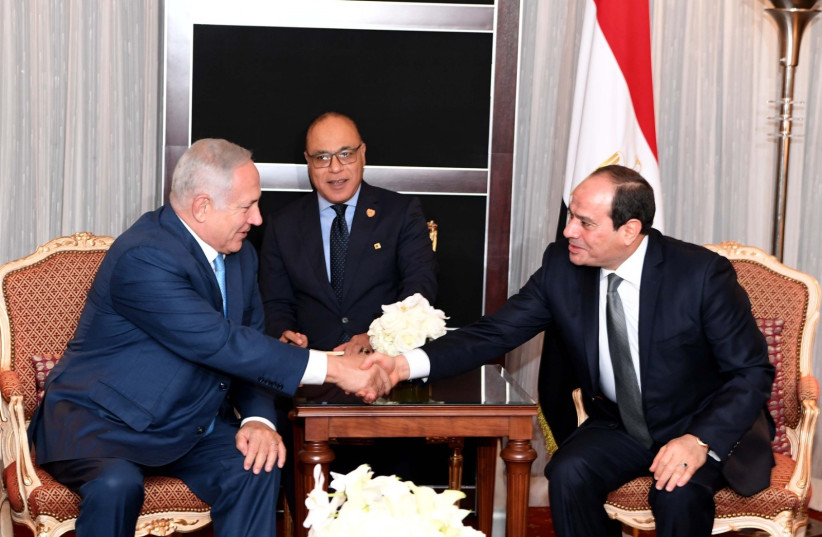
The elections were originally expected to take place in 2024. Riccardo Fabiani, North Africa
director at the International Crisis Group, told The Media Line that despite the long-standing
rumors that the presidential elections might be called earlier than expected, the announcement
was in fact triggered by the country’s deteriorating economic situation.
He explained that el-Sisi plans to introduce unpopular and difficult measures, such as a policy of
exchange rate depreciation, in order to become eligible for IMF aid. Holding an election before
introducing these measures will allow him more control over the situation, he said.
Fabiani noted that the exchange rate depreciation “has been postponed for several months,
against the IMF’s wishes, due to its potentially massive impact on inflation and incomes for a
population that has already been suffering from these problems for months.”
Thomas Gratowski, a geopolitics expert and senior practice director at Global Counsel, echoed
this sentiment. He explained that the IMF program, which Egypt agreed to in late 2022, requires
the government to enact several policies, including devaluing the Egyptian pound, in order to
unlock the IMF’s financial support.
He told The Media Line that the IMF recently conducted a review of the existing program,
which is set to conclude ahead of the IMF and World Bank annual meetings in Marrakesh this
October, and that it appears not enough progress has been made.
“It seems Cairo is now trying to bring the election forward because the devaluation needs to
happen soon to unlock the funding, or else Egypt will run out of money,” he said.
Dr. Noha Bakr, an advisory board member of the Egyptian Center of Strategic Studies, disputed
the widespread perception that the elections are being held earlier than originally scheduled.
“There is a clear misunderstanding about this from the people,” she told The Media Line. She
said that the elections are being held according to the timetable that was set in the 2014
constitution and its 2019 amendments.
She explained that the process is meant to take place no more than 120 days prior to the end of
the current presidential term, but that aspects such as accepting candidacy requests, reviewing
candidates’ documents, campaigning, the election days themselves, the potential need for a
second round, and the opportunity to appeal the results all take time and must all be
accomplished before el-Sisi’s term ends.
A suspect election
El-Sisi won over 97% of the votes in the 2018 elections, in which his only opponent was Moussa
Mostafa Moussa of the centrist liberal El-Ghad party. Moussa, himself a supporter of el-Sisi,
announced his candidacy just a day before the deadline, in what many called a maneuver to
avoid a one-candidate presidential election.
This year, despite the early announcement of the elections, at least other four candidates have
announced their bids to run. The most popular of them is Ahmed Tantawi, a Nasserist former
lawmaker who lost his seat in parliament in 2020. Tantawi claims that the country’s security
services detained some of his campaign workers and prevented him from conducting
presidential election events.
Some of the other candidates who have announced their bids are Abdel-Sanad Yamama, who
leads the Wafd Party, Gameela Ismail, head of the liberal Dostour party, and Farid Zahran, who
leads the Egyptian Social Democratic Party.
Bakr said that none of these candidates is likely to be elected as President.
She noted that Tantawi is seen as inexperienced, despite public recognition due to his social
media presence. Ismail is known for her role in the 2011 Egyptian revolution, Bakr said, but “her
experience in international relations and security topics is not clear, and for many, being a rebel
who shares in a revolution is not enough experience to build a state.”
Yamama leads one of the most popular political parties but has no relationship with its
grassroots, she said.
Despite the low chances that el-Sisi will be unseated, Bakr described the wide field as a good
sign for Egyptian democracy. It reflects “that the prevailing system is open to competition and
that we have surpassed the major security concerns that previously made Egyptians focus only
on stability and security topics,” she said.
Fabiani said that the other candidates’ bids have to do with the National Dialogue initiative
launched earlier this year by el-Sisi.
“Many within the opposition have hoped to seize this opportunity to push the political system
towards a gradual political opening,” he said.
This initiative, Fabiani said, has fueled some limited hopes for a loosening of el-Sisi’s grip over
the political system, which would allow for opposition candidates to participate and give voice
to popular dissatisfaction.
However, he said, “From the arrests and measures that have hit some of the candidates and
the restrictions and obstacles that they face, it is clear that they stand no chance of challenging
el-Sisi.”
He described the race as obviously skewed in favor of el-Sisi. “The recent hacking of Tantawi’s
mobile phone and the arrests of dozens of his campaign volunteers highlight clearly that there
is no level playing field,” he said.
In addition to that, Fabiani said, the other candidates have very little popular support and are
largely unknown outside of their small circle of engaged activist supporters. He said that the
average Egyptian is hopeless, disengaged from politics, and not interested in the activities of
what remains of the opposition.
In any case, according to Bakr, the elections will be monitored to ensure that they are held in a
democratic way. She said that 34 Egyptian and nine international nongovernmental
organizations will monitor the process.