
The Aleinu prayer combines the idea of Israel as God’s “am segulah” (treasured people), assuming the continued responsibility to live a life of worth and meaning,” and “a kingdom of priests and a holy nation” (Exodus 19:6). Since the 13th century, this prayer has been recited at the conclusion of every prayer service.
The first paragraph of Aleinu praises God for having chosen the people of Israel from the other nations, teaching them to worship the One God while others bow down to idols. The second paragraph expresses the ardent desire for the time when the world will be perfected under the kingship of the Almighty, idolatry will vanish, and all humankind will recognize the only true God. Aleinu closes with two biblical quotes: “The Lord will reign for ever and ever” (Exodus 15:18), and “The Lord shall be King over all the earth; in that day shall the Lord be One and His Name One” (Zechariah 14:9).
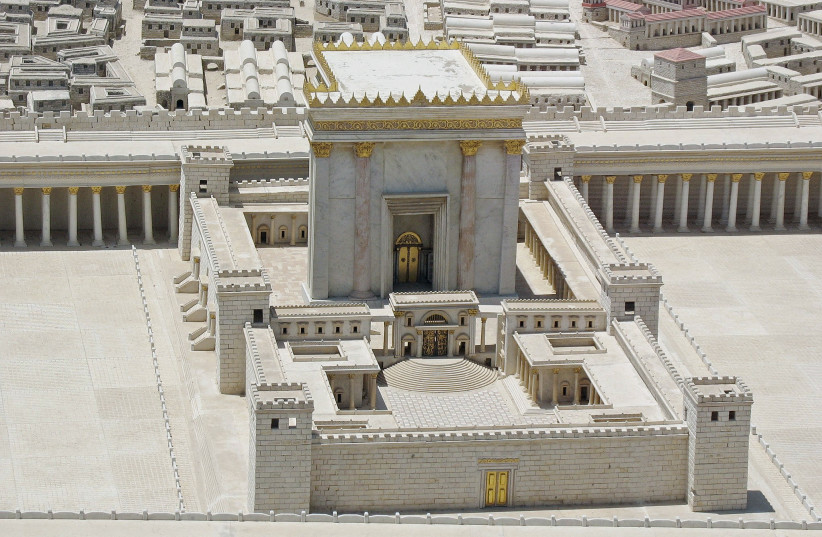
The Aleinu originally was recited as the introduction to the Malchuyot (Kingship) section of the Musaf Amidah on Rosh Hashanah, which proclaims God’s universal sovereignty and stresses the belief in the coming of the day when all human beings will acknowledge Divine rule over the world. It was also said at the beginning of the Avodah (lit., “service”), the name for the Temple ritual that is now applied to a central part of the Musaf liturgy on Yom Kippur. It poetically recounts the sacrificial ritual in the Temple on the Day of Atonement, preserving the most impressive and important rite of ancient Judaism.
This was the most solemn moment of the Jewish year when the key elements of holiness came together – the holiest individual (kohen gadol), the holiest time (Yom Kippur), and the holiest place (Temple in Jerusalem). Although not one of the pilgrimage festivals on which Jews were biblically required to appear at the Temple in Jerusalem, on Yom Kippur, huge throngs of worshipers came here to see the awesome ritual and to hear the words of the high priest.
The evolution of Aleinu
After the destruction of the Second Temple and the cessation of the sacrificial rites, how could the people achieve atonement? The rabbis ruled that in this emergency situation, one could perform the Temple duties by reading about them, since the utterance of a person’s lips is equivalent to the actual performance of the ritual. In addition, the rabbis were convinced that a yearly recitation of the Yom Kippur ritual in the Temple would give Jews a sense of historic continuity and an intense longing for the restoration of their ancient homeland.
In the Ashkenazi tradition, congregants bow when reciting the words “va-anachnu korim” (“we bend our knees”). During the Musaf Amidah on Rosh Hashanah and the Avodah service on Yom Kippur, it is customary in traditional synagogues for prayer leaders to actually kneel down and touch their heads to the floor when reciting this portion. In some synagogues, all members of the congregation prostrate themselves before God at these times.
In both the Ashkenazi and the Sephardi rituals, the order of the confession of the kohen gadol is recited three times, as is the response of the people – “And when the priests and the people that stood in the court (of the Temple) heard the glorious Name (of God) pronounced out of the mouth of the high priest, in holiness and purity, they knelt and prostrated themselves, and made acknowledgment to God, falling on their faces and saying: ‘Praised is the name of His glorious kingdom for all eternity.’” This response is said a fourth time in the Sephardi rite. When this passage is recited, it is still customary in some communities for worshipers to prostrate themselves on the floor of the synagogue. A cloth or piece of paper must be placed between one’s head and the floor (not between one’s knees and the floor, as many erroneously do), because it is forbidden to bow down on a stone floor, except in the Temple.
ALTHOUGH THE Aleinu prayer has been ascribed to Rav, one of the greatest of the Talmudic sages, who lived in Babylon during the early third century CE, some have maintained that this declaration of faith and dedication was composed by Joshua after he led the Israelites across the Jordan. However, Aleinu was probably written by the Men of the Great Assembly during the Second Temple period. Evidence for this view is the reference to the Temple practice of prostration and the absence of any expression of hope for the restoration of the Temple. The phrase “Melech malchei ha-melachim” (King of the king of kings) to refer to God may reflect the influence of the Persians, who referred to their monarch as the “king of kings.”
The original version of the Aleinu contained a sentence that was censored during the Inquisition as an implied insult to Christianity. This verse from Isaiah (45:20) – “For they bow to vanity and emptiness and pray to a god that helps not” – appeared just before “but we bend our knees” and was claimed to be a slanderous reference to the Christian trinity.
The Jews countered that the objectionable line could not possibly refer to Christianity, since the biblical phrase was pre-Christian, and the Aleinu prayer was composed either well before the time of Jesus or in a non-Christian country. This defense might have succeeded were it not for a Jewish apostate, who “proved” the anti-Christian sentiment of the prayer by demonstrating the coincidental equivalence of the numerical value (316) of the Hebrew words “va-rik” (“emptiness”) and Yeshu (Jesus). Eventually, the offending line was eliminated from Ashkenazi prayer books.
The Sephardim, especially in eastern countries under Muslim rule, retained the full text, despite the tradition that the numerical value of “la-hevel va-rik” (“vanity and emptiness”) equals that of Yeshu u-Muhammad (Jesus and Muhammad). Even in countries where censorship of Jewish prayers no longer exists, the expurgated sentence of Aleinu has generally not been restored in the Ashkenazi text, though it does appear in parentheses in the ArtScroll Siddur and some Israeli siddurim.
The Aleinu prayer has also been associated with martyrdom, especially of the Jews of Blois, who in 1171 were accused of ritual murder and offered their lives in exchange for baptism. The Jews heroically refused, affirming their faith in God while fervently reciting this prayer as they were burned at the stake. Some authorities maintain that it was this act of defiance that led to Aleinu being included in every worship service. ■
The author is professor of radiology at Harvard Medical School and has a doctoral degree in Jewish studies.