


While the war with Iran sent shock waves across the Middle East, many in the Gaza Strip watched closely, hoping that whatever the outcome, their dire reality might finally change for the better.
Since the US-mediated ceasefire was reached in October, residents of the war-torn territory feel they are stuck, forgotten amid a new conflict and, for many, it does not really matter who claims victory; the hope is it will provide a momentum to get them out of their stalemate.
“At the start of the war with Iran, people in Gaza weren’t optimistic, but now we believe that whatever happens at the end of this conflict could actually be good for us,” Ali, a Palestinian analyst and resident of the Gaza Strip, who asked to remain anonymous for security reasons, told The Jerusalem Report.
“Whether Israel and the US come out on top, or Iran emerges stronger, the outcome will affect the entire region, and Gaza is part of the region, so something is also bound to change for us,” he said.
“We’ve already reached our lowest point. We’ve been living through the deadliest war here inside Gaza, with people displaced and forced to endure unimaginable conditions. Can there be anything worse than what we’ve already seen?
“At this stage, we’re waiting for anything that might take us in a different direction,” Ali continued, adding that Gazans were just trying to hold on to any sign of hope, anything that could offer even the slightest improvement in their lives.
Defeat for Israel
While Gazans do not naturally align with Iran due to the Sunni-Shi’ite divide, Ali said that many people in the Strip were hoping to see the Islamic Republic deliver a severe blow to Israel.
“It’s not because they love Iran,” he explained. “It’s because of the enormous destruction in Gaza and the great losses they’ve suffered due to the massive Israeli bombardments. People have lost their homes, their dignity, their families in this war, and that’s why they see Israel as the enemy and feel so much hatred now,” Ali noted.
“After so much suffering and ongoing physical and mental stress, even those who don’t usually sympathize with Iran do not mind if Iran takes revenge on Israel. There is also hope that if Iran wins, maybe something good will come out of it for Gaza,” he posited.
Another Palestinian analyst told the Report that the anger among Gazans does not necessarily stem from any logic.
“Palestinians reject anything that Israel does and tend to support the other side that is fighting Israel, regardless of whether it benefits them or not,” said the Gaza resident, who also asked to remain anonymous.
Focused on survival
In multiple Arab media reports, Gazans say they feel abandoned due to the “new” war in Iran and because of other global events. Many feel they have been left to face their fate alone.
“We’re left on our own, with no one paying attention or caring about what happens to us. Everyone else is busy with their own problems,” said one Gazan in a recent news report.
In other reports in the Palestinian media, observers commented that once the war with Iran eases, Israel will have no choice but to turn its attention back to Gaza.
Inside Gaza, most people appear to be less interested in the regional unrest, as they are still struggling daily just to survive. For most, the main concern is how to secure food and maintain a place to live.
“This has become the new job of mothers and fathers in Gaza; they are not preoccupied with anything else except that,” Ali said.
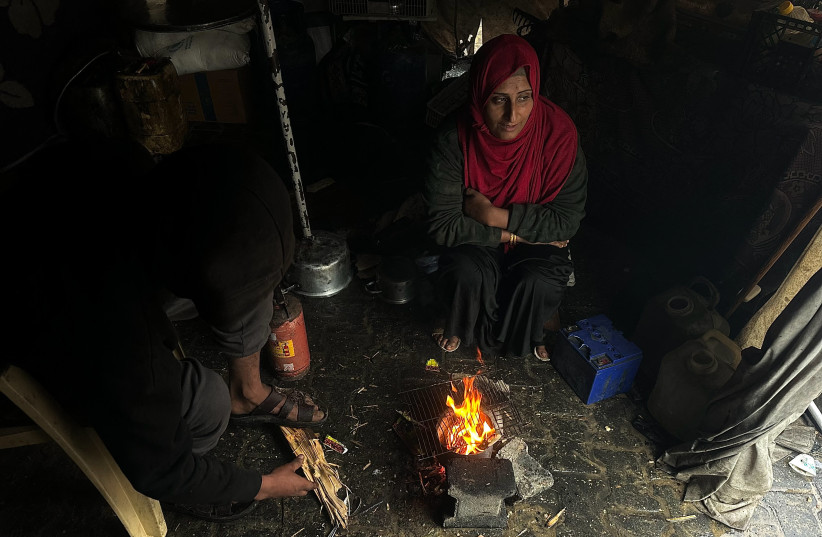
“Every morning, they have to find a way to cook and keep warm from the cold by setting up a small fire outside the tents. More than 70% of the people here are displaced, living in tents, in the streets, or in rubble and ruined structures, using pieces of wood or whatever material they have to patch up the sides of damaged buildings,” he described.
“This leaves us with little energy to think about things happening beyond Gaza. We just think about how to get through the day. That’s our only priority,” Ali said.
He said that despite the October ceasefire and the fighting against Tehran, Israeli strikes continued in Gaza almost daily.
“The fallout from the war in Gaza is enormous, and sometimes it feels like we are still in a state of war,” Ali said. “Some people are afraid that Israel will renew the fighting, although I believe there is nothing left to fight – everything here is already decimated, and Hamas has lost much of its advanced weapons and rockets. We cannot endure more disasters in Gaza.”
Reasserting control
Ali said he believes that Hamas’s military capabilities had been greatly degraded and that the terrorist organization is “willing to hand over its governing powers to the new technocratic committee appointed to administer the Strip.”
However, recent reports indicate that Hamas is actively trying to reassert its control. Images published recently by the Hamas-run Interior Ministry show members of its police and security forces conducting patrols and setting up checkpoints in various areas, including markets and road junctions.
The terrorist group claims such that measures are aimed at “maintaining residents’ safety and protecting them from unfair practices, such us vendors raising prices, exploiting the circumstances.”

In one social media post, the ministry said that “police officers were deployed in Gaza City to enhance security and facilitate the movement of residents in vital places, streets, and main intersections.” Another post showed police officers patrolling a market in Khan Yunis.
While Hamas has said these measures are merely enforcing law and order, some civilians report that the group has been targeting critics or those thought to be collaborating with Israel – beating, abusing, and in at least one case, killing a man.
Yet Palestinian sources said that Hamas is seeking guarantees that its civil servants will be integrated into the institutions being established by the newly created National Committee for the Administration of Gaza (NCAG), the body tasked with managing Gaza’s reconstruction under the supervision of US President Donald Trump’s so-called Board of Peace.
“Hamas doesn’t trust this committee,” Ali said. “That’s why they want to make sure their personnel continue to receive their salaries, and that other members of the organization are not targeted by the new body. They want to be engaged. Except for that, Hamas accepts that the body will take on the civilian burden of the Strip.”
Ali expressed his own concerns about NCAG, saying that he is not “convinced it is something to rely on – not until we see how it actually works on the ground.”
He said it is no longer about politics or dreams of a Palestinian state. “People just want someone who can manage their lives properly. We want to be able to move freely, enjoy our rights, and simply live. It doesn’t matter who is in charge.”■